May/June 2026
To Shanghai
May 22. Newly gained visa fee travel for British passport holders, our arrival cards completed online…hotel addresses translated to Chinese to show to Didi taxi drivers. We can’t wait to get to China now, there’s been so much forward planning for this part of our trip.
Arriving at Shanghai Pudong International airport, at check in the lady kindly gave our bags priority stickers. From getting off the plane to walking through customs, less than 20 minutes. An hour drive in a Didi (China’s Uber) using the app and we’re checked in to the Kunlun Jing An Hotel on Hua Shan Road. The lobby is huge, marble floors and a wide sweeping staircase, a restaurant, bar, a patisserie and a Durian ice-cream vending machine…the infamously stinking fruit. We’re on the 26th floor in a large sprawled room, the bed is massive and floor to ceiling windows look across the city. All this for about $100 a night. Amazing.
It’s 9.30pm, we head out for a walk of the neighbourhood. After a 10 hour flight, a bit too knackered to take it all in…it’s Friday night…bustling with young people, so many bars and restaurants. We chose a great place to stay. Heading back crossing a huge main road, pedestrian bridges span the highway accessed by escalators. Everything fascinates.
Exploring Shanghai
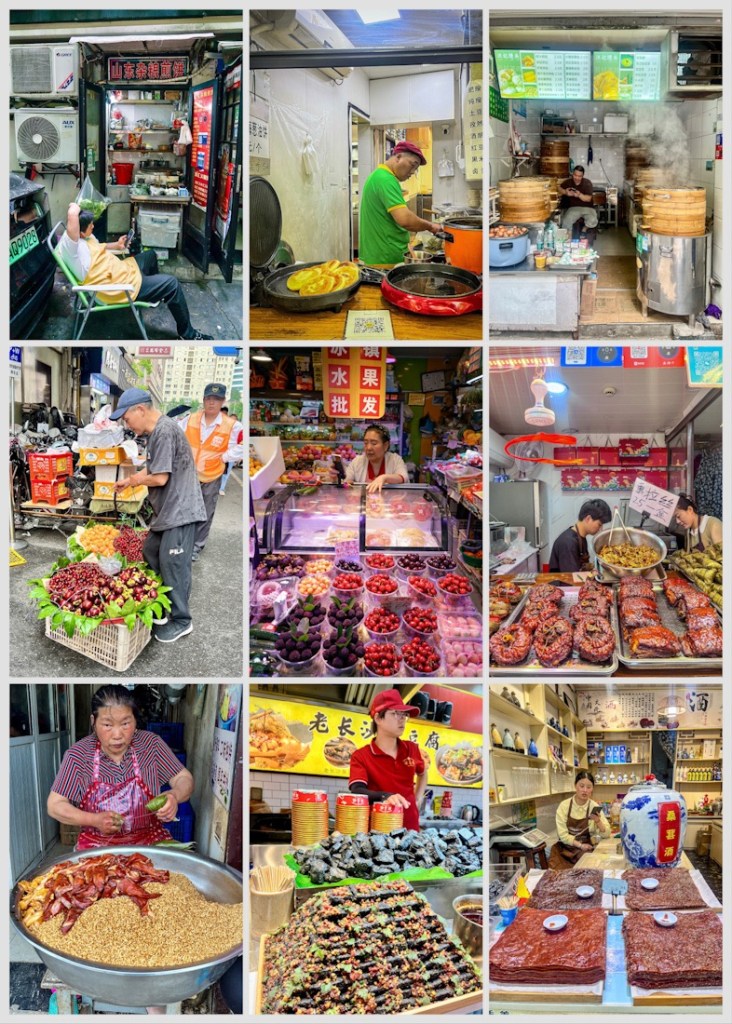
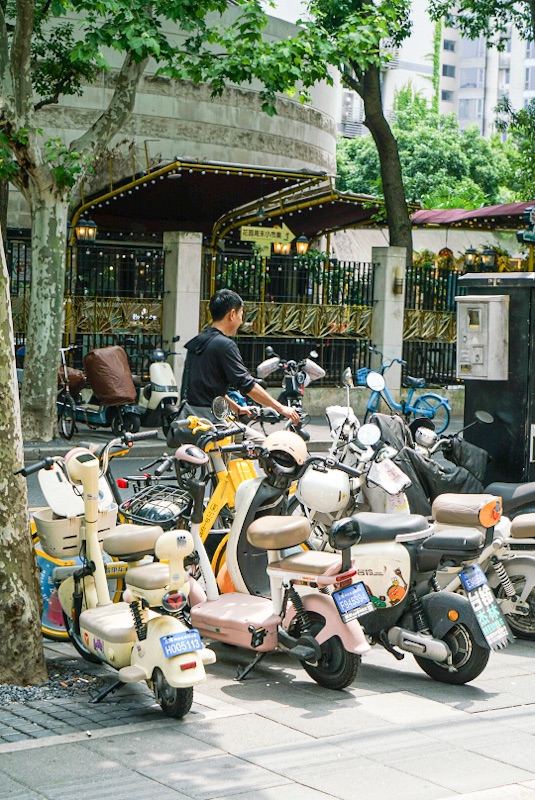
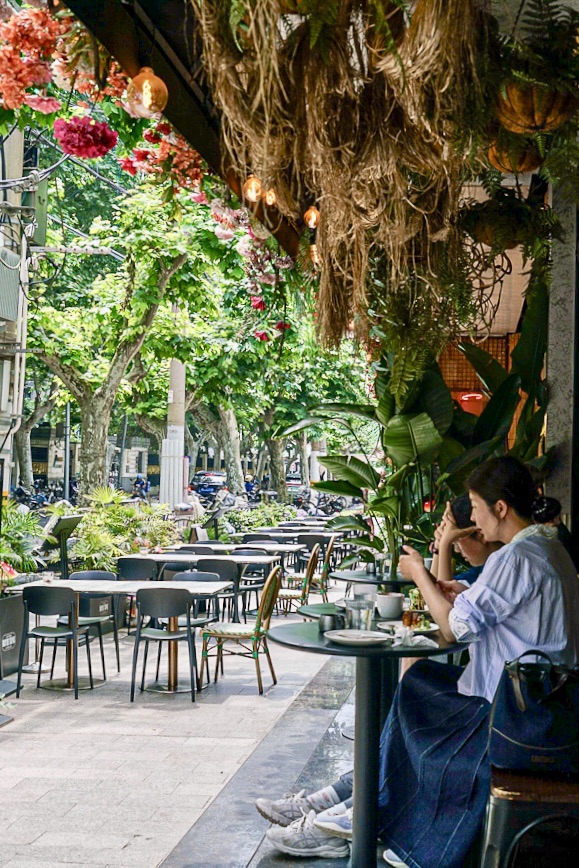
May 23. It’s immediate; the impact on the senses…the food smells, the hustle, the energy, the unexpected, the food hawkers, the bonkers stuff. It’s all here and I know we’re going to love it. This is why we travel and this is why travelling is so valuable…getting your mind blown is a brilliant learning experience. In walking distance of the hotel there’s coffee shops, restaurants, small boutiques. We have breakfast at Money Shops; an odd name for a stylish place. Packed out, we eat sitting at an outdoor table, granola and fruit, (Dave’s happy), pastries. I have a ginger lemon tea crammed with slivers of fresh lemon. Watching near disasters at the road crossing where bicycles, taxis, scooters and buses weave through the pedestrians. I could people watch here for hours.
It’s 28c, warm and sticky, humid but not unpleasant. We take our time, passing a bookseller offering us little red Chairman Mao books published 1966. To the former French concession where the sprawling red brick police department (1918) is now listed as an historical site. Signs that look like ‘no trumpet blowing’ deter motorists from using their horns. At the mansion of the former CPC Delegation on Sinan Road, (another protected heritage site) we wander through its gardens. A Parisian style building has finely dressed people eating in the window. Tall apartment blocks surround, trees are planted everywhere.
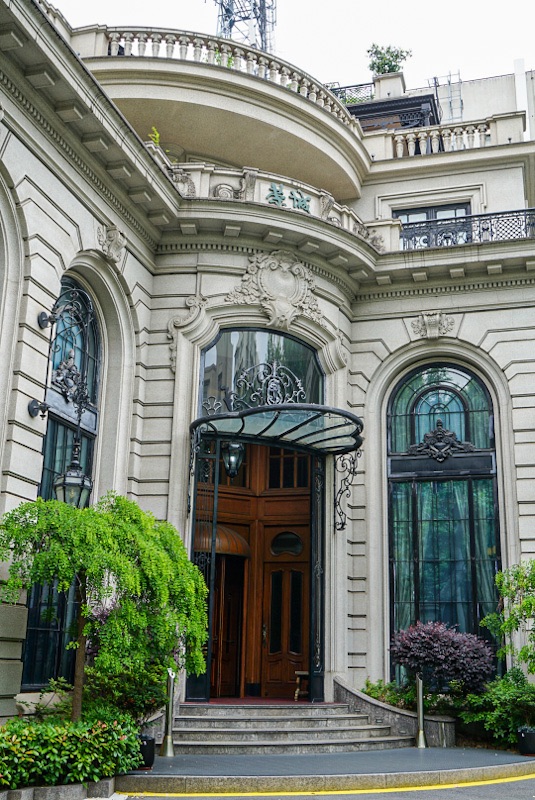
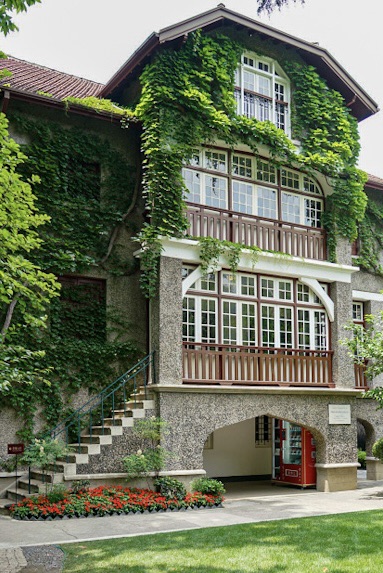
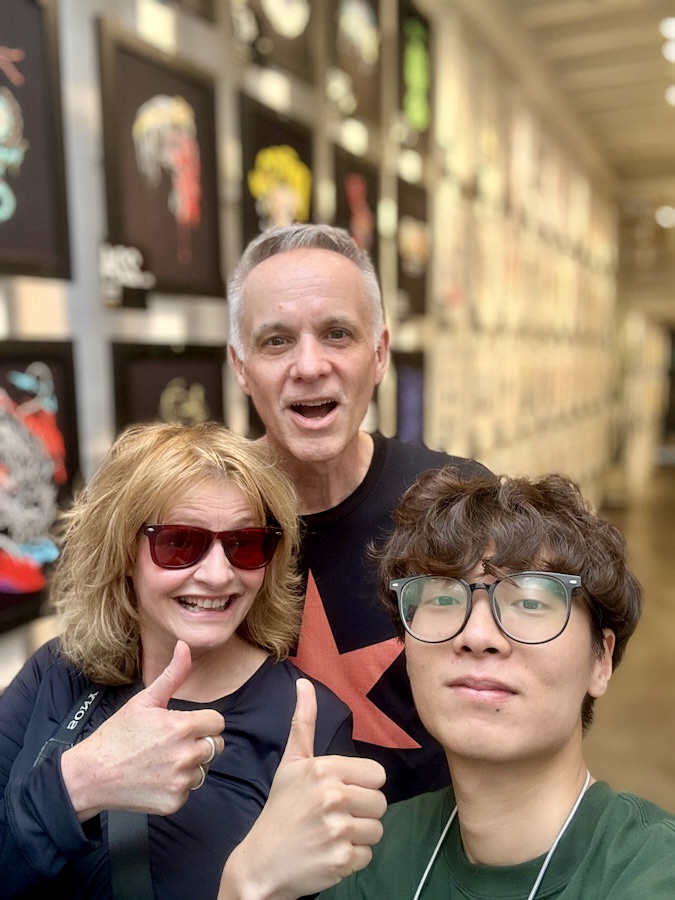
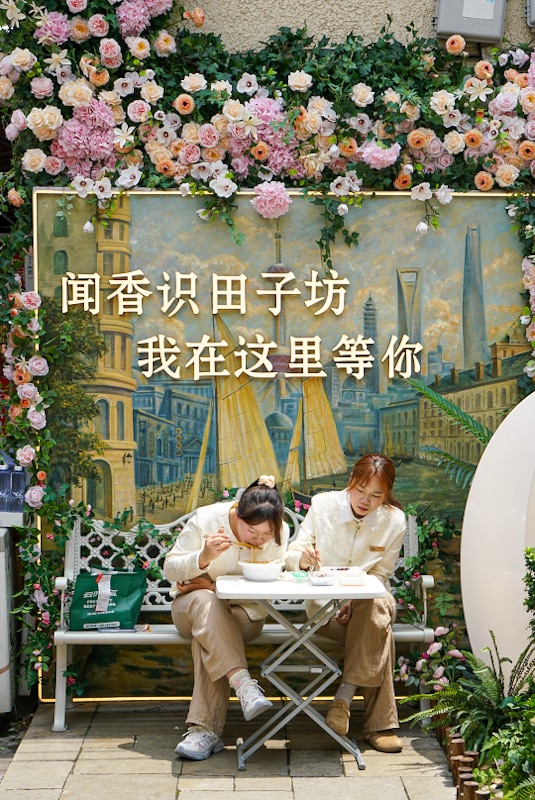
Walking busy streets humming with energy, we explore the narrow lanes of Tianzi Fang. We meet Chris selling screen-printed t-shirts. He chats with us; he’s studied in the U.K. in Scotland, is an Arsenal fan…(Dave booed, he’s Spurs), asked us lots of questions and upon leaving requested a selfie. So far people in China are very friendly. Dave wanders in to a leather shop and buys a belt for the equivalent of $25. Boutiques sell jewellery, clothing and keychain furries…many people have them hanging (in multiple numbers) from their bags. It’s like an exceptionally clean, modernised Camden Market in London and full of other tourists. I buy stamps from a card shop, relieved I don’t have to negotiate the language barriers of the post office.
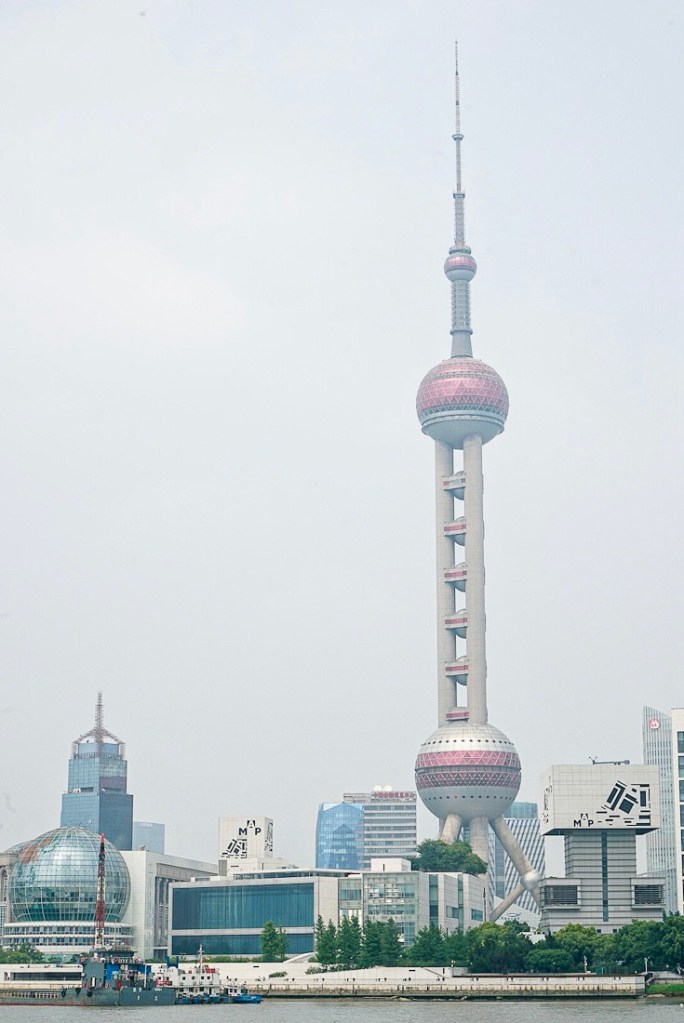
A Didi taxi to The Bund, driving under towering concrete highways covered in climbing plants. The smog of air pollution hazes the view. It looks misty, not yellow…a faint blue obscured. Unfortunate for the people of this vibrant city but they’ve made changes…most cars and bikes (if not all) are electric. Within minutes my throat is scratchy. We hadn’t noticed it in the densely tree lined streets. We don’t stay long, crossing the road to the Fairmont Peace Hotel, a quick look inside.
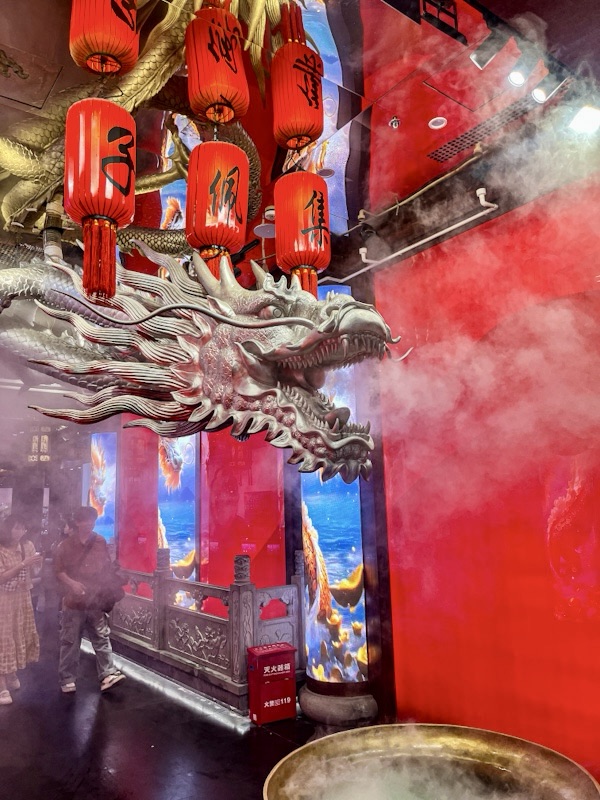
Then immediately in to the madness of the long sprawl of Nanjing Road Pedestrian Street…an artery of big name brands and gharish shop fronts. Smoke breathing dragons entice us in to jewellery stores. A young uniformed assistant shadows me for several minutes; I’m sure they work on commission and she isn’t pushy, just constantly there at my elbow. I feel like apologising when I don’t buy anything.
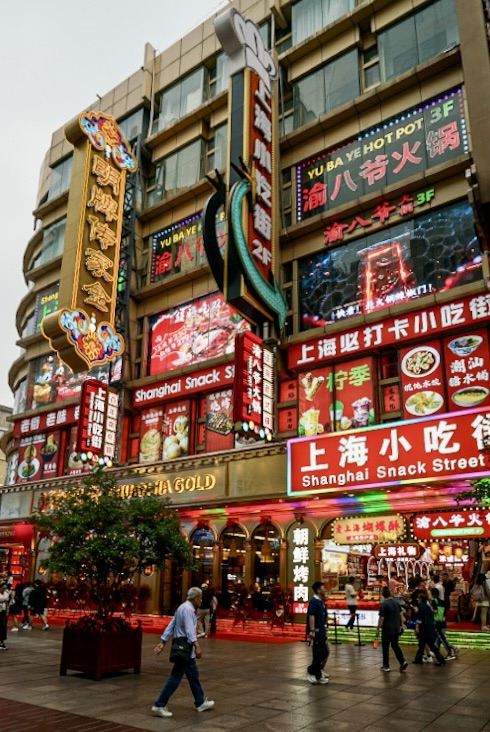
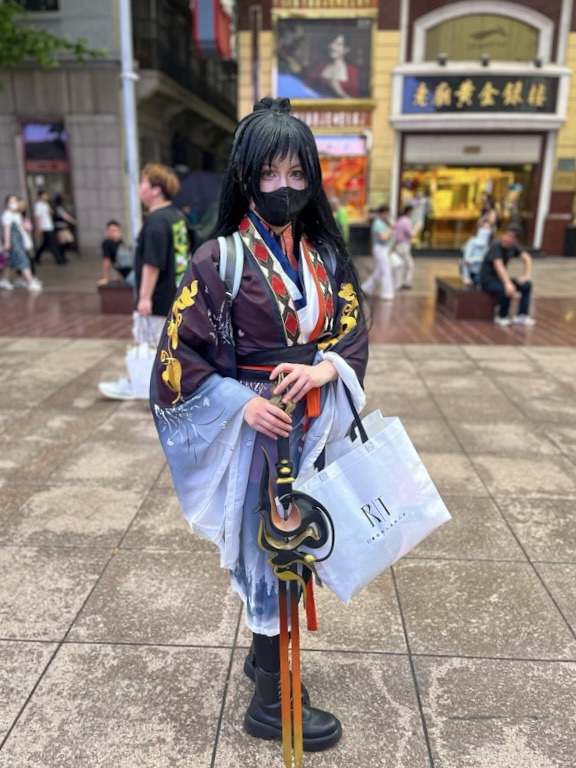
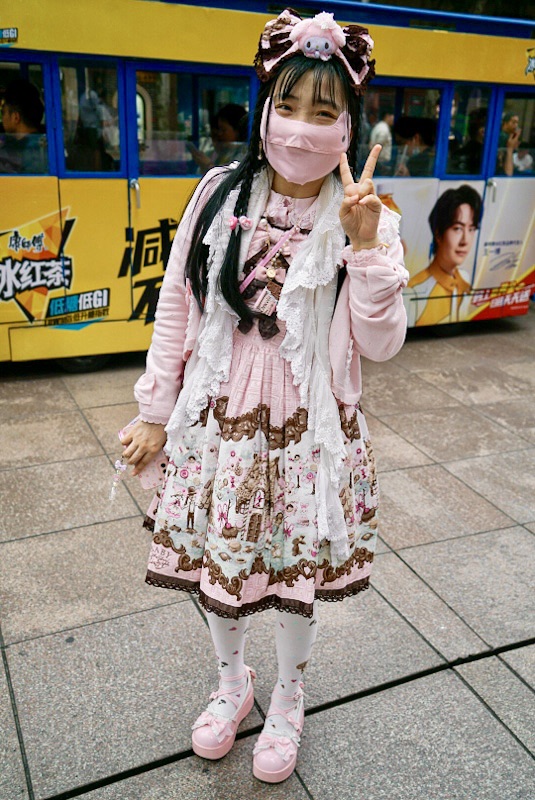
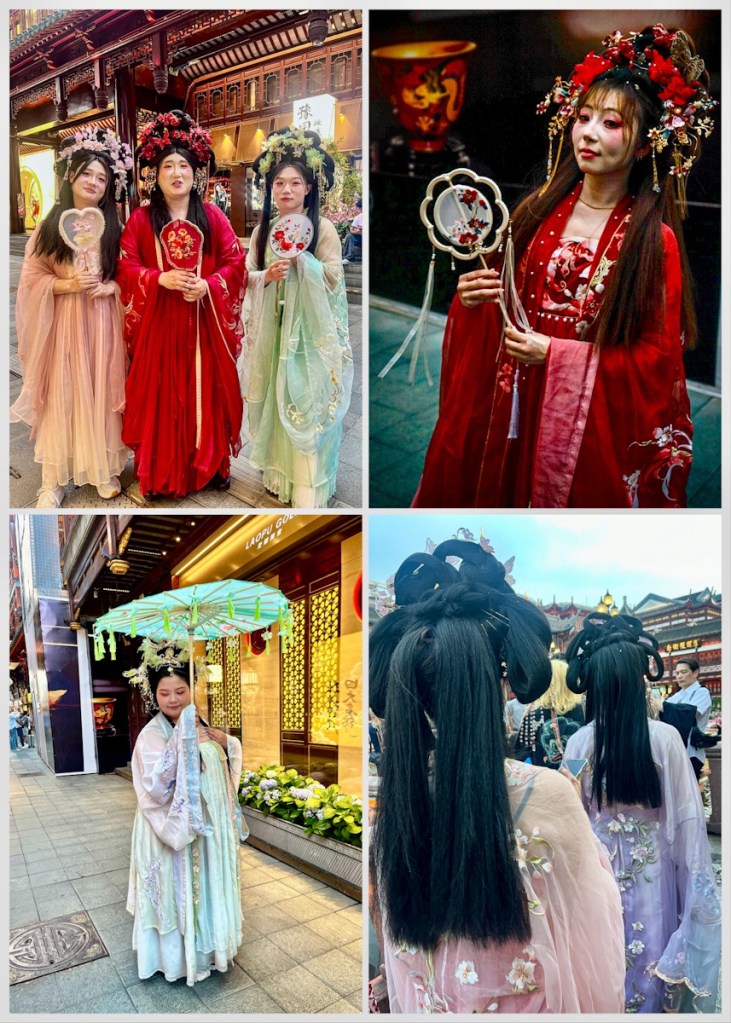
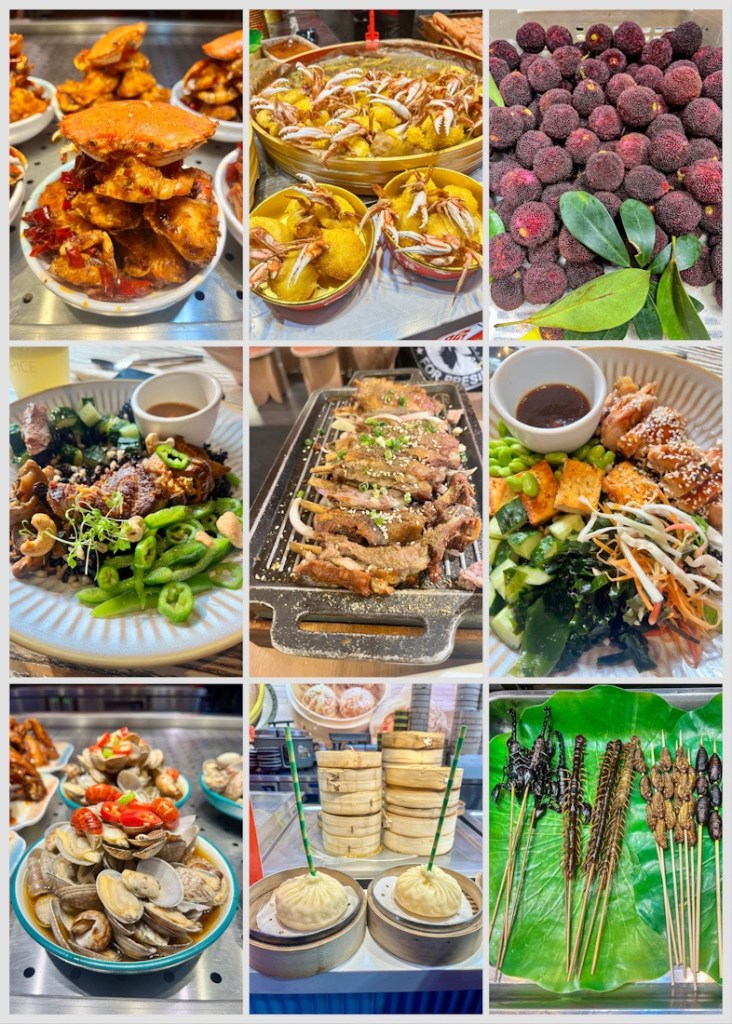
Food places glitter with exotic treats; scorpions and various skewered bugs cooked to an inoffensive crunch. Bowls of small crabs glisten orange. Another jewellery store has an animatronic giant oyster shell with a pearl. Chinese ladies giggle as they photograph each other sitting at its lip, but a sudden rush of dry ice renders everything smoky and invisible, it’s amusing…we’re all laughing together. Young girls dressed in Cosplay outfits are thrilled when I ask for photographs.
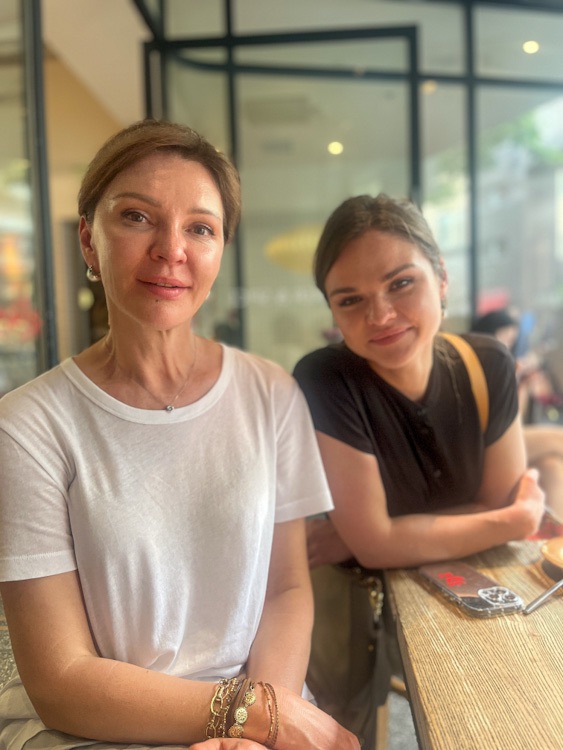
Worn out from walking, it’s started to rain, another Didi car back towards the hotel. The rain suddenly throws down, traffic crawls…a 30 minute drive during which the rain clears. At Baker and Spice we eat healthy bowls of tender grilled steak with lots of greens. Seated outside at a communal table we meet Evgenia and her daughter Pauline from Kazakhstan. Here on a business trip, they have a company supplying cooking ingredients.
Evgenia speaks some English, her daughter Pauline is fluent, mum glows with pride. They are interrupted by an eccentric Chinese lady who wants her photo taken with Evgenia; different poses, a slow walk holding hands, seated with arms around each other, each pose requested. It goes on and on, but Evgenia, amused, graciously plays along. The Chinese lady moves on, we laugh at the madness of it all. The area is full of young women posing for TikTok content…not happy with one or two photos/videos but taking 20 minutes on one pose. The narcissism is extreme. I don’t understand it. We leave and buy Natas pastries on our walk back to the hotel.
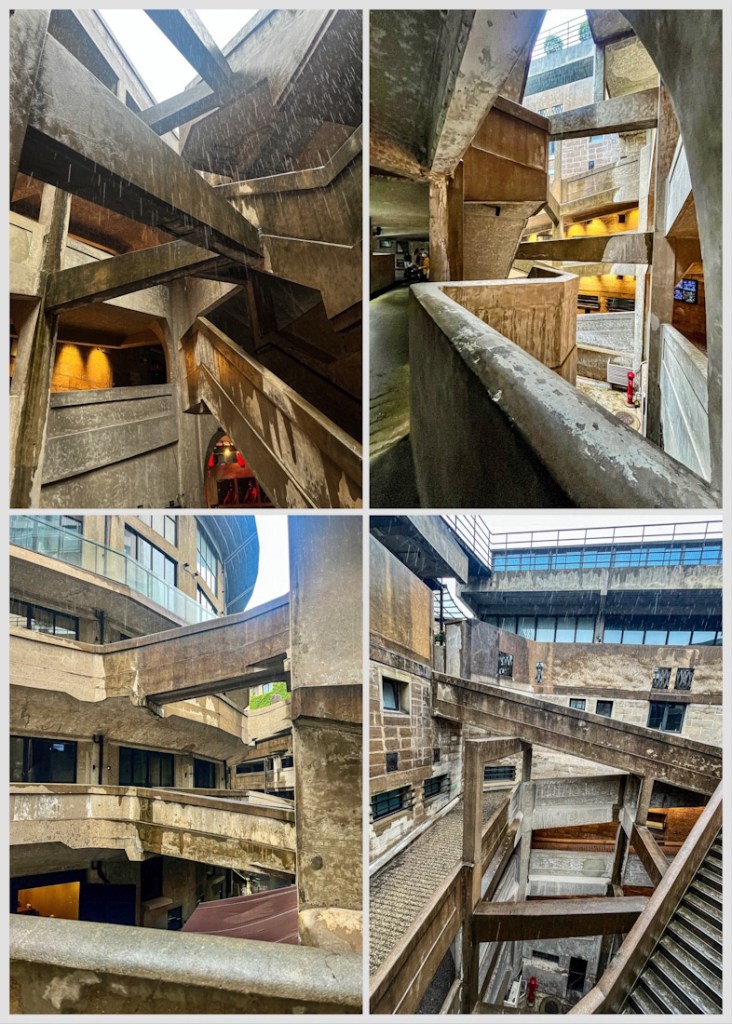
Millfun 1933, Art Museum, Jing’An Temple
May 24. More rain. Dave buys breakfast from the pastry shop in the hotel lobby. Thunder rolls in so we get a Didi to 1933 Millfun, a former slaughterhouse designed by British architects. We’re both admirers of Brutalist architecture and this is a spectacular concrete structure of straight lines and severe angles. A few retail places have been chosen to fit with the architecture. An industrial designer store sells one off fashion pieces in the style of Rick Owens; studded platform boots, statement jewellery. I covet much of it but it’s out of my price range. An adjoining boutique sells playful bespoke pieces made by a Japanese designer. We walk up several storeys, up the cobbled sloping curve where the animals were led to slaughter. My heart twists; I love the building I don’t love its brutal history. I’m a meat eating hypocrite.
Still raining; waiting for a Didi car we see a man holding an umbrella with one hand and an electric pneumatic drill with the other, he drills down between the cobblestones, then holding a metal rod with an ear cup at one end he pushes it between the stones and listens. I’m fascinated but the cab arrives.
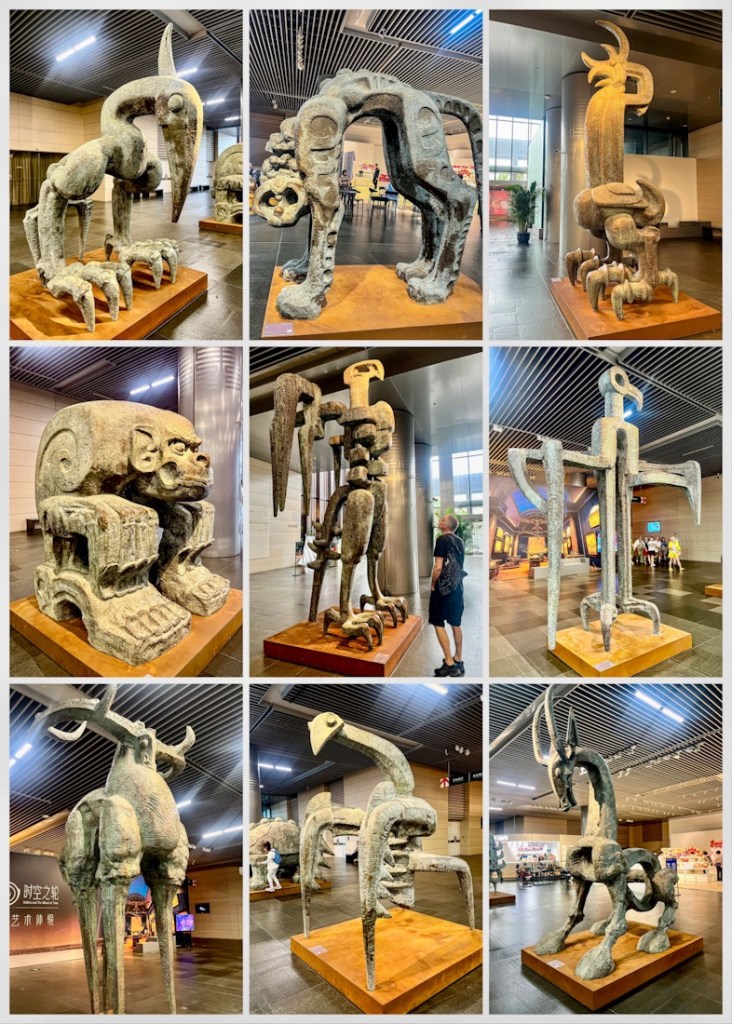
We escape the weather at Shanghai Art Museum. An impressive entrance and massive building, but inside it’s lacking…too much space to fill. Vast areas of carpet and escalators. On the 12th floor is the multimedia ‘Along the River during the Qingming Festival’ ($1.50 each). A 100-meter-long animated digital projection based on the famous 12th-century scroll painting by the Song Dynasty artist Zhang Zeduan. A digital canvas brings the ancient city of Kaifeng to life..people on boats, walking the streets, a camel train. It shifts between day to night showing illuminated shopfronts and river lanterns. It’s worth the visit for this and the massive fibreglass sculptures on the ground floor.
The rain’s stopped, cleared the pollution and cooled the air. Hungry we head for a branch of Yang’s Dumplings but the cramped plasticy decor and glaring pink signage put us off. Nearby we find a place with a helpful lady who translates the menu using her app. Seeing us fail to rent a powerbank for our dying phones (pretty much everything runs on apps), she uses her own to pay and rent one for us. I can’t think of many countries where this level of help would be offered. A sizzling hotplate of lamb, beef skewers, sweet pickled garlic, fried rice…we over ordered, $15 each and delicious. It would be $70 each for this quality back in New York. Using google translate to thank her and show appreciation to the Chef, we laugh and hug before leaving.
We arrive just in time for Jing’An temple before it closes. It sits in surreal juxtaposition to the surrounding luxury mall and soaring glass towers. This sprawling temple complex sits serenely in the city chaos. Thick incense sticks burn, the smoke drifts through the courtyards. The devoted move between the prayer halls, from standing to a low supplicant crouch on prayer cushions before the golden Buddha and deities…pushing money in to donation boxes. A man chants in a somnambulant timbre, spinning his prayer wheel; a meditative tool in Tibetan Buddhism. I find it extremely moving and unexpectedly I’m blinking tears.
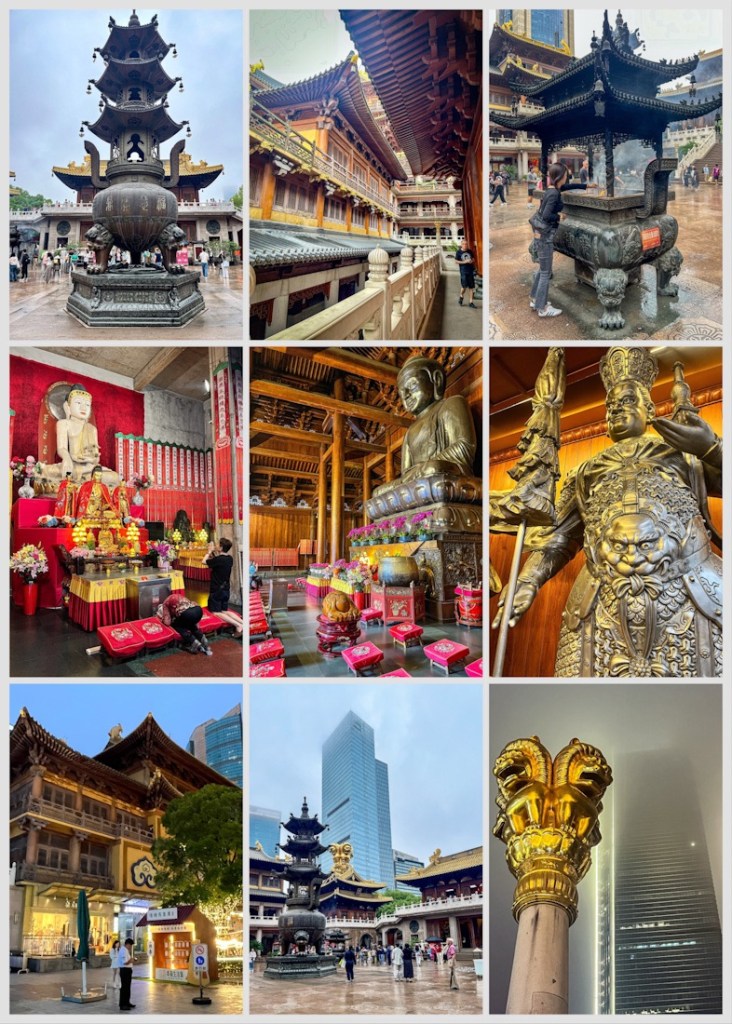
This is not a quiet place. People bustle in and out, drop to their knees in prayer then climb over the raised temple thresholds to the next hall where they repeat the process. There is chatter everywhere. Tourists are throwing coins to land on the central bronze incense pagoda; if your coin lands on the roof good fortune will come to you.
As dusk descends, light plays on intricate ceilings, the dark carved wood and statues. It’s not a hidden escape from Shanghai, more a part of the city’s personality; a co-existence between the ancient and the modern.
Zhujiajiao, Poster Museum, Old Town
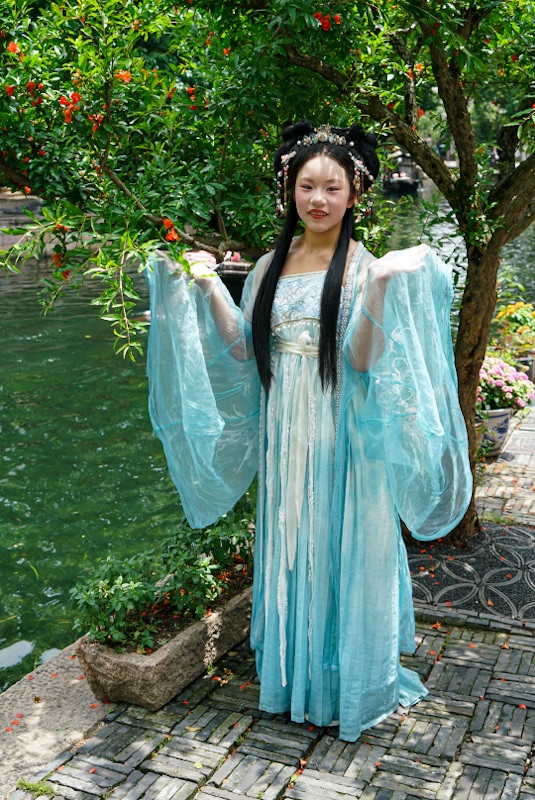
May 25. A one hour excursion out of the city to Zhujiajiao water town. At the tourist information desk there’s a digitally glitching screen of incomprehensible words; a sign declares it ‘The Comprehensive Inquiry Window’. We buy a multi ticket bundle and wander along the canal. It’s very touristy, the canal is a warren of food hawker stands and souvenir shops, and ubiquitous here…the dress up places offering makeup and clothing for those who want to pose for ‘traditional dress’ photographs.
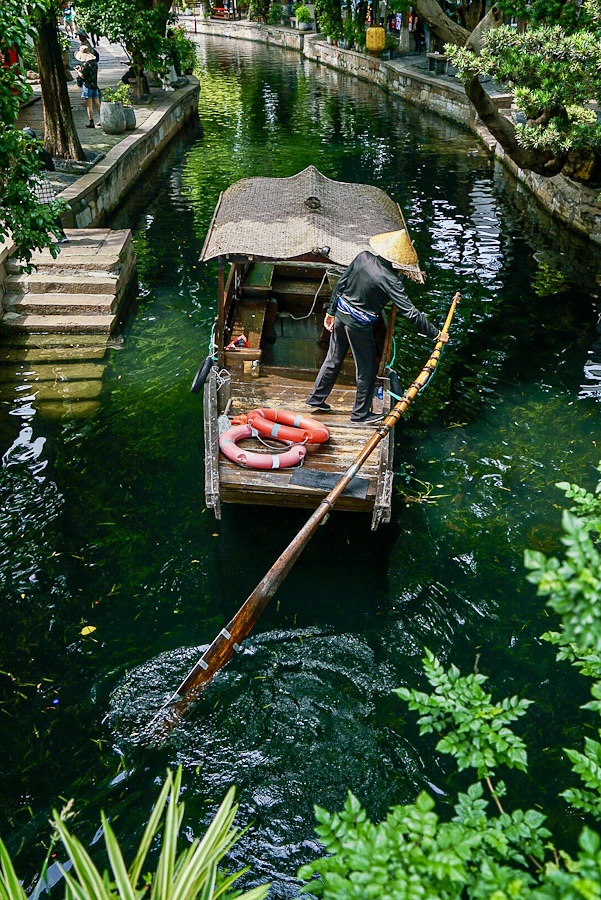
It’s packed but a lot of fun. The Garden of Inseparable Hearts is beautiful. Over 70 skilled craftsmen spent 10 years building it, integrating Qing dynasty architectural elements and precious relics. Some buildings were originally constructed during the reign of Jiaqing of the Qing Dynasty and relocated here. There’s a collection of calligraphy inscribed stones. Trees and bamboo are a lush green after the recent heavy rain. I climb a spiral staircase to look out from a pagoda, a close up view of roof carvings and mossy curved tiles.
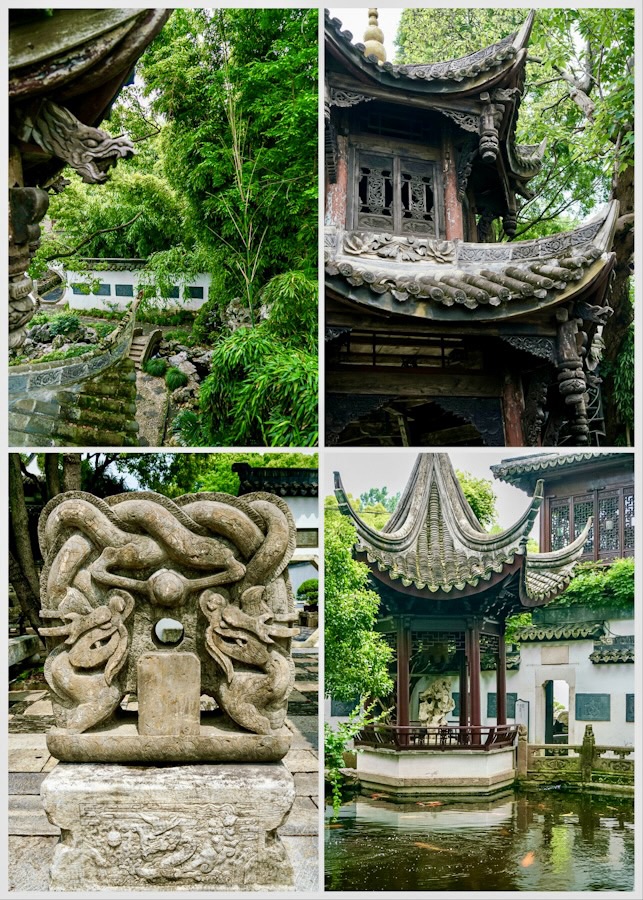
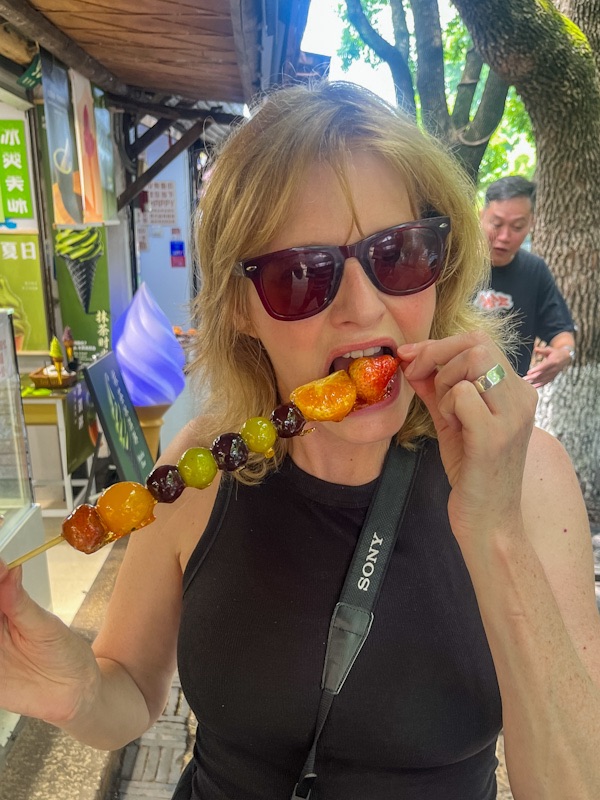
Back on the canal to watch boats picking tourists up to punt along the water. We share a bamboo skewer of fruit rolled in spun sugar, just like the toffee apples we enjoyed as children.
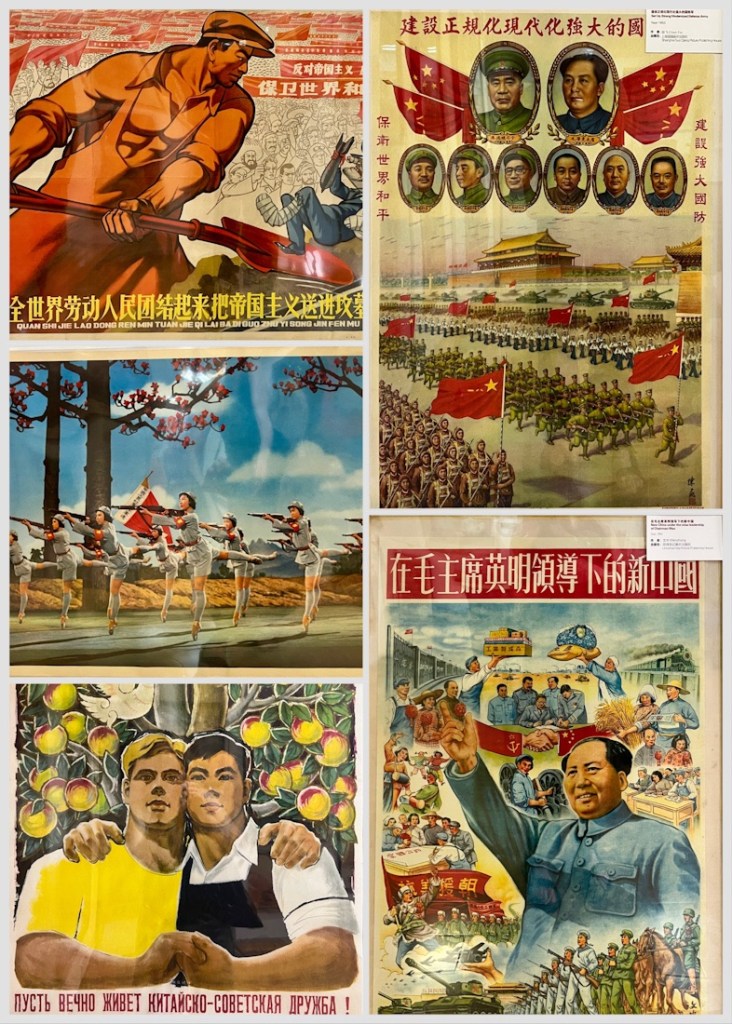
Another cab, (Didi is so cheap), to the Shanghai Propaganda Poster Art Centre on Yan’an West Road, located a few floors up in an office block. It’s a great little space with office dividers used as ‘walls’ to maximise the display area…the posters either framed or protected in plastic. These are all rare last-piece posters, the original screens used to print them no longer exist or have not been found. Most are from the Maoist period of communist China and the Cultural Revolution. The colours are densely rich. My favourite features women marching holding rifles. Striking and informative of the time; round faced cherubic children, happy families, strong men at work…anti-imperialist sentiment against the West, support for comrades in China. We both loved it.
It’s hot and humid, we head to The Old Town (Nanshi) in Shanghai’s historic Huangpu district. We can’t hire the yellow powerbanks again despite being offered assistance from a man keen to test his English. We realise it’s because we haven’t got Chinese phone numbers so the mini apps within AliPay and WeChat won’t work. We enter an indoor market and get ripped off buying a useless powerbank; the first time we’ve been stung. Google Translate gets lost in translation; the answer to my question comes back as: “The armpit hair is 3 years old.”
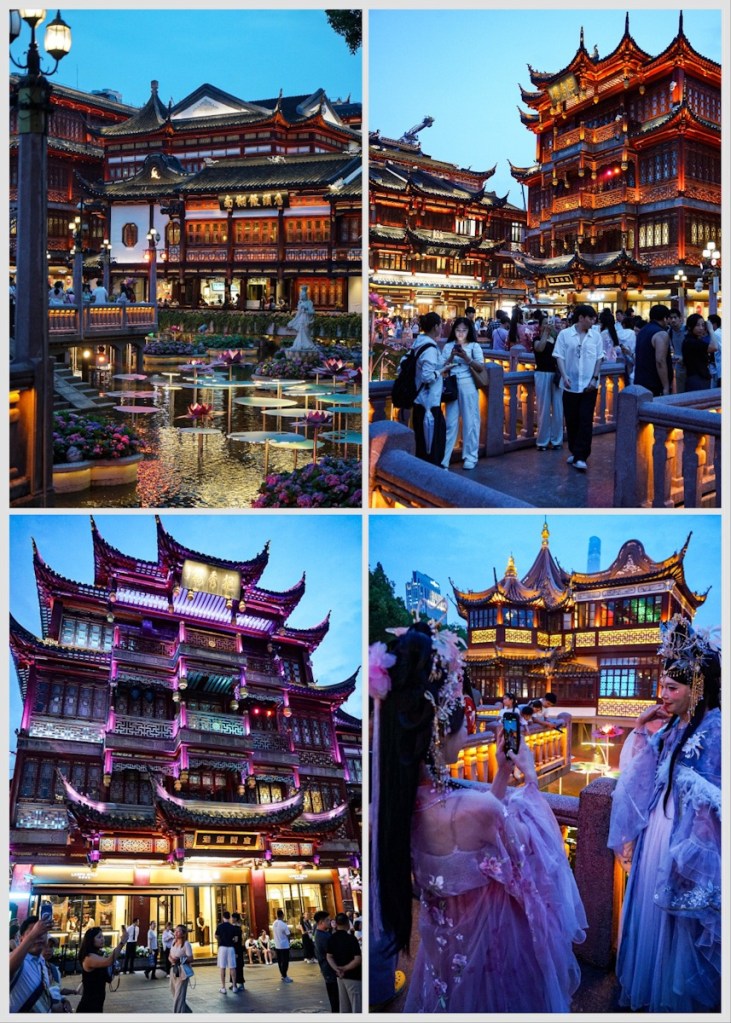
Shanghai Old Town is heaving with people, waiting like us for the place to light up. It doesn’t look genuinely old, more a theatre set, a stylised version of old China built for photographs. And so many shops; jewellery, fashion, tourist souvenirs…food stalls sell bowls of noodles, snacks, fancy ice-cream. The zigzag bridges cross ornamental ponds filled with metal flowers, dry ice blowing out. Asian girls dressed in costume have elaborate hair and makeup. They pose for photographs…adjusting a sleeve, a mass of hairpins, some of the boys join the fun. It’s Disneyfied but a visual spectacle, great fun if you don’t mind crowds.
May 26. A day of going nowhere. We’ve walked miles over the last few days even factoring in the amount of Didi cabs we’ve used. We relax in our huge hotel room and work on routing the upcoming trip to Korea. Most of the hotels I’d saved on Expedia are already sold out, it’s hard to wing it whilst travelling in the age of Instagram and TikTok which have shrunk the world. We get another China train trip confirmed, they’re all coming through first class though we requested second class as first option through Trip. It’s pricier but at least we’re getting the tickets and feeling less stressed. We wander out for a late lunch on one of the local tree lined streets, people-watching from a pavement table.
Leaving Shanghai, flying to Zhangjiajie
May 27. A short 2 hour flight to Zhangjiajie, a car from airport to hotel driving through dense greenery, rice paddys, fruit growing poly-tunnels, houses peeling paint. It’s an immediate contrast to the city. Climbing narrow mountain roads until we reach our hotel, No.5 Valley Lodge…and we’re blown away, China surpassing itself again. A beautiful set up of wooden rooms built in to the mountain hillside, steps and flagstone paths winding between. Two pools…one an infinity pool and a restaurant with the same mountain view.
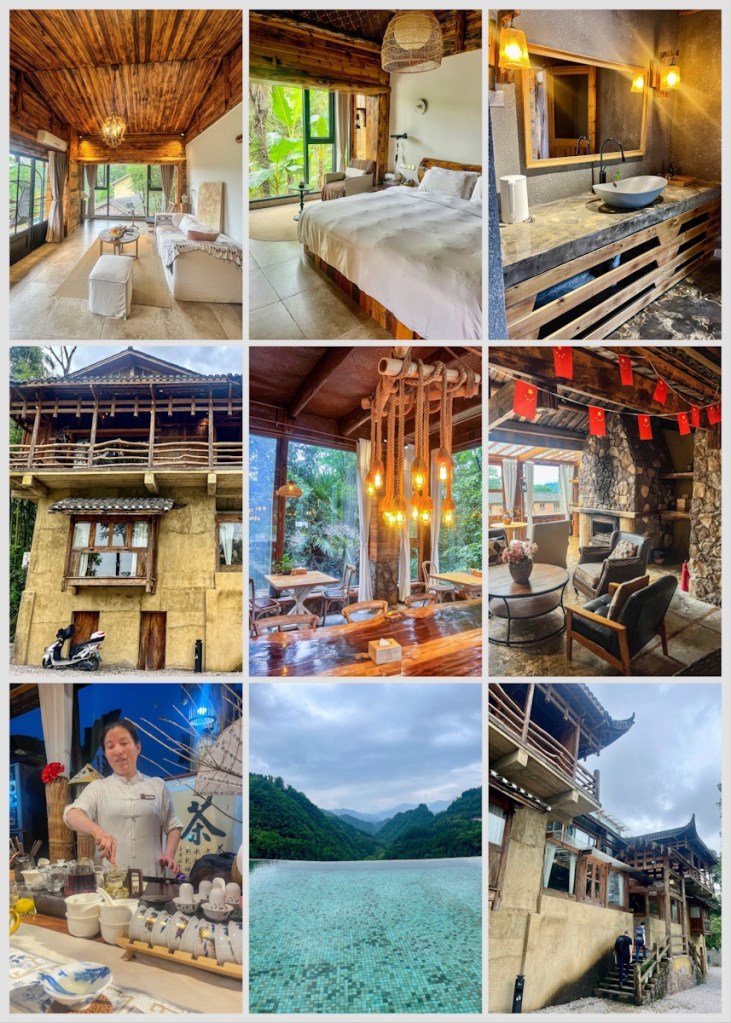
A huge bed, separate living room…a pretty bathroom with a natural stone floor. There’s a large projector screen but everything is in Chinese with no subtitles…with these views we won’t need it. Banana palms brush against our window, a cockerel crows. We order dinner on the WeChat app with the hotel service team, they text to say it’s ready. In the restaurant our places are set, our food on the table. Stir fried pork and green peppers, spicy and delicious. It’s a communal atmosphere and we chat with other guests.
We drop in to the tea room where one of the staff is practising calligraphy. She comments on my blue eyes, lays out teapots and tasting cups and introduces us to different Chinese teas. She’s good fun.
Zhangjiajie National Park Valley Floor
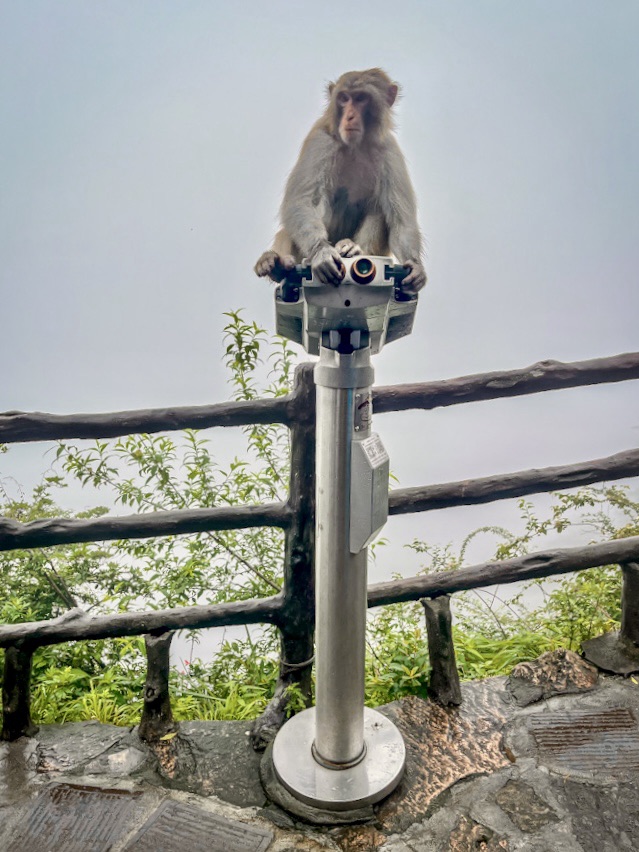
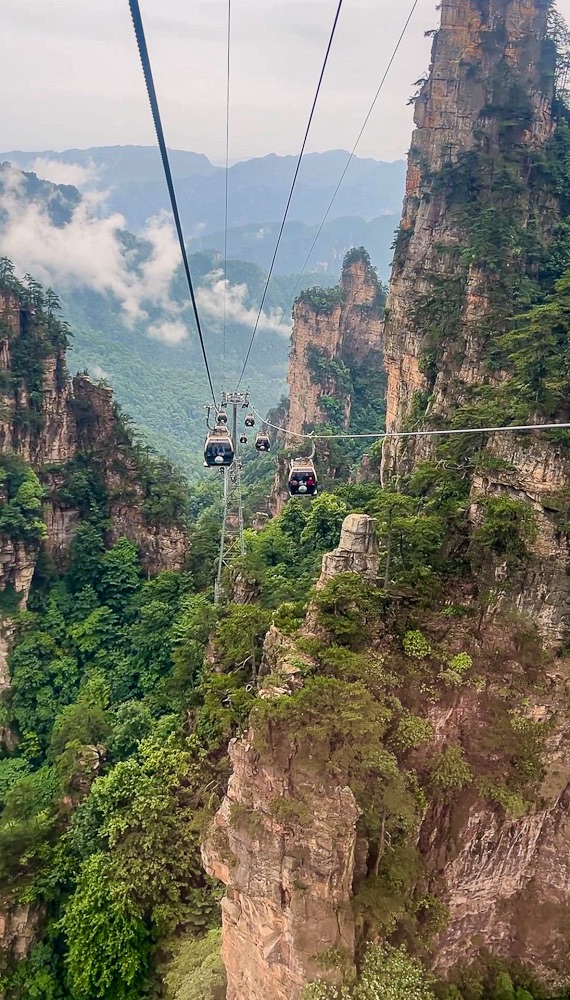
May 28. Breakfast at 8am, joining Brigid and Harvey who we’d chatted with yesterday. We plan to explore the southern area of the park together, get a free ride from the hotel to the west gate entrance. We bought tickets from Rain at the hotel desk, opting for a 4 day pass with unlimited cable rides. It’s pouring with rain but we’ve got waterproof rainmacs. Brigid buys plastic overshoes from a lady at the entrance, I decline (foolishly it turns out) but I do get a bamboo stick for a couple of yuan paid for by Harvey. We begin on a shuttle bus taking us to 500 descending steps, routing our way through the tree canopy to the Huangshi Village Cableway. The cable cars glide in slowly; the 4 of us hop in. I’m not as good with heights as when younger but after a few minutes I relax in to it. It climbs smoothly through the mountain pinnacles. Visibility is low, mist moves in at the summit and everything disappears. We walk to the lookout point ‘Yellow Stone Village’; it’s a blank canvas, thick cloud…monkeys run around looking to tourists for food. I love monkeys but I’m wary. A large male keeps pace with me, he turns and hisses. I raise my handy bamboo stick in warning.
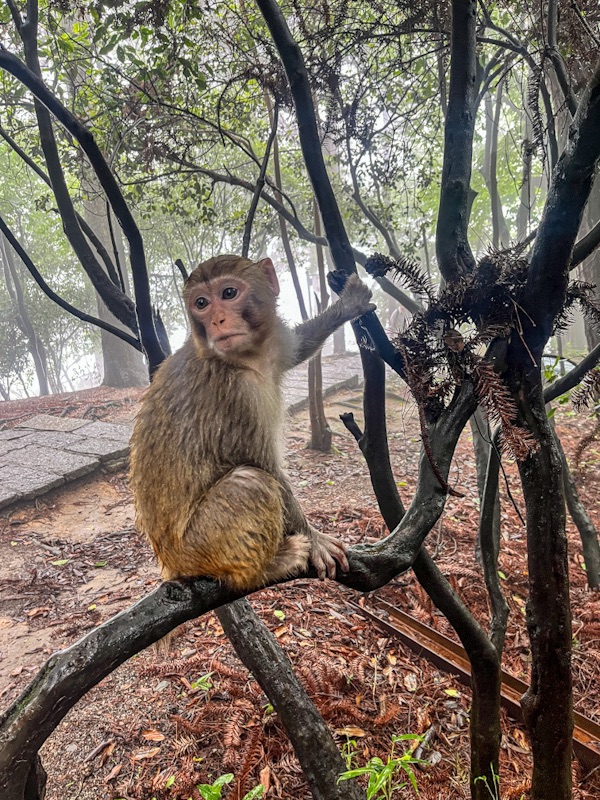
Taking the cable car back down…then up and down again. Great fun and the views are better from this vantage point. Another shuttle bus takes us to Oxygen Bar Square; food and drink stalls, souvenirs for sale at every bus stop, cable car entry and vista point. Torrential rain hits and the four of us shelter under a pagoda. A Chinese woman refuses to move so Brigid can sit down, rude but amusing. Brigid speaks Chinese but gets nowhere. The rain slows and as we walk away I give the woman a big smile and a wave…she looks furious.
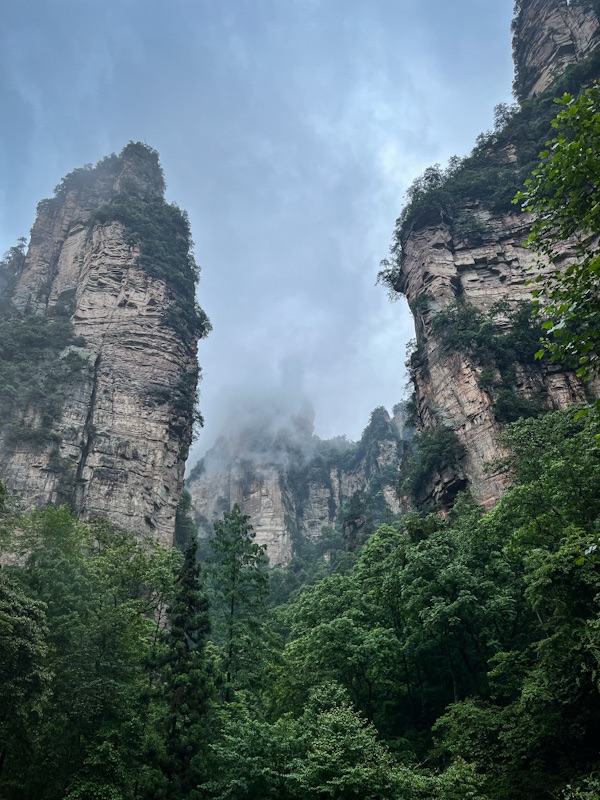
Walking an hour to Golden Whip Stream, my feet soaked but mist clears to reveal pinnacle cliffs soaring above us. There’s a giant screen playing a favourite childhood TV show ‘Monkey’ filmed here in the ‘70s with low budget special effects. We don’t complete the full loop, walking back on ourselves to catch the bus and the long slog back up the 500 steps to catch another shuttle back to the west gate. A WeChat text and within minutes the hotel car is there to take us back. Dinner in the restaurant laughing about the stubborn Chinese lady. We walked 6 miles and plan our route to go together to the top of the park tomorrow.
Zhangjiajie shuttle bus bonkers
May 29. Breakfast and back with Harvey and Brigid to the west gate of Zhangjiajie park. Taking the Yuanjiajie cableway, a short walk for a shuttle which drops us at Great Natural Bridge parking lot. From there walking over an hour climbing hundreds of steps to access vista points; huge crowds at Natural Bridge. Chinese tour groups in high spirits, each group identifiable to their tour leader by matching hats or raincoats…a group with mini ducklings on springs wobbling on the brims of baseball caps. All have earpieces to hear guides who all have microphones yet shout loudly. It’s mad. We go with the pushing flow climbing narrow steps, the handrails fluttering with red Chinese ribbons. For 10 yuan I buy one wishing for good health…thinking he was blessing it, realising he was asking if I wanted to buy more. We’re walking vastly elevated walkways to see the natural bridge which crosses between pinnacles. At the opposite viewpoint realising we’d walked over it; our lives balanced on a stretch of limestone bearing the weight of hundreds.
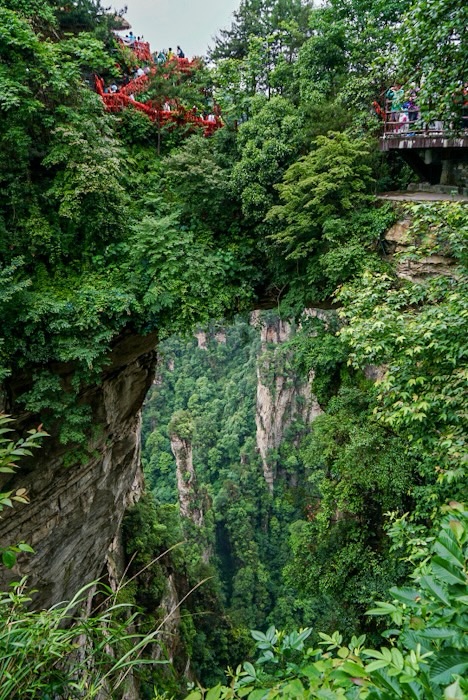
More steps, more viewpoints, more people jostling to look at the star of the show; the Avatar Mountains named after the movie they inspired. Views are clear and it’s jawdropping, it looks so ancient one could imagine a dinosaur lumbering in to the scene.
The monkeys are aggressive, trying to grab food from tourists, baring their teeth. The shuttle buses are baffling, destinations in Chinese. No-one speaks English which is understandable, we get by pointing at signs, pointing at the map and pointing at Brigid whose Malay Chinese is understood. She’s our secret weapon, but often difficult to find as she disappears to buy snacks (a Chinese version of Pringles in tomato flavour made my eyes water). I’ve learned that gently squeezing the shoulder and smiling at whoever is shouting at us seems to get a great reaction, Brigid tells me it’s my blue eyes and my ‘white privilege’…she’s being playful (but she’s got a point).
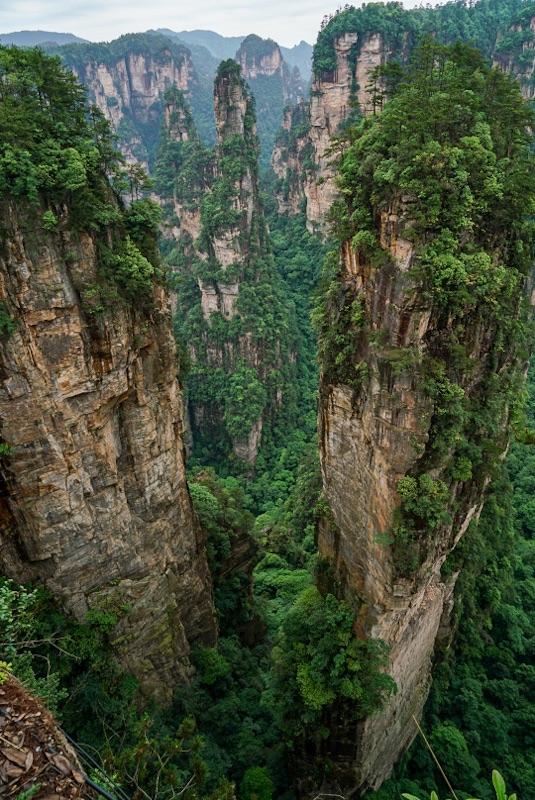
Another shuttle bus ride to the Bailong Elevator where we stop at the Silent Coffee shop operated by people with hearing disabilities, we point at hot chocolate and give a thumbs up. At the elevator entrance we’re channeled in single file through steel runs like cattle…the system works but is crowded. Brigid gets pushed in the back by an excitable Chinese man; she tells him off, then tells a guard to tell him off. She’s feisty. About 20 of us in an elevator; one ‘cabin’ split in two sections so they fill the top half with us lot and the lower half with the people from the level below. Floor to ceiling glass we drop through the pinnacles at speed, descending the last few seconds in to rock…again baffled by the ingenuity of Chinese engineering.
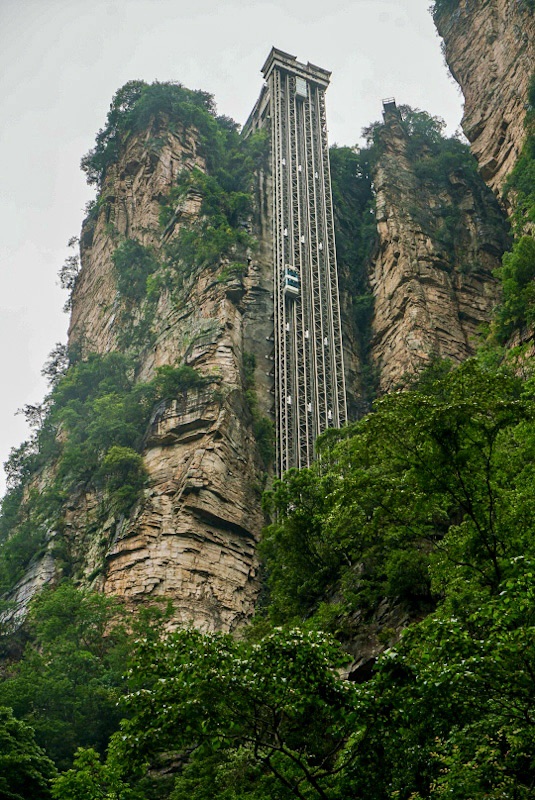
At its base, another view of towering pinnacles and a gigantic screen advertising other attractions. A walk to another shuttle (I’m nodding off at this point). To Ten Mile Gallery, we get dropped off on a main road baffling Brigid, Harvey and me but Dave seems to have it figured out. It’s a convoluted system, I can’t fathom how he understands it. Dave’s trust pays off as a bus stops and we’re off to Tianzi Mountain cable cars…the longest and highest of the three in the park. I’m knackered and grumpy from so many steps but the cable car ride is glorious, gliding higher the drop below is massive but doesn’t bother me…total faith at this point in Chinese innovation. How the hell did they get all this stuff up here and build it? It’s impossible to fathom. At the summit we’re at the top of the mountains, gorgeous vistas of rolling green.
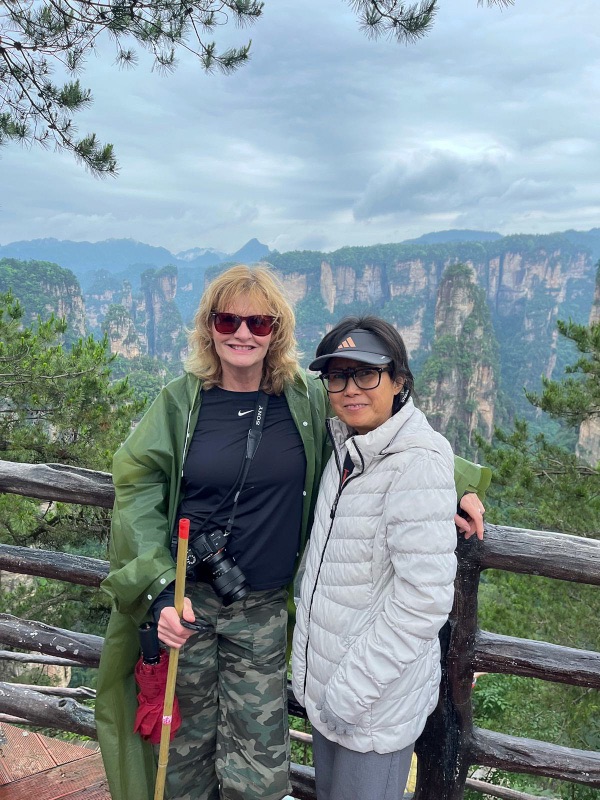
I’m wiped out, Brigid is too. And she’s thinking of food again. She buys chestnuts and shares them with us on…another shuttle bus heading to Helong Park. Too tired to explore we walk to yet another shuttle which takes us 30 minutes across the top of the mountains, glimpses of tea terraces, returning us to the Yangjiajie cableway. A steep descent above pinnacles and tree tops to (you’ve guessed it), a final shuttle bus back to the west gate. My calf muscles are throbbing, we’re hungry, I’m happy to be back at the hotel. Despite the strenuous nature of the day (walked 5 miles/climbed the equivalent of 48 flights of stairs), I’m exhilarated by what we’ve experienced. A last dinner with Harvey and Brigid, they leave for Chengdu tomorrow. Mario, the gregarious Italian hairdresser living in England, joins us for a drink. The restaurant staff spray bug repellent…a strategic move to close.
Rest day at No.5 Valley Lodge.
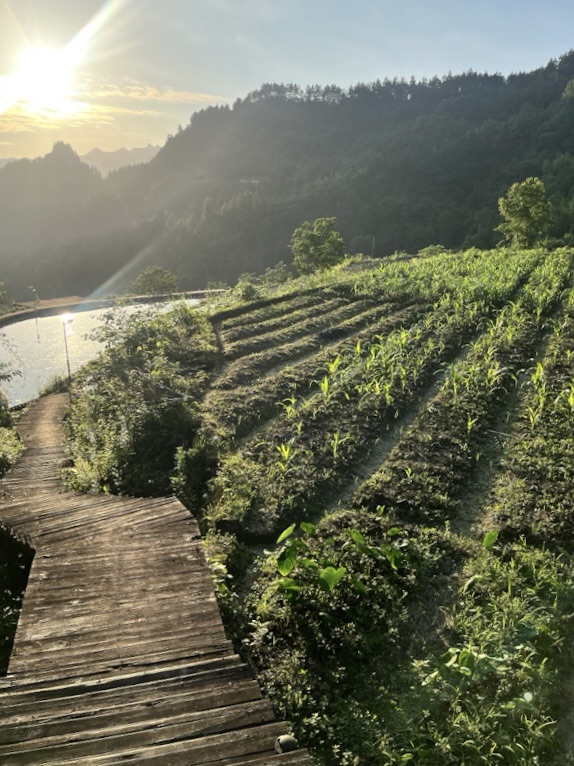
May 30. Muscle sore, 2 days of walking (11 miles) and climbing the equivalent of 83 flights of stairs we decide against going to the canyon glass bridge or Tienamen Mountain. We don’t want to rush trying to see everything. So instead we lounge around at Valley Lodge, have a late breakfast, meet two young Norwegians and a young man from Chicago. We sit together at a communal table. I love this when travelling; meeting people all ages all nationalities. The monkey alarms are croaking and barking around the lily pond, a necessary deterrent to keep them away from the property, tearing up crops, stealing food. We get laundry done and later in the evening go for a walk down to the rice paddy fields outside the lodge..the sun dropping behind the mountains. We’re sad to leave this place, it’s beautiful. Rain and the rest of the staff have been fantastic.
Our first High Speed Train – Chongqing
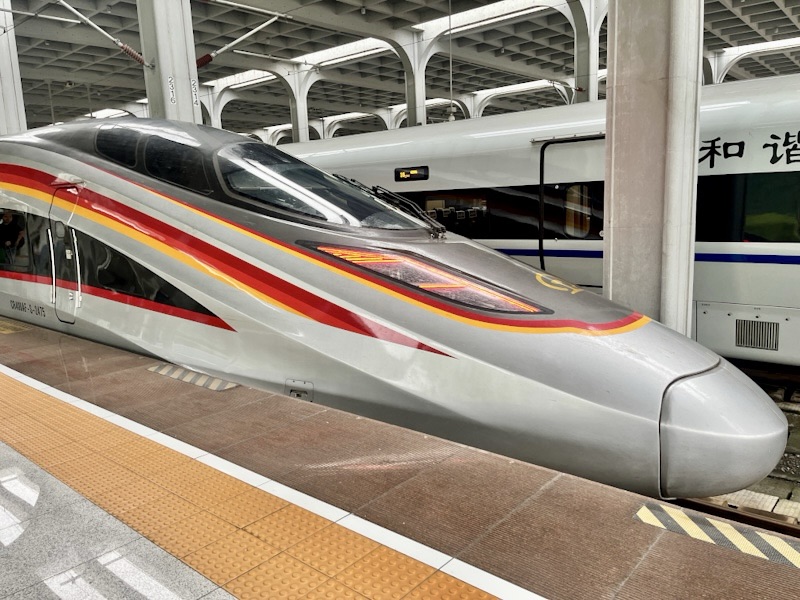
May 31. An early start, we meet a couple at Zhangjiajie train station; she’s Russian, he’s Italian, heading to Chongqing on a later train. We eat breakfast on our laps in the waiting area together…ours a packed bag of fruit and cakes from Rain at the Lodge. Our 8.52am train comes up on the board and at 8.48 it glides in to the station, everyone boards and it leaves exactly on time. We’re in first class because that’s what we ended up with through Trip. It’s not that much more expensive, seats are wider and when it reaches 348km an hour, it’s as smooth as glass. I’m chatting to the people behind me when the stewardess approaches to tell me off for talking, showing me the translation on her phone “Speak more softly.” We’re all greatly amused.
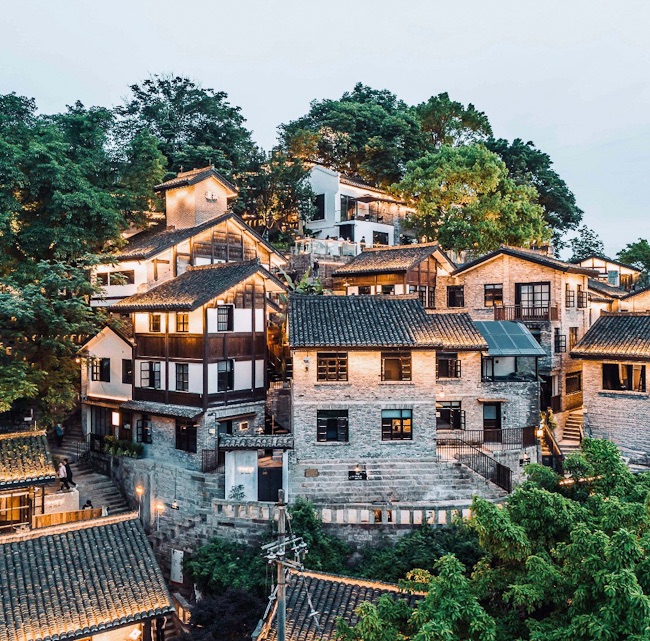
Checking in to Futon Designer Hotel in the stone terraced alleyways of Xiahaoli, we’re on the other side of the river from the city centre to get the views across to it. They let us check in early, a lovely room…a lot of stone steps to get here but that’s Chongqing…thousands of steps.
Scorching hot day we head out in a Didi to Liziba Station in the Yuzhong District to see the infamous overhead China CRT 2 train line pass through the 6th to 8th floors of an apartment building. Chongqing is built on hills; to avoid displacing residents, the station has been integrated into the apartment building by creating an infrastructure of two separate supportive frameworks, one for residential floors the other for rail tracks. Allegedly this removes vibrations and noise disturbance. Now it’s a viral sensation, the side of the busy main road turned in to a viewing platform. We’re surrounded by other tourists; it’s an excitable atmosphere. Over the road on Liziba food street in a busy food court, I buy a bubble tea pointing at pictures fumbling with google translate. A young woman asks for a selfie. I oblige, she’s got her phone set to a super soft focus special effect…I look like a 25 year old Disney Princess, it’s hilarious but she’s happy.
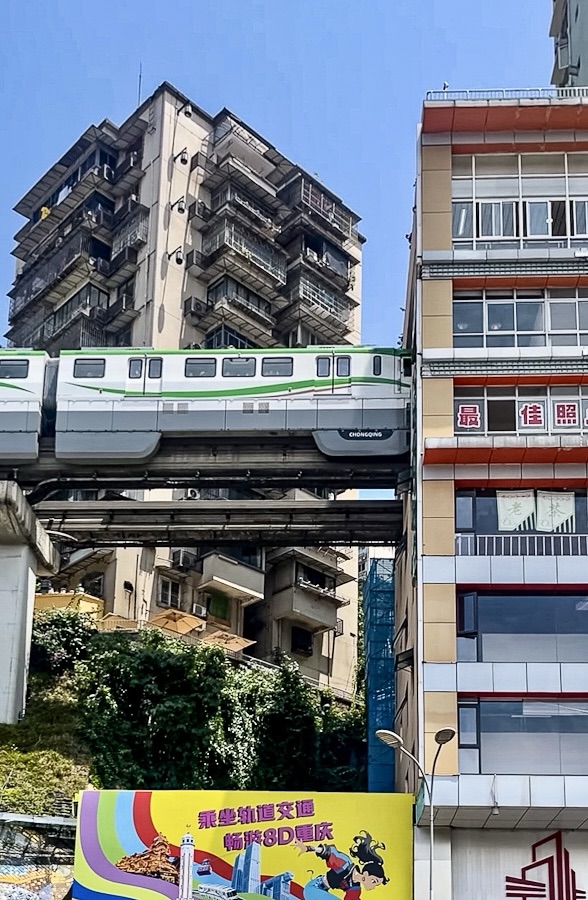
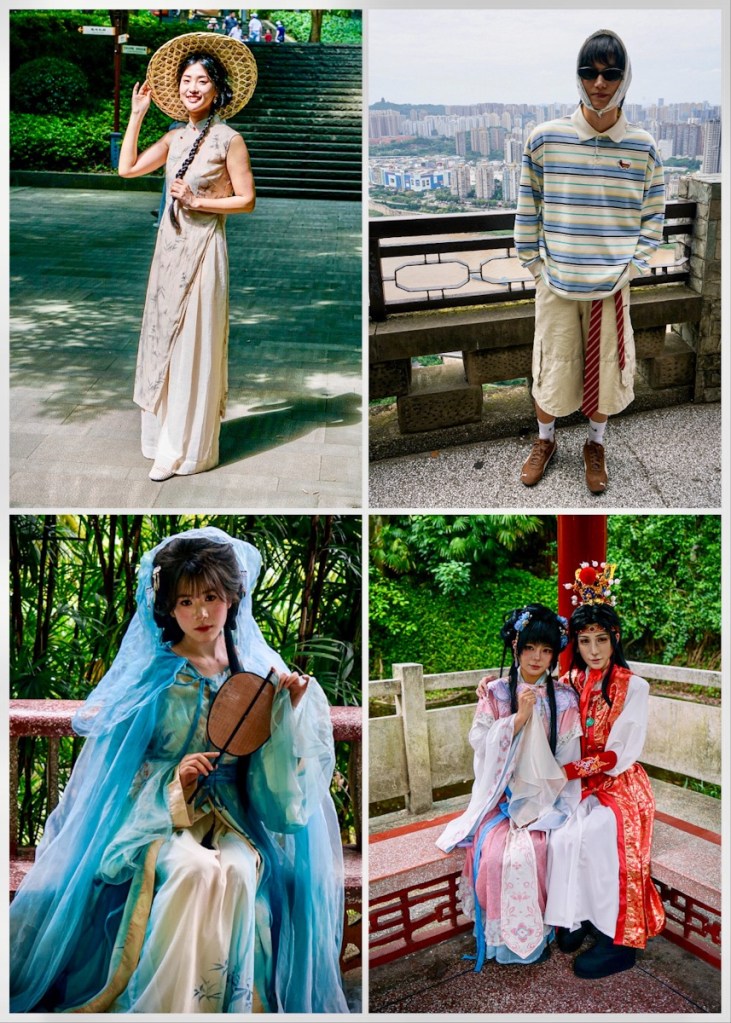
The city is huge and sprawled…vertical; buildings climb as well as soar. Thousands of apartment towers. At Eling Park we look out across the Yangtze River to city views. Young people are dressed up, women in floaty dresses, a photographer uses a leaf blower to get a particularly diaphanous shot. Others are in full Cosplay outfits, dressed as anime characters I’m not familiar with. It’s 31 degrees, they’re wearing thick makeup, layers of clothing.
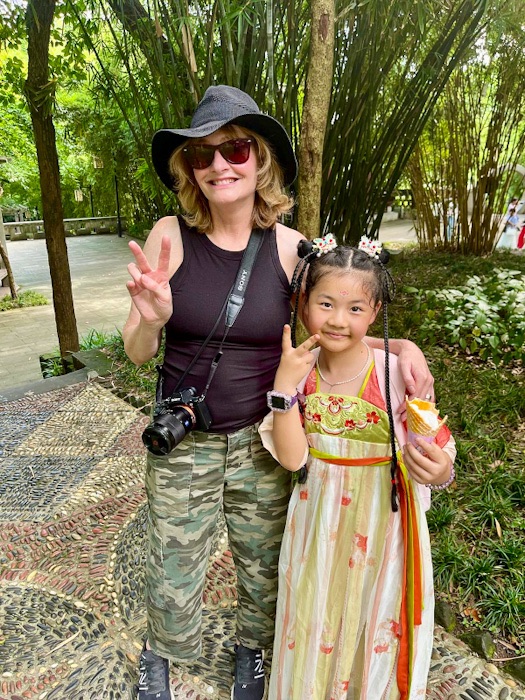
I try my hand at a shooting range with plastic toy rifles. I hit 15 balloons out of 20, my prize a bubble-wand which I give to a little boy…his parents smiling, laughing. A young girl excitably talks to me in Chinese and through google translate her mum asks for a photo of me with her daughter, photographs with foreigners are a thing.
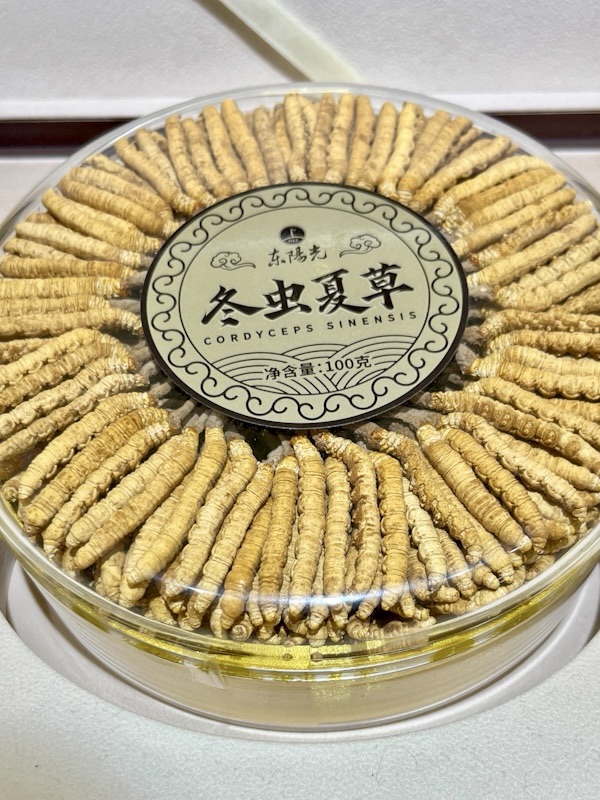
We’re using Didi cars everywhere, it’s cheap and it’s too humid to think. We head to Ole Supermarket hoping to buy imported cereals but this is high end. I see exclusive packaging containing what look like Mescal worms selling at £1,850…ChatGPT identifying them as Cordyceps sinensis (冬虫夏草), one of the most famous and expensive ingredients in traditional Chinese medicine. Literally a fungus which grows out of the body of a caterpillar larva. Madness.
A short walk to Kuixing Tower, Linjiang Road where we experience the bizarre construction of this city. Entering the plaza, glittering skyscrapers at our backs, we walk to the railings where it plunges to a downtown grid of cars and pedestrian streets. A sky bridge connects to the other side where buildings are marked 22nd floor, though we’re at street level in the plaza, a vertiginous drop below.
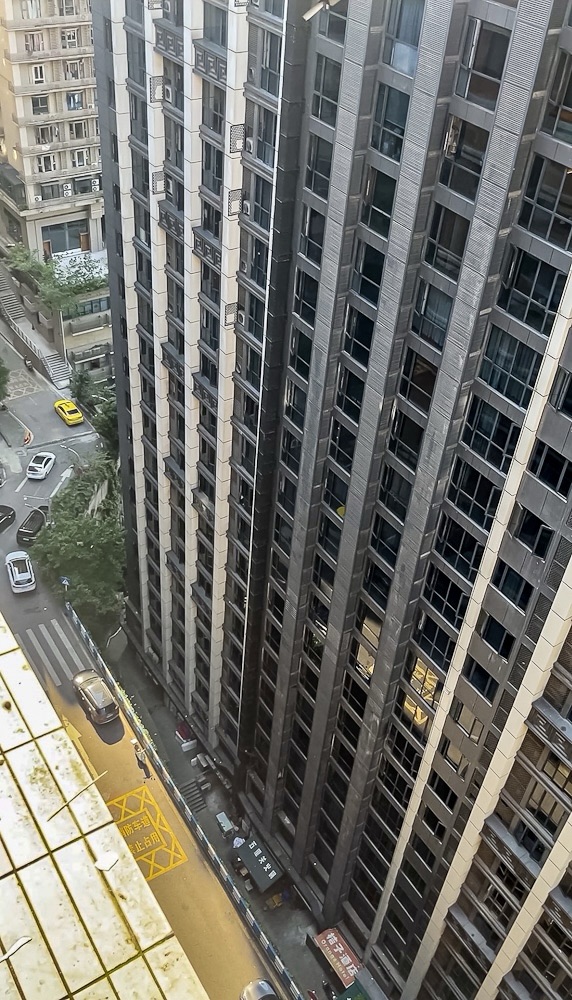
We spend some time baffled, bickering over different Hot Pot restaurants, where’s the one I’ve seen advertised online…it’s in a World War 2 tunnel which you’d think would be easy but it looks like there’s several tunnels, Amap and Didi are confused, it’s really bloody hot. I’m determined to find the right one and finally we’re in a car and on our way to Zhicheng Old Hot Pot, No. 5 Ji’an Road, Longta Street in the Yubei District. We reach there to find several World War 2 shelters…the first a community kitchen, the second a tea tasting place and the hot pot next along. We explore each before walking the 1km length of the hot pot restaurant. Yes, it’s that long, can seat 1,300 diners and has robotic servers and staff on golf carts moving through this interconnected underground labyrinth.
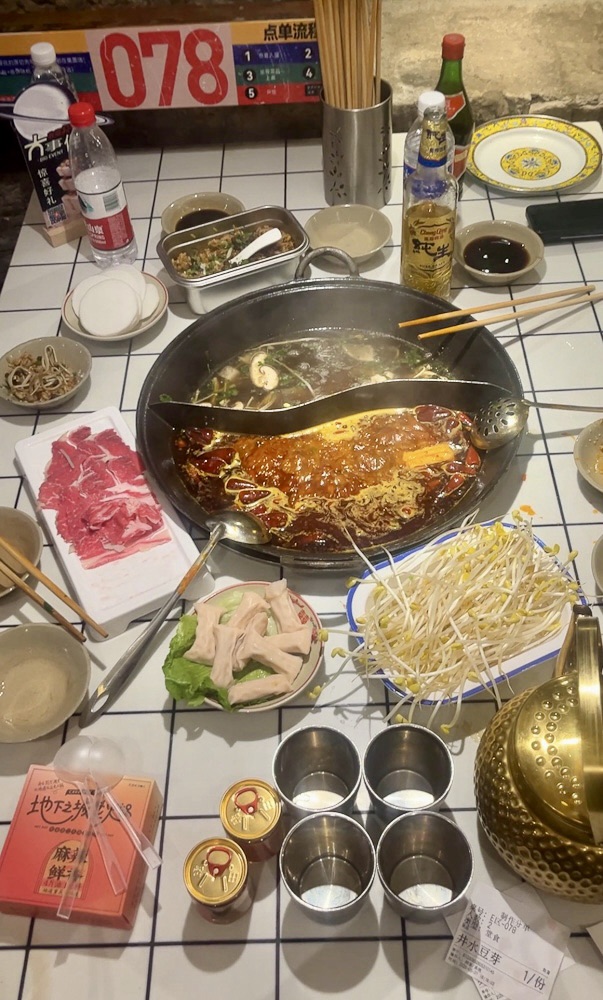
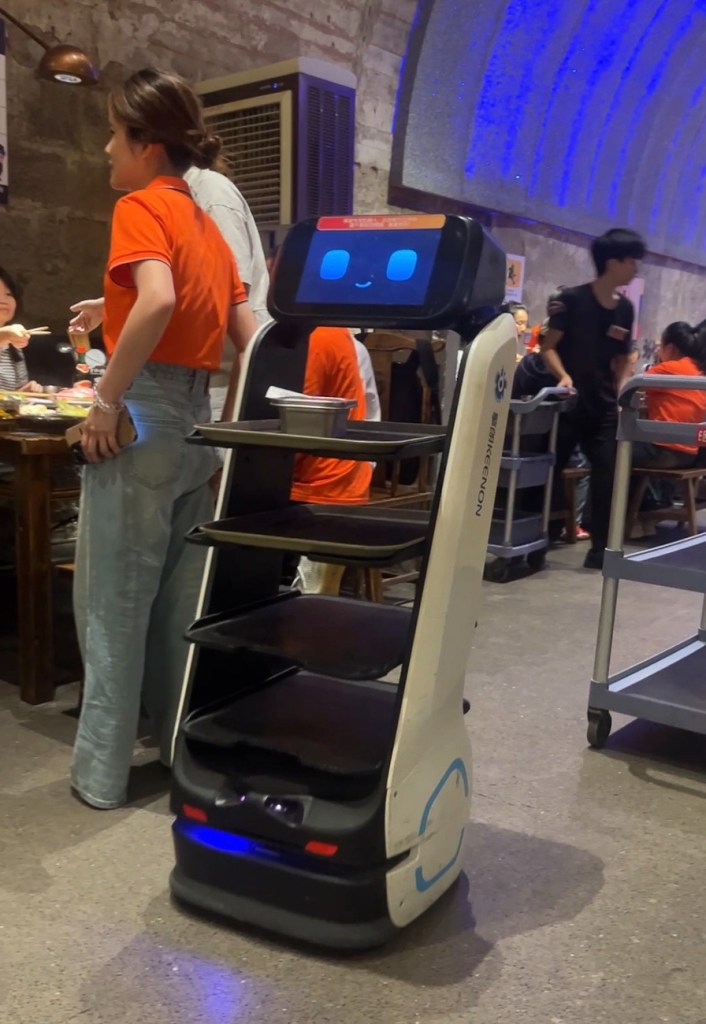
Sure it’s touristy but who cares when it’s this much fun, the food is pretty good and the price is low. They set us up with a split pan; one side spicy which they fill with chilli and peppers, the other a mushroom broth…turn on the electric hot plate, add water, and it starts bubbling. We order on the restaurant app skipping popular Chinese items like goose intestines, thousand layer tripe, bull’s gallbladder throat and bowl of blood… selecting sliced water chestnut, shrimp balls, thin slices of beef shoulder, bean sprouts, noodles and I add fried rice when I learn that’s the only way to get a robot delivery to your table. Everything is brought at different times…the fried rice trundles to us on a robot tray. The robot winks at me, speaks in Chinese, I obviously can’t understand, it sits patiently until a server takes the rice and the robot trundles off back to the kitchen. It’s hilarious. The place fills with Chinese people, big family groups who wave at us…I take a group photo for one. A table dressed in orange T-shirts shout a salute each time they take a drink. An hour later they’re pissed with their T-shirts rolled up.
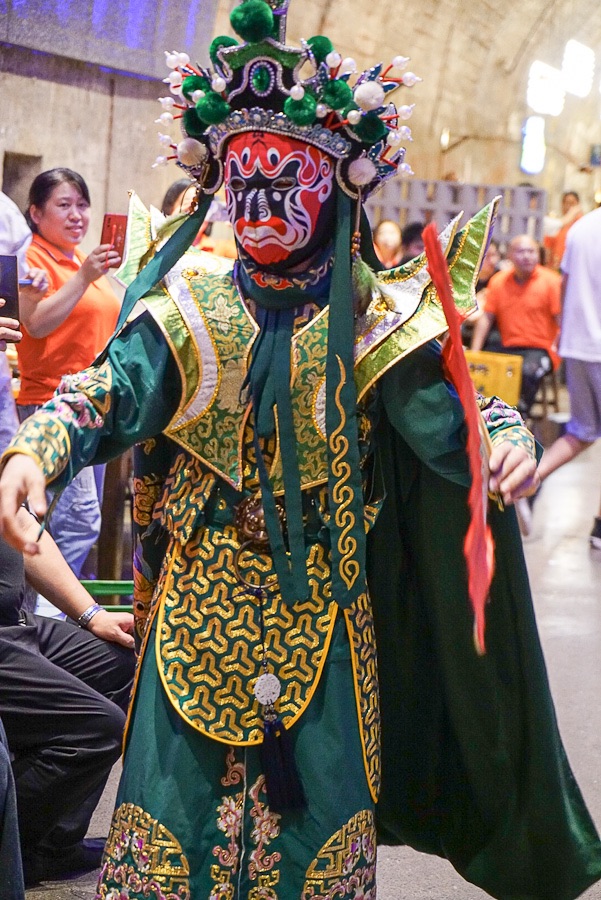
Music blares, a young woman pulls a speaker down the centre of the restaurant and an elaborately dressed figure appears. We’re in for a free show of the well known face-changing act; the performer dances wearing a mask and ingeniously behind a fan flips to a different ‘face’. Really enjoyed this place. Back to the hotel in a Didi, marvelling at the city lights…it looks fabulous.
Chongqing 1949
June 1. Raining heavily, a Didi day, lazy to negotiate the metro train system. This city is built on 8 levels; staircases, hills, escalators…it’s mind boggling how they planned it. At the massive upscale Ring shopping mall the main atrium features a large animatronic boat, a cascading waterfall…viewing platforms spiral upwards. We’re not interested in shopping, we’re looking for the spectacle. Among the designer stores and American sportswear brands are arcade gaming rooms, virtual reality rides, a mini race car track, it all pulses with lights attracting a young crowd…the noise is ear splitting.
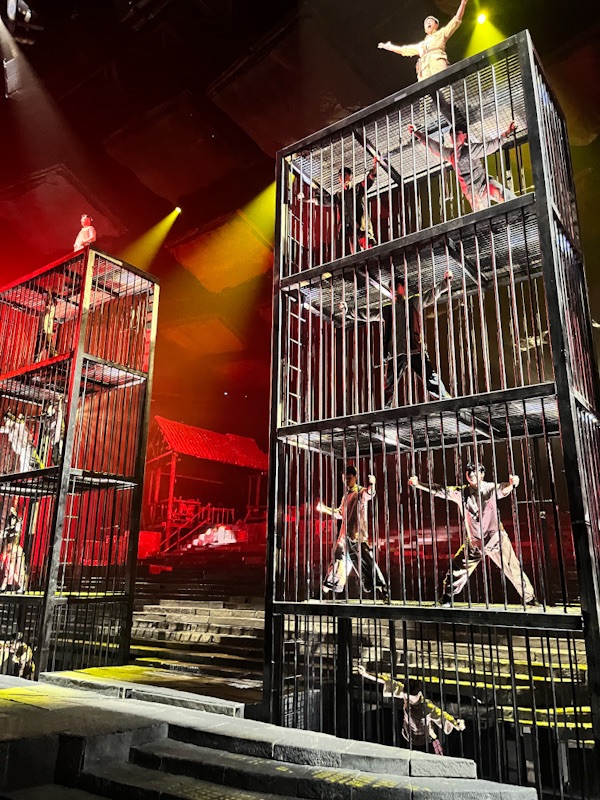
Another Didi, everything seems to be a 30 minute drive apart. The motorway is clogged with taxis. I’ve found us a genuine Italian pizza restaurant Bro’s Neapolitana, 2 floors up in a building. Happy days after 10 straight of mainly Chinese food. Didi in the rain again (30 minutes) to the Chongqing 1949 show in a theatre specifically built for it. An incredible rotating stage with stages rotating within it. Our ‘A’ section seats also rotate; a moving audience..we circle the stage. So many moving parts within other moving parts. At 70 minutes long and entirely in Mandarin, we were transfixed. I didn’t use the translation headset as it took me out of the experience. The story centres around a group of revolutionaries and underground operatives in 1949, imprisoned in secret prisons, choosing death rather than surrender during the final days before the city’s liberation.
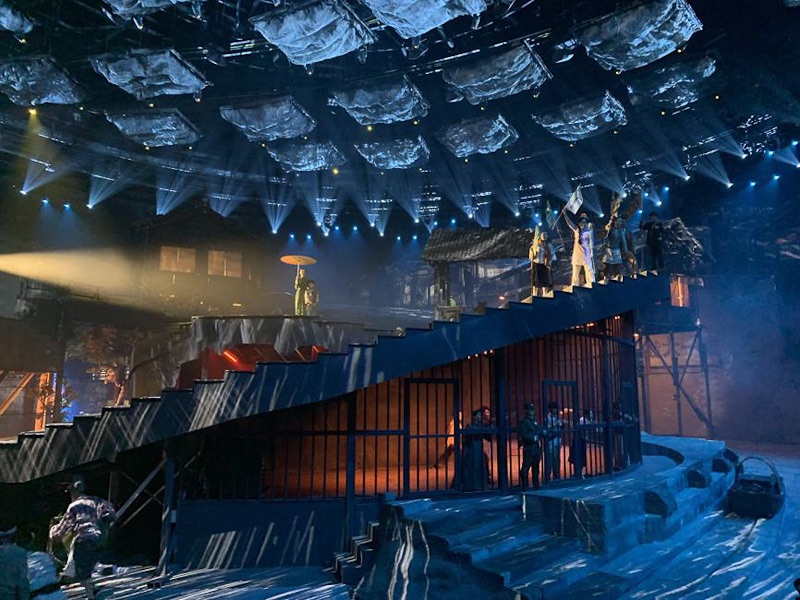
The cast of over 100 break our hearts with their recreation of this devastating time in Chinese history. Perfectly synchronised choreography with so many complex moving obstacles to negotiate. It’s the world’s largest 360-degree theatre show and it’s breathtaking.
The audience spills out at 6.30pm. On a high we explore nearby Ciqikou ‘ancient’ village but it’s another tourist trap connected by escalators and steep steps. Women hustle us to buy wood bracelets, raspberry tea, sweet treats and decorative fans.
Chongqing at night
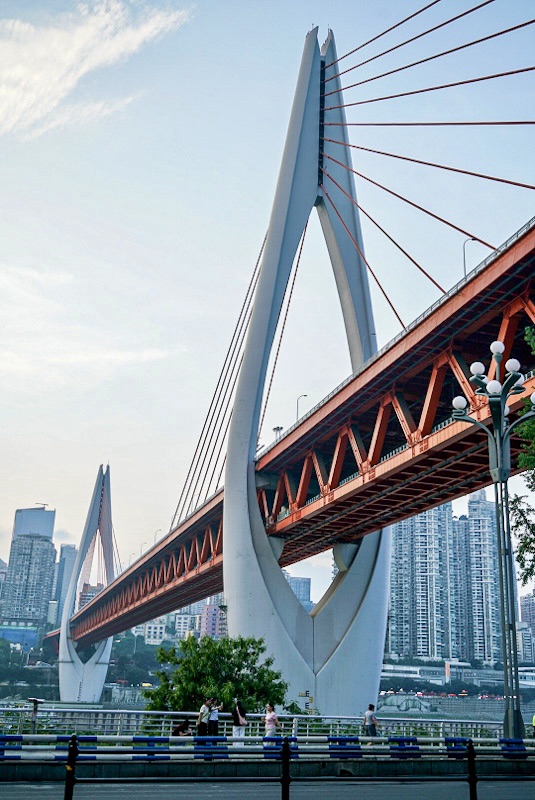
June 2. We’re planning ahead thinking of what tickets we need to buy. It’s become easier as we’ve settled in to travelling China…we’re not as stressed about figuring it out. We discuss panda options in Chengdu, its biggest draw…Dave stating: “If you want me to go to the top of a mountain with you to see pandas, I will. But personally I don’t give a shit about pandas.” It makes me laugh enough to note it down. No rain, smoggy with pollution, a nondescript sky. The hotel brought us a bowl of fruit on request as the previous day’s breakfast was dry and cold. We want a western breakfast and a long walk. We head out over Dongshuimen Changjiang bridge crossing the river, views of stacked apartment blocks. At the end of the bridge covered escalators drop several levels to a subway station.
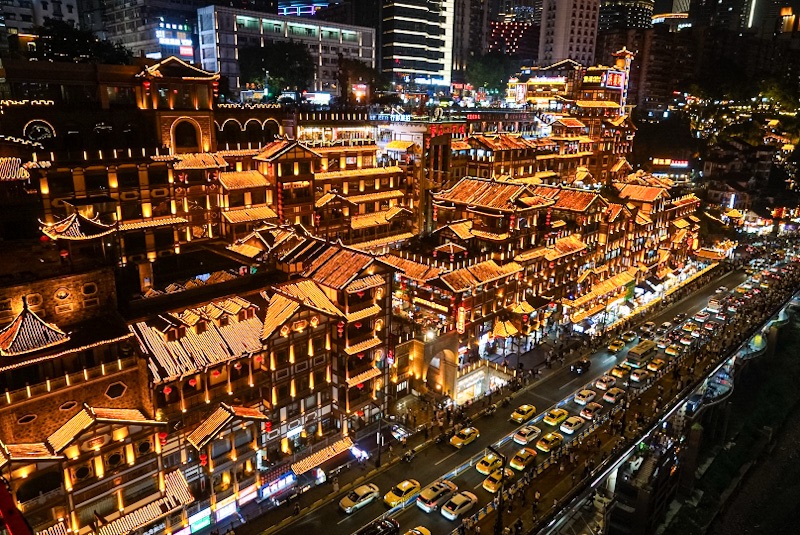
We walk the bustling Shanxi Road packed with shops selling bedding, cheap T-shirts, food. At Raffles City we wander the mall getting a cheap breakfast at Tim Horton (croissants and bagels). Outside to Chaotianmen Square to look at the confluence of two major rivers; the Yangtze and the Jialing…looking up at the Raffles City building; 8 curved skyscrapers, the 4 main towers supporting a skybridge viewing deck. Innovative but ugly. Walking back the same way, resting at the hotel before dinner at a Vietnamese place close by on Xiahaoli Old Street. After, we take the cableway south to north across the river for the night view of the city skyline. Walking from its northern exit we have to push our way on to Qiansimen bridge with hundreds of people here for the same reason as us; to see the infamous Hongyadong (Hongya Cave) light up. An 11 storey, 75 metre arrangement of stilted wooden buildings built into a cliffside…thought to be the inspiration for the bathhouse in the Studio Ghibli film ‘Spirited Away’.
Train to Chengdu
June 3. Up at 6am in to a cab, pouring with rain. The hotel hires a porter who carries our suitcases up and down the stone steps, one balanced on either end of a long wooden pole…33 kg. In to a Didi car to Chongqing West high speed rail station for a 1 hour journey to Chengdu. Far less stressful to negotiate these huge stations than online Chinese travel forums led me to believe. The system works, everything’s on time, it’s easy to find your train platform and waiting area. The train glides in so quietly its arrival makes me jump.
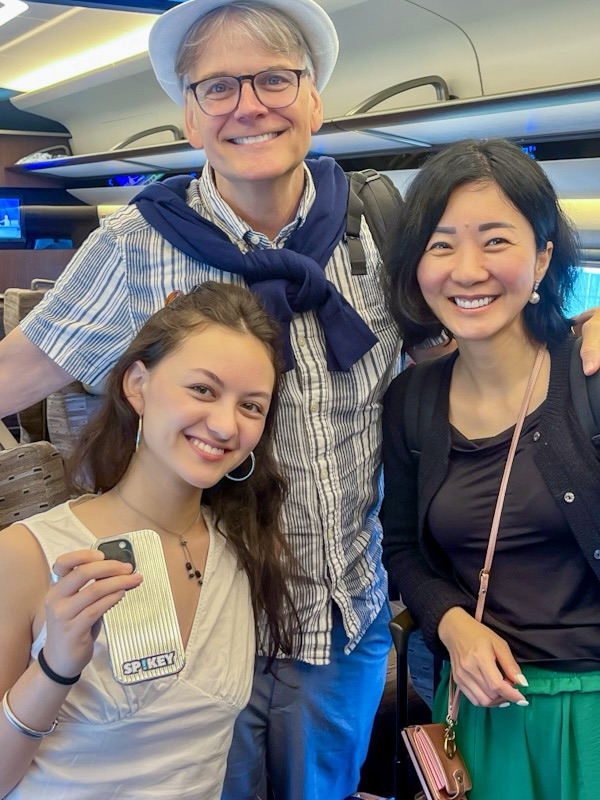
On the train we get into conversation with an American/Chinese family Jeffrey, Laura and Abbie that lasts the entire journey. Daughter Abbie has created an innovative litmus testing accessory for women as an anti drink spiking device for safe drinking. 17 years old and already making the world a better place. Look it up on Instagram @spikeyfirst or spikeyfirst.com A fabulous interesting family, we’re sad to say goodbye.
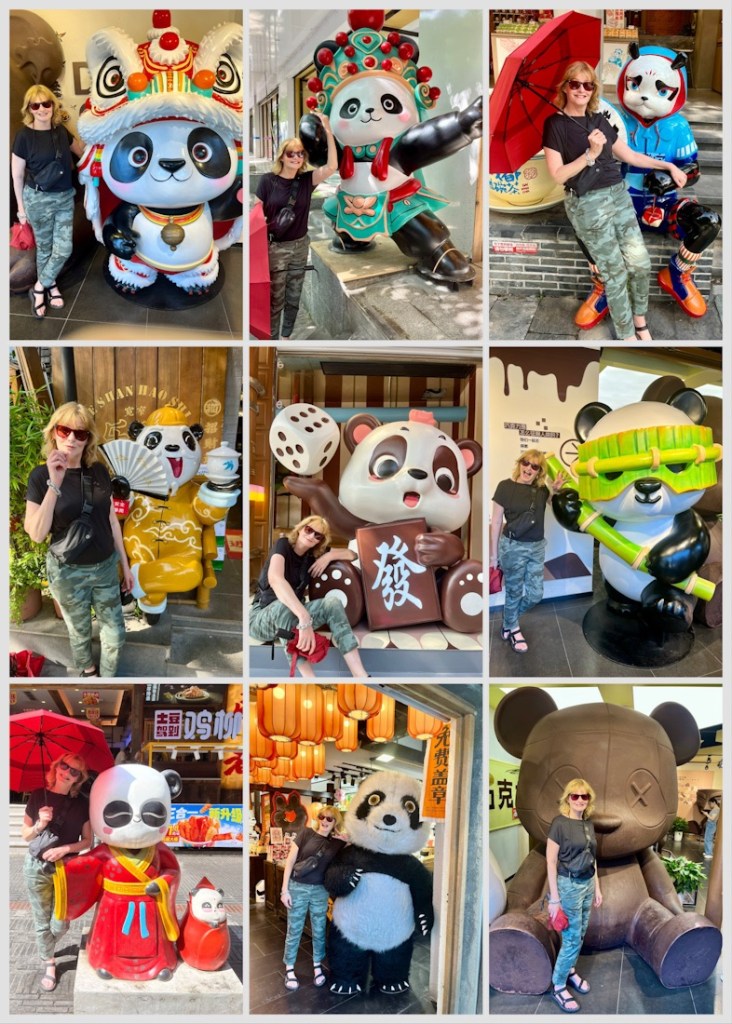
Parting ways we follow the car hailing signs and book a Didi to LAN’s Hotel (another hotel which has 3 different names), letting us check in 3 hours early to a lovely room with a large picture window overlooking Yongling Park. Here for 6 nights to wind down and relax, we use the free laundry room (a great thing to offer), eventually heading out for a 20 minute walk to Kuanzhai Alley. One of three parallel ancient alleys, it’s now full of boutiques, restaurants, cafes, a Starbucks and lots of Chinese ladies offering ‘ear picking’ services. I’d love to have my ears cleaned but I’m a little wary as to what they stick in there. There are panda statues everywhere marketing various businesses. I get Dave to photograph me in front of several… sitting on the leg of one discovering it to be plastic coated in real chocolate.
We eat pizza (okayish) and have drinks (delicious) at Monde Cafe in an indoor/outdoor setting with a guitar player performing in the garden. We get chatting with a Singaporean lady who tells me I’d love Nepal. We run the hustler gauntlet walking back; more ear picking, raspberry tea tasting, sweet treats, fans and souvenirs. It’s all good humoured, I don’t have a problem with being hustled. On Yongling Road local people are gathered in the tree shade watching a lady sing traditional Chinese songs…they smile and wave as we pass.
Chengdu Pandas
June 4. Another 6.30am start to beat the heat and visit the Chengdu Research Base of Giant Panda Breeding. The Didi driver uses google translate to sell us his tour guide services, we politely decline several times…on realising we don’t need anything he switches to telling us about his ex wife from Chongqing and how Chengdu has prettier women.
Pandas don’t like the heat so we’re here early to see them before they sleep, head inside, or both by 11am. Like most things we’ve seen in China the research base is massive, the park grounds spread for miles. Tour groups have already started arriving and along with the throng we trudge around the park, seeing our first panda only a few minutes in. They have space to roam and an endless supply of fast growing bamboo. They appear well looked after. Pandas have been on the endangered list for years, approx 1,800 exist in the wild and only in China, so the breeding programme is viewed as a necessity, though some would argue nature should take its course.
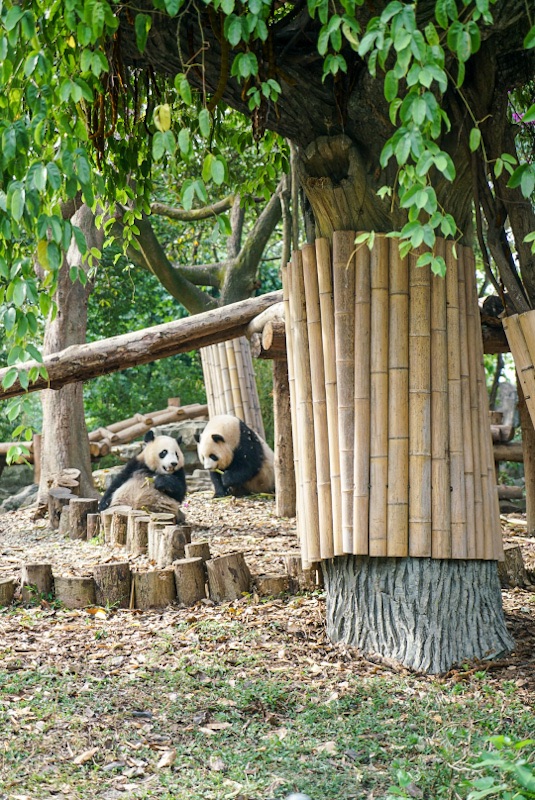
After an hour circling the lower section of the park we cheat, buying a wristband for the shuttle carts which whizz around. Several kilometres later at the west gate exit we get off and head back in to the upper section, seeing pandas back in their enclosures to cool down. I understand the affection for them, they tumble around and are playful. Their limited bamboo diet gives very few calories. They need to chew for 10 or more hours a day to consume enough to give them energy, hence their slow movements and need to sleep. You’d expect over millions of years of existence their diet could evolve.
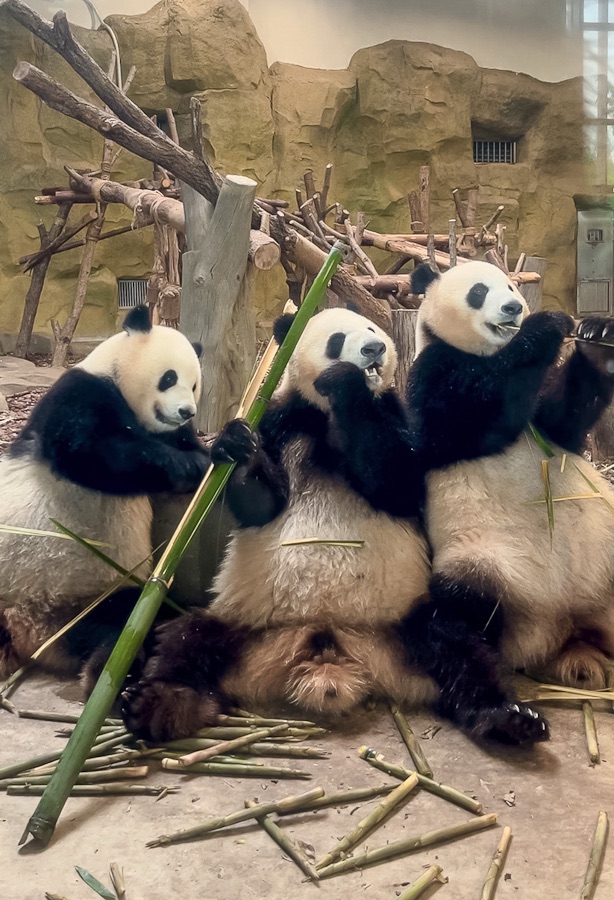
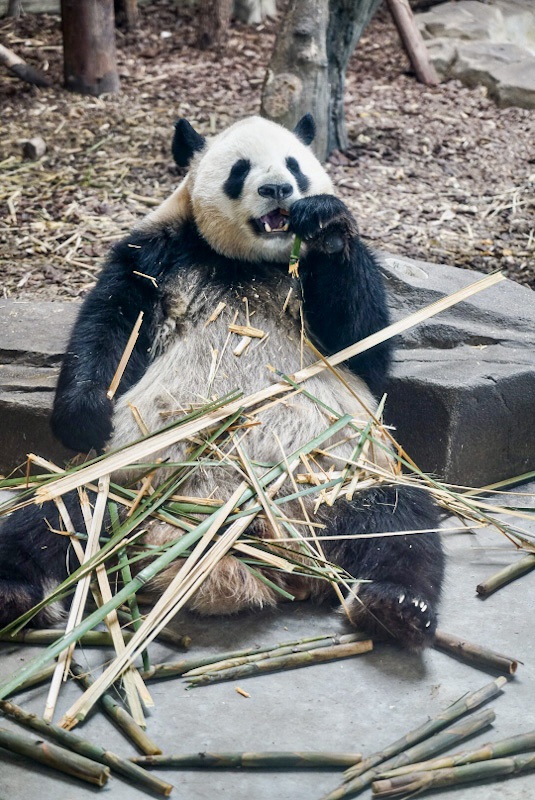
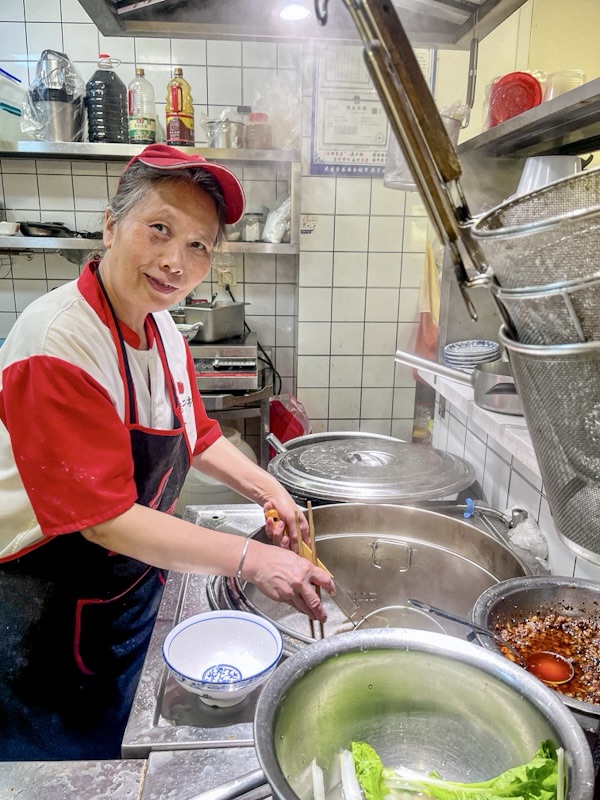
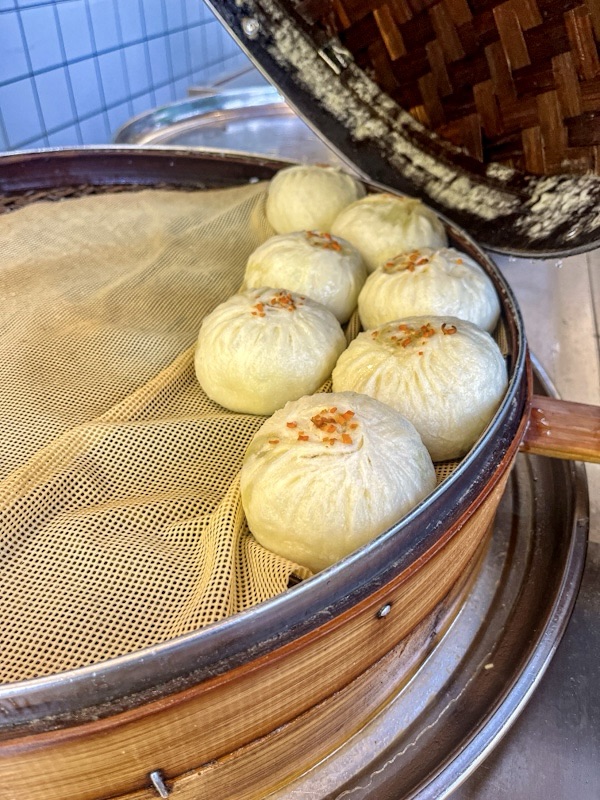
We leave the research base at 11am and relax the rest of the day. We venture out in the evening to nearby Fuqin night market located in an old neighborhood courtyard in the Jinniu District. It’s a bit early and it hasn’t really geared up, I enquire about roast duck but it’s for takeaway only. Walking back we find a tiny bao style dumpling and noodle shop, the dumplings steamed at the front, the noodle soup cooked in a rear kitchen. Pointing our phone cameras at the menus Google translate works well. We eat bowls of beef noodle and pork noodle soup with a meat stuffed dumpling to share. Very tasty, 26 yuan each, (about $4 total). We thank the lady cooking, buy a sweet treat from the Yummy Food store next door to the hotel and enjoy an early night.
Chengdu chill out
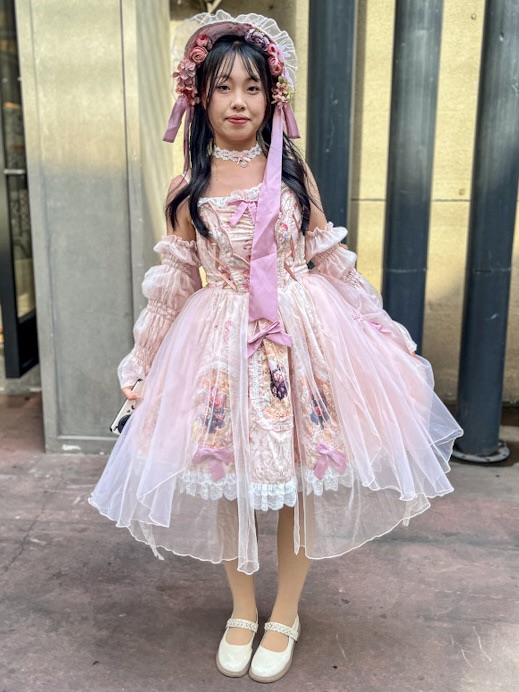
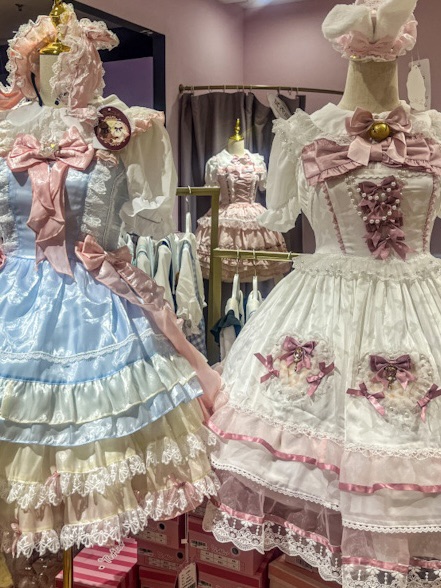
June 5. We found a subsidiary branch of Baker and Spice called Wagas and head to Dongyu Street early afternoon to eat. It’s located on the outdoor edge of Tianfu Hồng shopping centre; entirely dedicated to anime, comic, game and youth fashion. Stores in bright pink, bright yellow packed with collectibles, trading cards, plush toys, life size cardboard cut outs of boy bands. There’s dresses and bonnets all frill and ribbons; Little Bo Beep for girls and young women…strangely infantile.
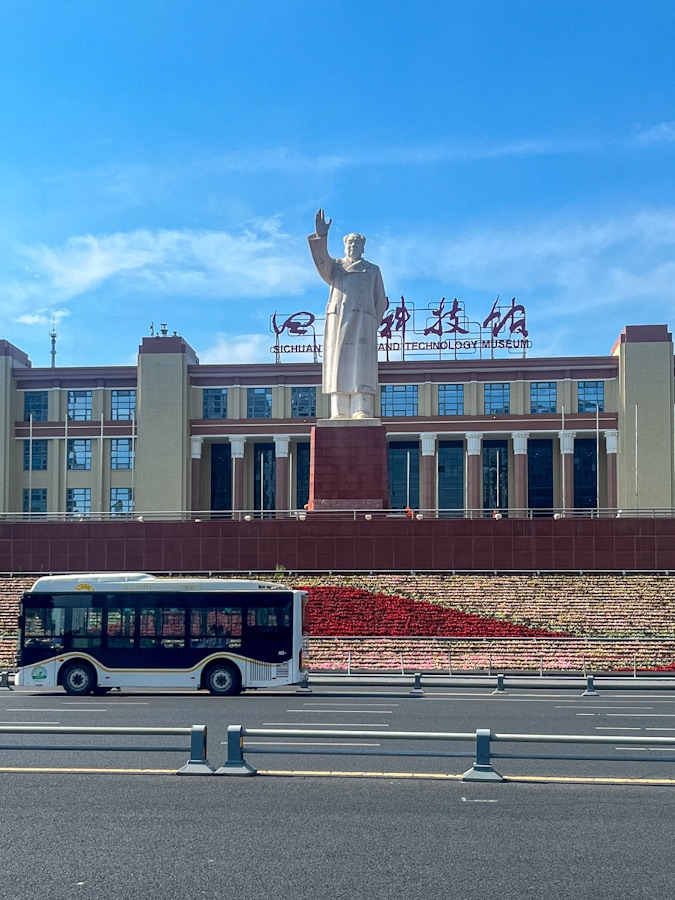
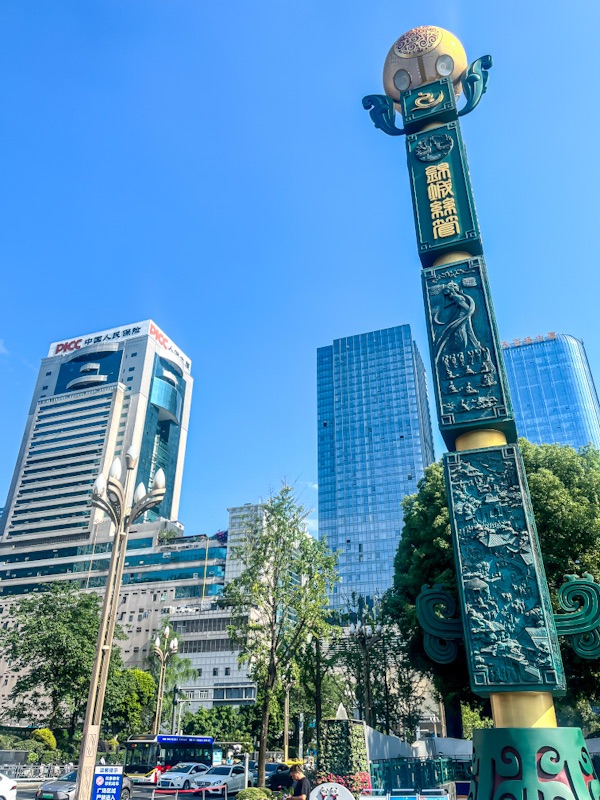
Back outside it’s 30 degrees, I use my red umbrella as we walk across Tianfu Square. It’s over 88 square metres, presided over by a towering statue of Mao Zedong whilst beneath lies a sprawling shopping mall. It’s the cultural heart of Chengdu, surrounded by museums and the library, similar in significance to Beijing’s Tiananmen Square. It’s too hot to do much more so we head back to relax dropping in to Yummy Store to buy ice-creams.
Chengdu Shrines and Tombs
June 6. To People’s Park where at the weekends they have a marriage corner…parents advertising their eligible daughters (pink) and sons (blue). It acts as an introduction service…kind of like Tinder run by your mum and dad.
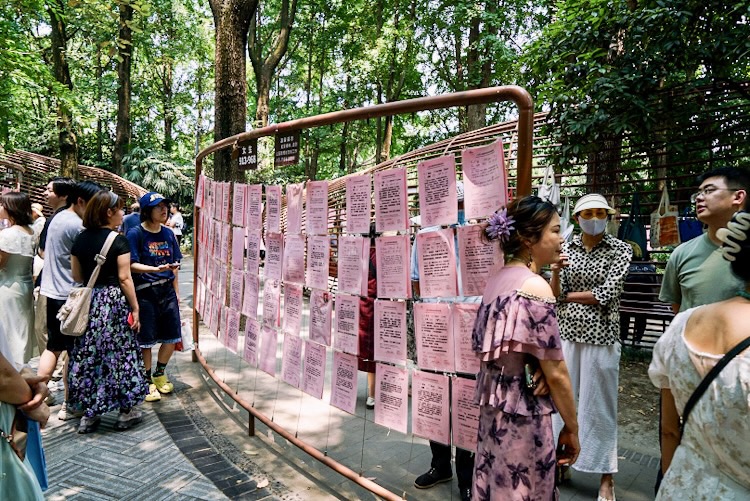
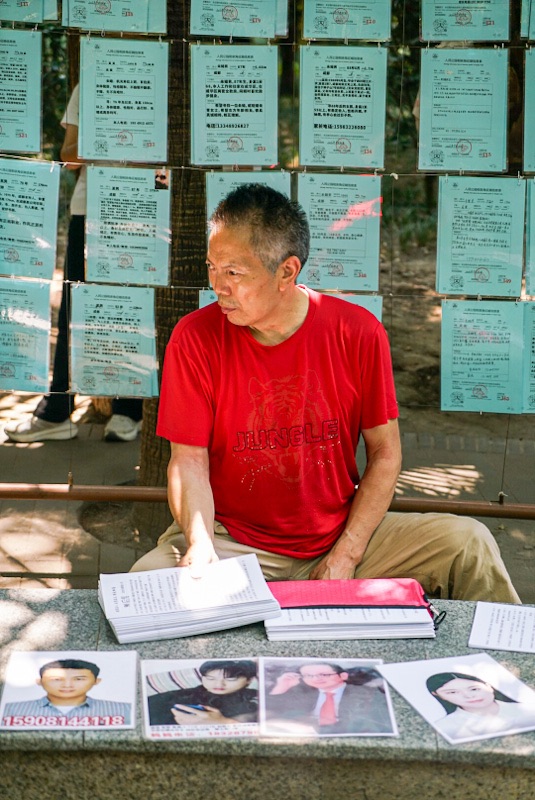
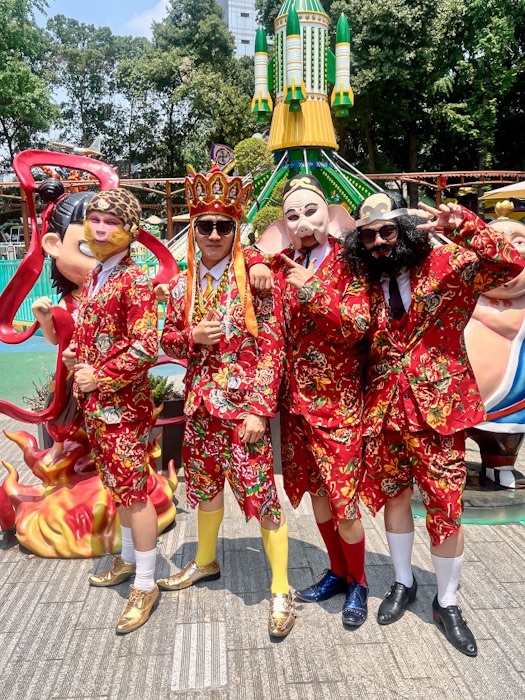
Wandering the rest of the park there’s a fairground for kids; a wall of death circles with two kids plastered against its padded walls. A line of mini JCB diggers stand in front of piles of sand, there’s loads of colourful inventive rides. And then…a group of 4 young men miming for a music video, the cameraman turns the camera on me. I wasn’t expecting to be in a bonkers Chinese video with people dressed as Monkey.
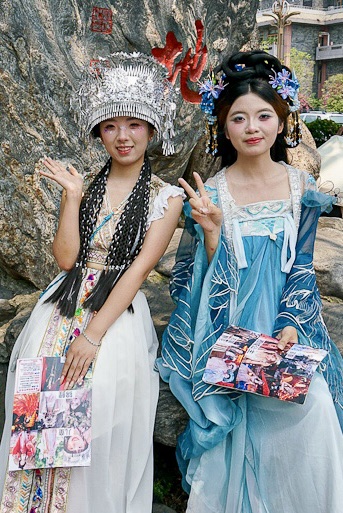
We head to Wuhou Shrine, one of the biggest draws in the city; dedicated to Zhuge Liang, Liu Bei and other heroes of the Shu Han Kingdom. Made during the Qing dynasty, the statues date to 1672. They replace the original statues made and destroyed even earlier. Beautiful gardens…stands of bamboo, water lily ponds, an area dedicated to Bonsai trees, a tea house. And everywhere pretty girls dressed in historical clothes which I’ve learned is part of a massive craze known as Hanfu.
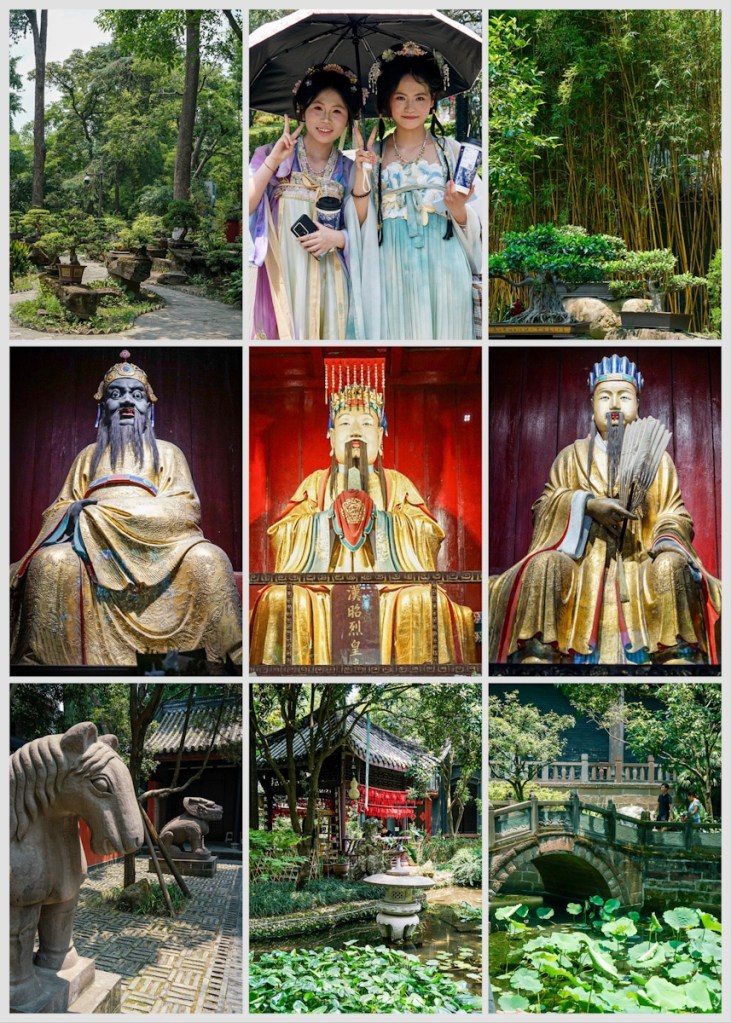
Outside Xiaohong and Xiaoqing are promoting photography shoots for Hanfu dress up. They spoke some English; happy to talk with us. We wander down Jinli ancient alley near the shrine…another previously ancient street now a tourist hub. It’s full of the usual food and souvenir vendors and ‘ear picking services’. One man bored with trying to get customers in, is nonchalantly picking at his trainers with his ear tongs. These ‘ancient’ alleys are repetitious, nothing ancient is left. I buy an orange ice cream, it’s another hot day.
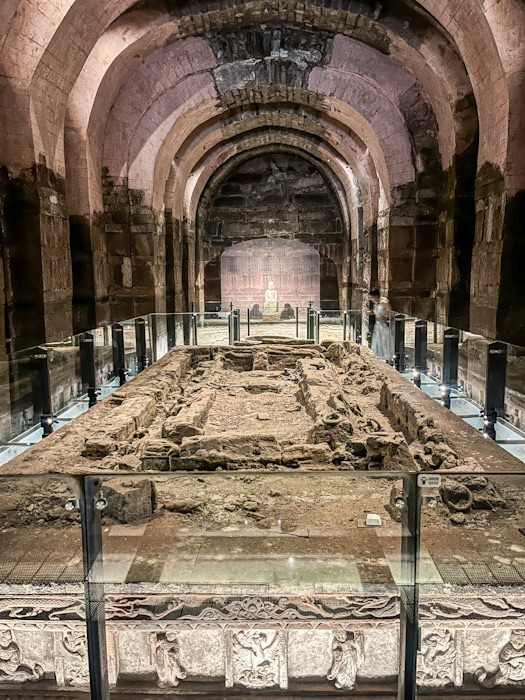
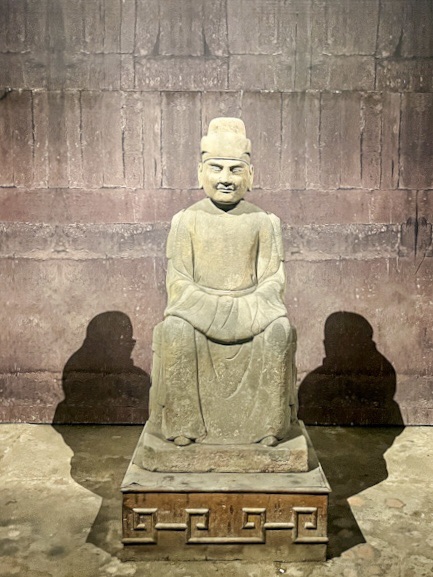
Didi back to our hotel and we venture in to Yungling park and Mausoleum. This is the tomb of Wang Jian (847-918) founding Emperor of Former Shu (during the Five Dynasties and Ten Kingdoms period). Only the grave mound and coffin chamber survive, excavated in 1940. It’s the only Chinese royal tomb found with a coffin chamber above ground. Beautiful place, our hotel room window overlooks the park it’s located in…a quieter part of Chengdu.
I find a duck place for dinner ‘Beijing Laoqianmen Roast Duck’, on Yongling Road a 2 minute walk from the hotel. Duck carved at our table, we wrap it in pancakes with cucumber and spring onion, hoisin sauce. Not as crispy a skin as I’d like, very fatty but tastes ok.
Chengdu Museum and Delicious Mall Food
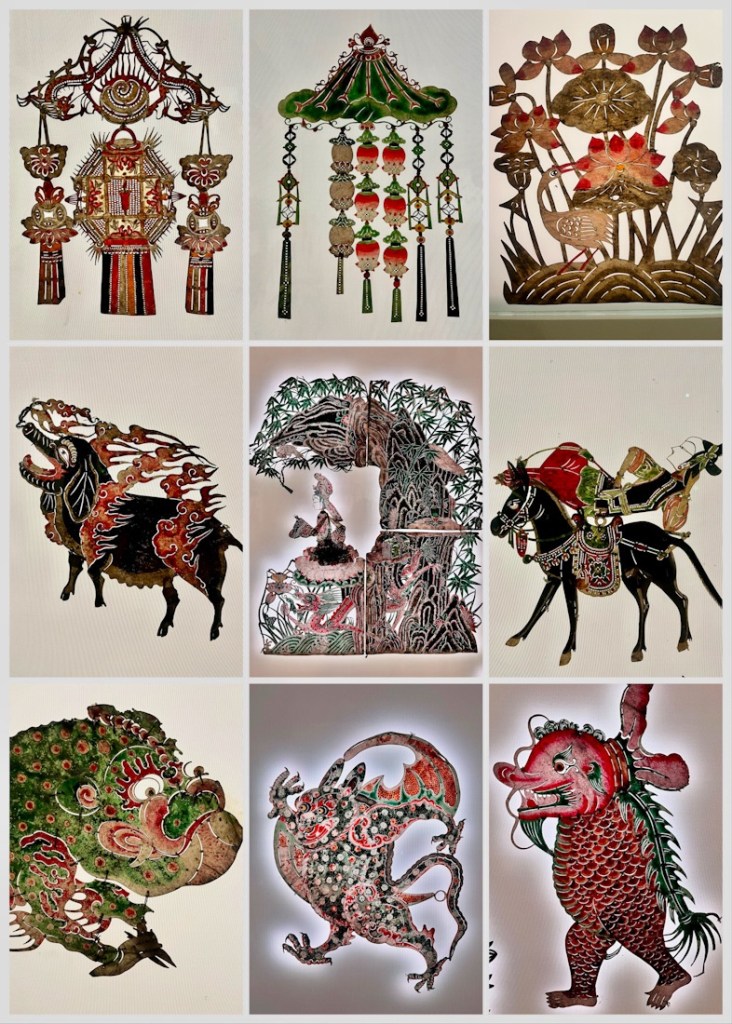
June 7. At the vast Chengdu museum we head to the 5th floor to see the shadow puppets. They are ancient, some dating back 350 years, carved on donkey skin and cow hide…remarkably preserved. It’s a large exhibition spanning two floors of one gallery and another floor of a separate gallery. Beautifully displayed with the puppets suspended between layers of backlit glass. Other areas exhibit traditional string puppets, carved heads, glove puppets and larger scale models. It’s one of the most beautiful exhibitions both of us have seen. It’s all Chinese until I turn to one glass case and there’s Kermit the frog, hand held in greeting. I immediately text his photograph to my Kermit fan cousin Rachel. On other floors we learn about Chengdu history and see artefacts over 2,000 years old.
It’s raining a little so a Didi ride to IFS Mall on Hongxing Road in the centre of downtown Chengdu. It’s upscale, international high end brands, an ice skating rink, Imax cinema…but we’re here for the Ole supermarket to see if we can top up on a few import items we’re running out of…no luck. But in the food court we enjoy a great new food discovery; Guokui. Delicately layered flaky bread, cut open and stuffed with seasoned beef, fresh green peppers, beef broth and chilli oil, 18 yuan each. I follow it with Bīngfěn, a bed of crushed ice with tapioca pearls, red bean and glutinous rice balls, 9 yuan. It’s all delicious. If only mall foodcourts were this good everywhere. Looking around there is a lot of fresh produce on display.
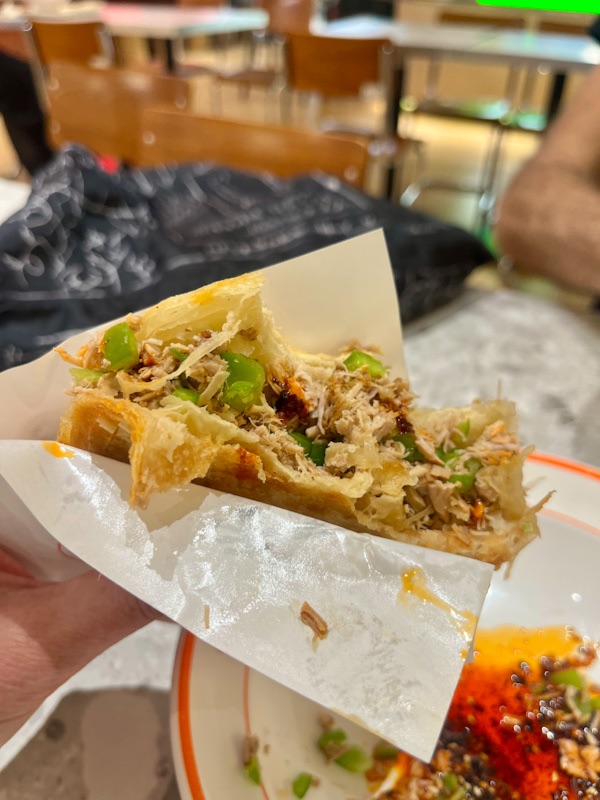
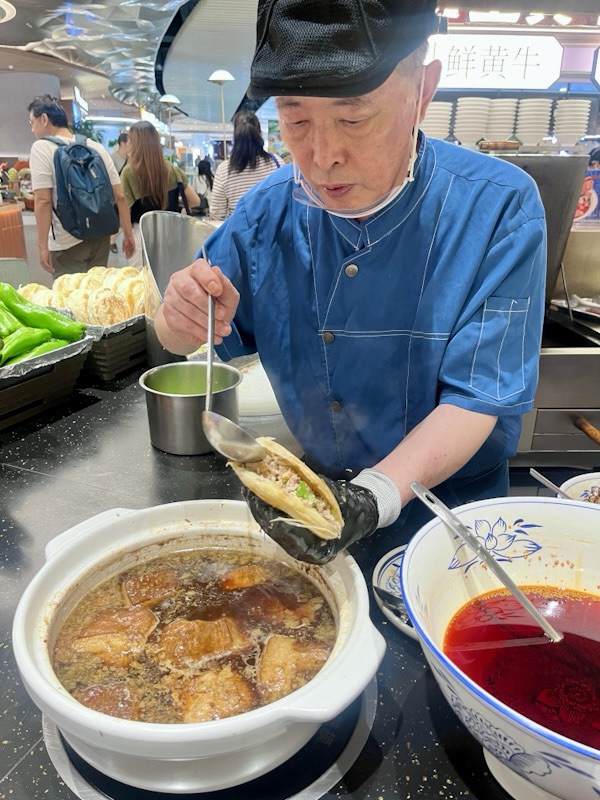
Chengdu hip hangouts
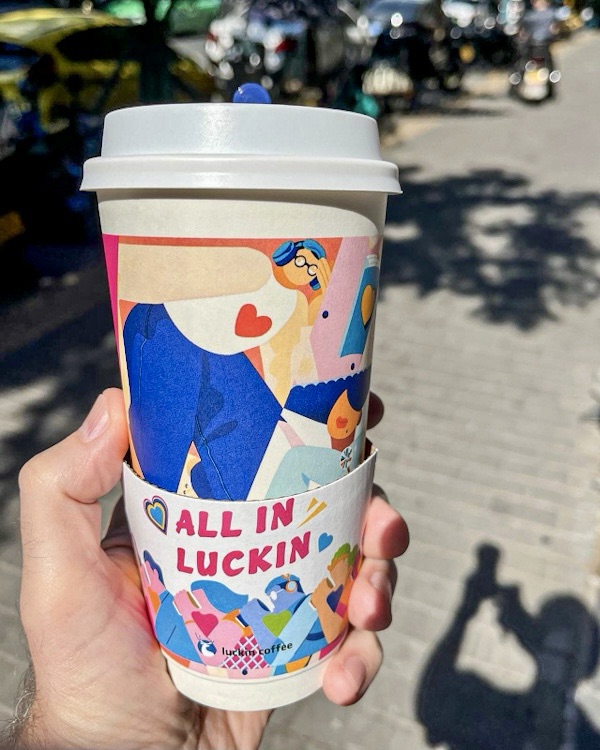
June 8. I lie in, Dave heads out to buy his coffee from Luckin. He brings back watermelon and steamed sweetcorn from the hotel breakfast buffet, pastries from Yummy Food. Our breakfasts are a mixed bag as we try to avoid noodle soup and things loaded with chilli. Chinese breakfast is too much, too early.
A Google search and I find the ‘hip’ areas where the younger people hang out. Instead of going to Wenshu monastery we choose some street life instead. At Fanghua Street we visit Minetone Records, a great record store with several rooms, one set up for DJs, a bar and coffee/tea area with seats inside and out. We talk to the young woman working there using Google translate. We flick through the vinyl, Dave finding records from his friend’s label ‘Jazz is Dead’.
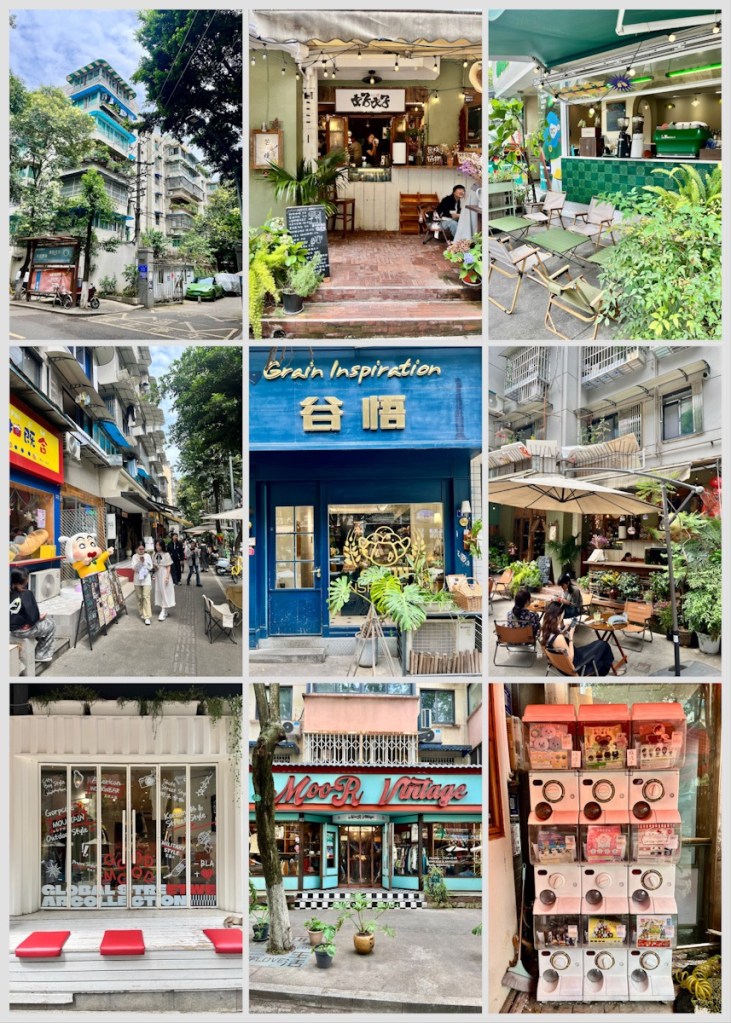
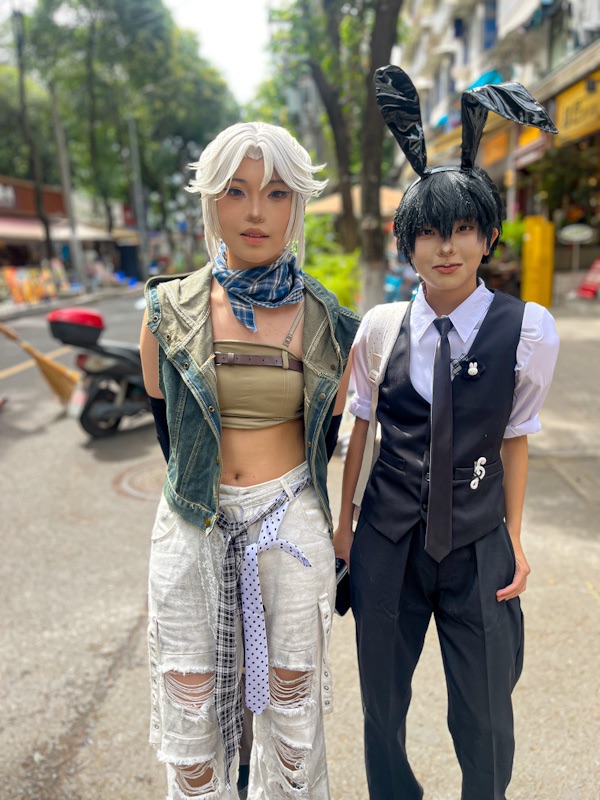
Fanghua is a fun street, tree lined with pretty pavement cafes, vintage clothing stores (expensive), unusual boutiques…it’s a welcome change from the ‘ancient alley’ tourist traps. Young people eat and shop, many with dogs following them unleashed. It’s got a great atmosphere and even the tired apartment blocks look more attractive. I photograph two young women dressed as Cosplay characters, their makeup, contact lenses and wigs so incredibly flawless they startle…the taller one looks assembled by Ai. We eat a durian pizza sitting outside, I wanted to try something with cooked durian as I’ve only eaten it raw. It’s a very thin pizza loaded with melted cheese, the sweetness of durian blends well.
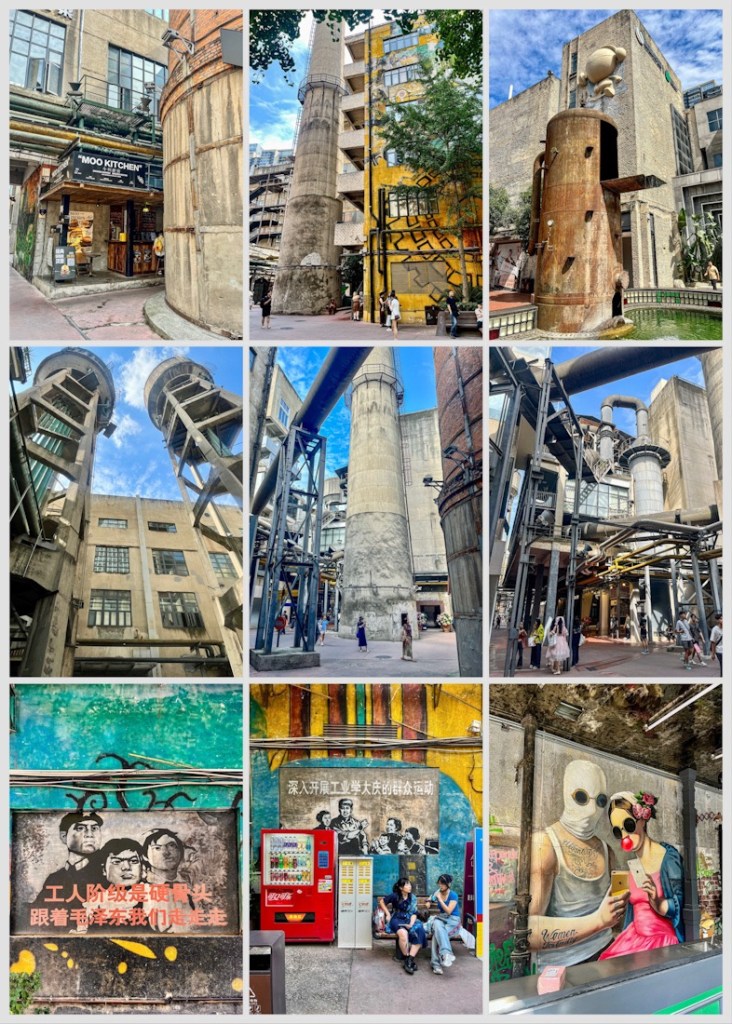
A Didi car to Eastern Suburb Memory, a former industrial complex for a 1950s Soviet-style electronic tube factory, revamped as a creative arts and culture district in 2011. It claims to have had 48 million visitors between its launch and 2020. Old factory buildings now used for dining and retail, a digital art museum, street art, bars, music venues and festivals…the original towering brick chimneys and industrial steel a fabulous backdrop. It’s buzzing, packed with young people, some dressed up posing for photographs (thankfully not as prolific here as in Shanghai). A street dance teacher from Brazil called Tevez teaches Wood and Linda some hip hop moves. Others are practising in front of full length mirrors lining an industrial corridor.
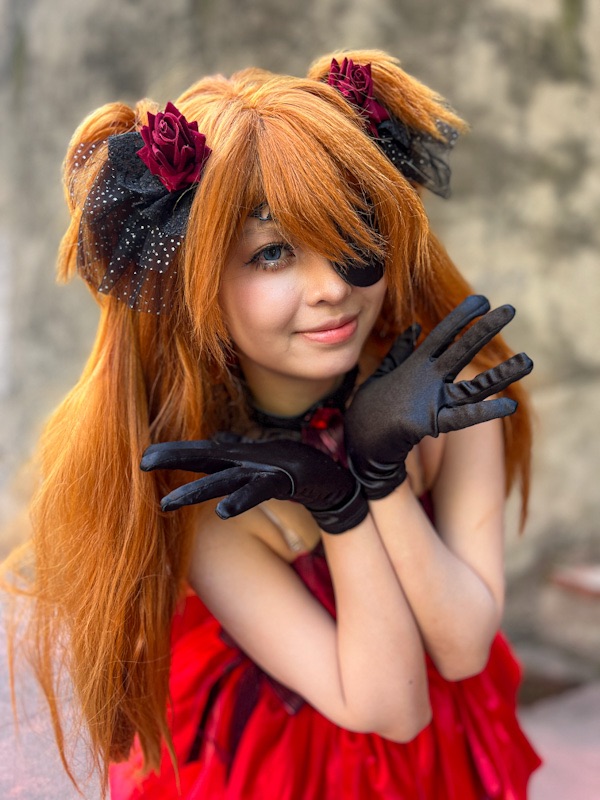
We meet Corin who speaks good English. Her and a friend are doing a photoshoot. Corin’s got the edge with her black eyepatch and gloves. She stands out among the dress up girls. I notice other young people in low-slung scuffed jeans, long dyed hair…piercings…that cool grungy look more common in youth culture worldwide. The childlike dresses, glass skin and Cosplay seem to be an influence from Japan and Korea.
Back at the hotel we pack. It’s been great staying in one place 6 days. We’re relaxed, ready to take on China’s most famous attractions.
Train to Xi’an and the Muslim Corner
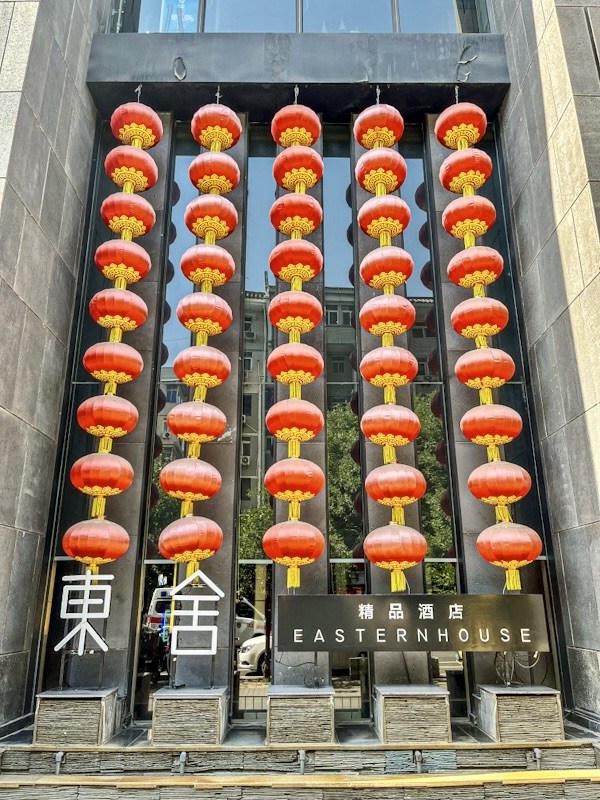
June 9. Our high speed train left exactly on time; an older train this journey, first class seats not as comfortable but the 4 hours go quickly covering the 451 miles to Xi’an. We’ve both been looking forward to this part of the trip, excited after watching the excellent Netflix documentary ‘Mysteries of the Terracotta Warriors.’ By 2.30pm we’re at our hotel Eastern House on Fenxiang Lane in the Beilin area within the ancient city walls. A great check in experience with Doris who looks the least Doris like person ever and we’re in our spacious room…all dark wood and stone for only $75 a night.
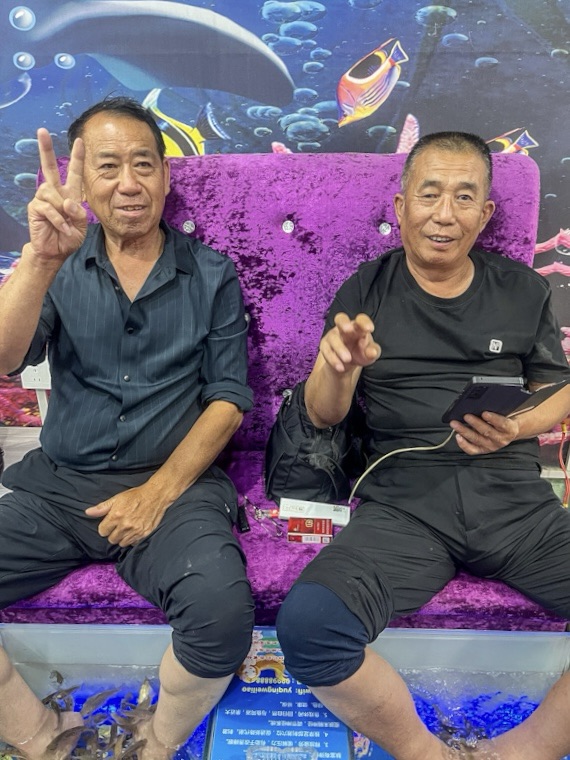
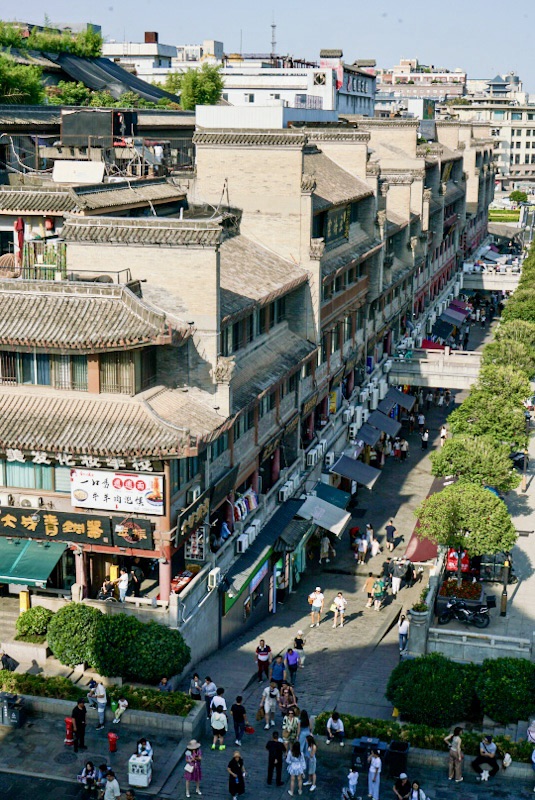
We’re a 15 minute walk from the Muslim Quarter where we wander the covered streets (they trace back to the Silk Road). Like the souks we’ve visited in other countries stalls are crammed in to the space, but there are no barrels of spices here, mainly tourist souvenirs. There’s a foot spa, fish nibble the dead skin from feet so we give it a go. I’m very ticklish so I’m laughing. Two Chinese men settled in opposite smoking their cigarettes, laugh at me laughing and film us. We talk to them using Google translate, shaking their hands when we leave.
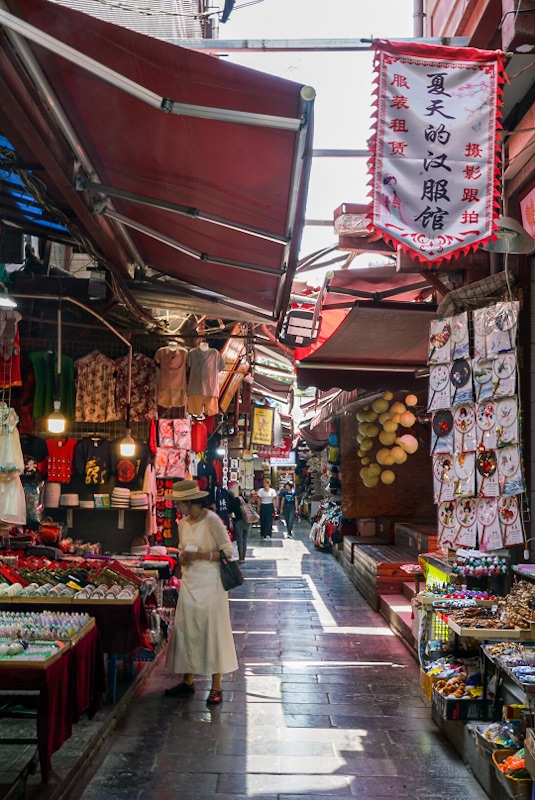
Out in to the melee of Beiyuanmen Street shoulder to shoulder with food stands; crispy chicken feet, fried crunchy corn, noodle bars, hotpot, fresh squeezed pomegranates…crowds of people strolling, the usual girls dressed up.
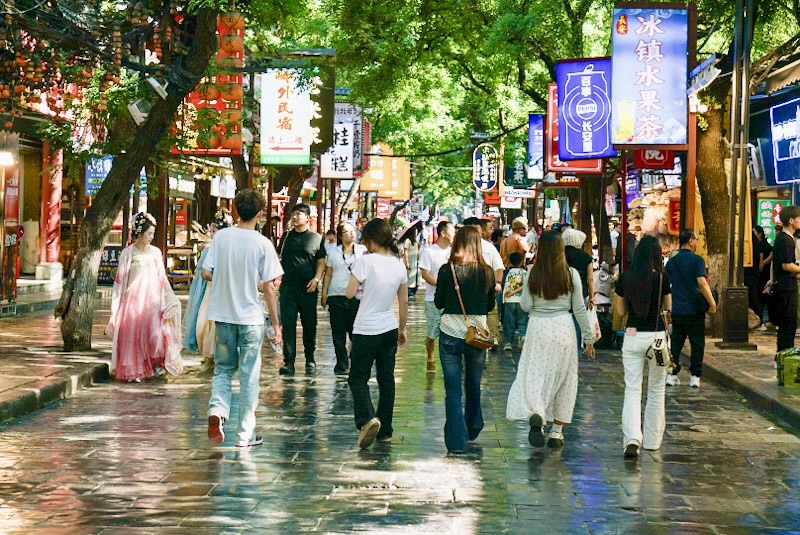
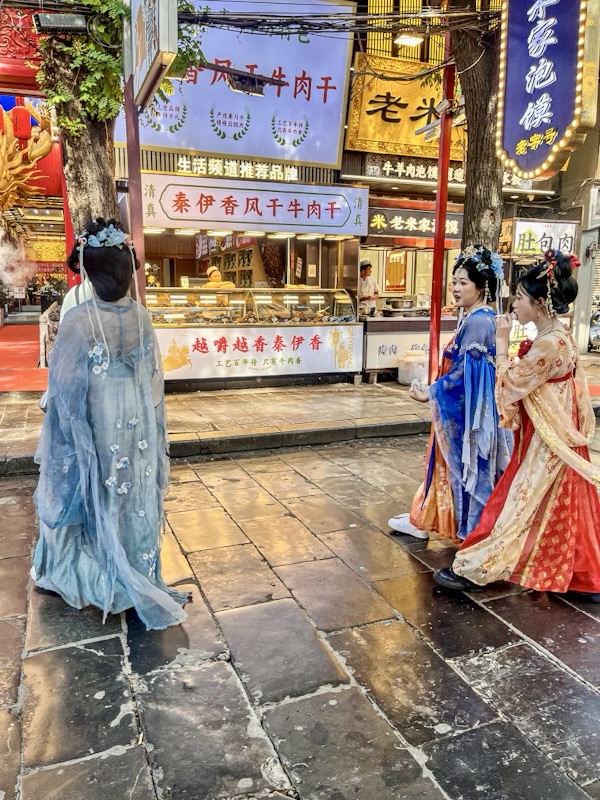
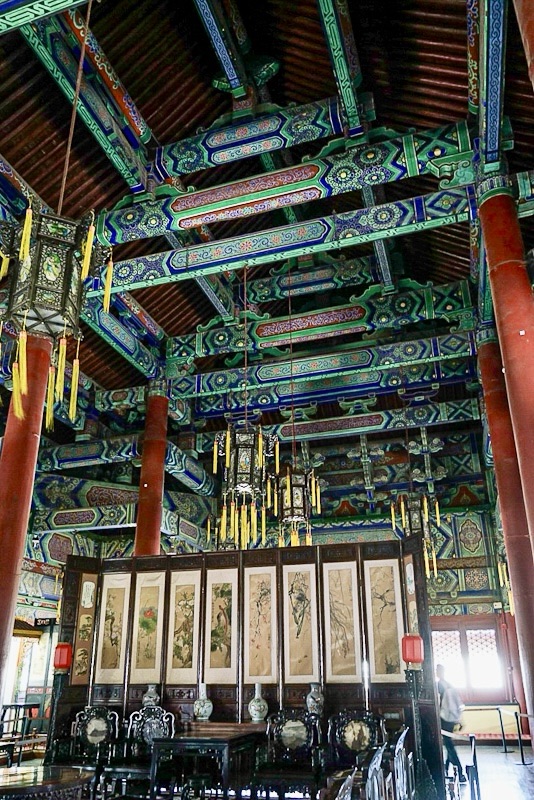
We pay 30 yuan each and climb the stairs of Xi’an’s Drum Tower to see the painted ceilings. Built in 1380 during the early Ming Dynasty, it stands in the centre of Xi’an inside the city walls. On the second floor are 24 drums each inscribed for the 24 solar terms of the Chinese lunisolar calendar. The drums are played as part of a daily bell and drum symphony with the nearby Bell Tower. We look out across the rooftops of the Muslim Quarter. Back at the hotel, room service for dinner…we cave in and order a surprisingly good spaghetti bolognaise.
Xi’an Terracotta Warriors
June 10. An hour Didi ride to see the Terracotta Warriors, the scale of it is staggering. Made for the first Emperor of China, Qin Shi Huang (210-209 BC) for his mausoleum to protect him in his afterlife. Incredibly, set on fire and destroyed only 4 years after his death by rebels looking to overthrow the Qin Dynasty.
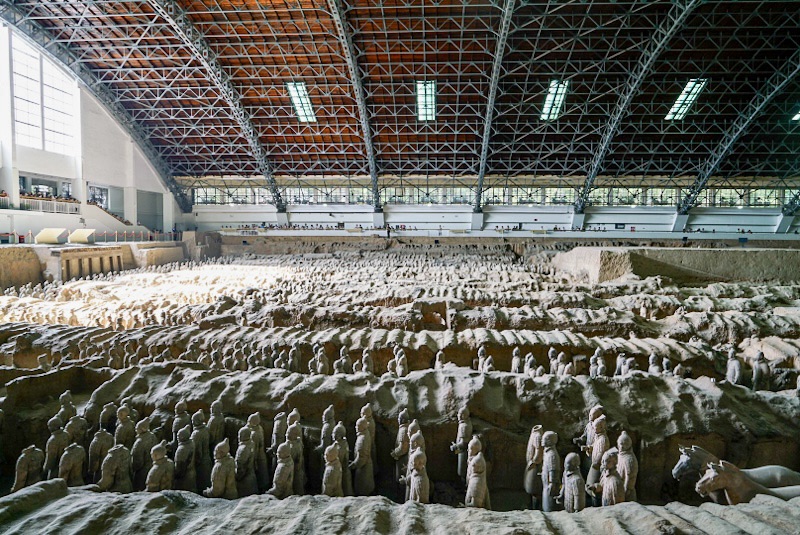
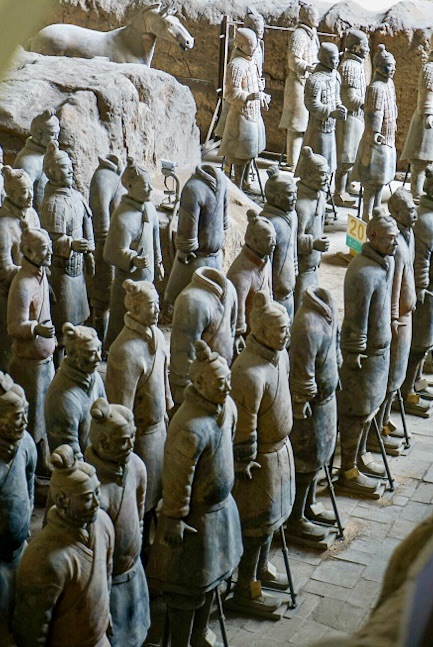
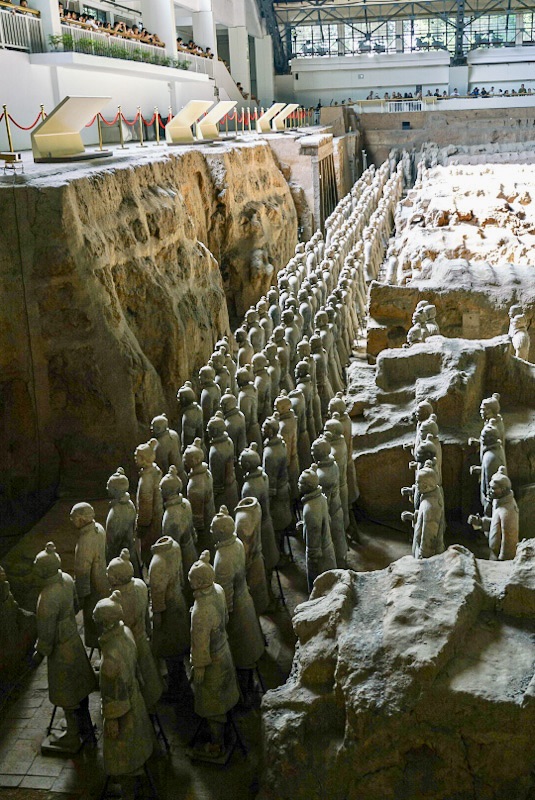
The site was discovered by farmers in 1974 and the statistics are staggering. The 3 pits hold more than 8,000 soldiers, 130 chariots with 520 horses, and 150 cavalry horses. Even more (non military) have been found in other pits along with bones from the men forced to work here…all of it buried under Mount Li. From records it shows 700,000 men worked on building the necropolis. The site is estimated, using radar, to cover 38sq miles…most of which remains unearthed. The tomb of the Emperor remains unopened for preservation reasons; it’s thought that measures 328ft by 246ft. Out of an estimated 8,000 warriors and horses, approx 1,300 have been restored. They will be excavating and restoring for years.
We meet Tom, a Pilot…born in Holland brought up in Australia with a distinct accent. He’s a bit lost like us looking for the actual mausoleum that holds the tomb and the bronze chariots. Google translate and several helpful Chinese people get us to the shuttle buses and we head to the other part of this vast site.
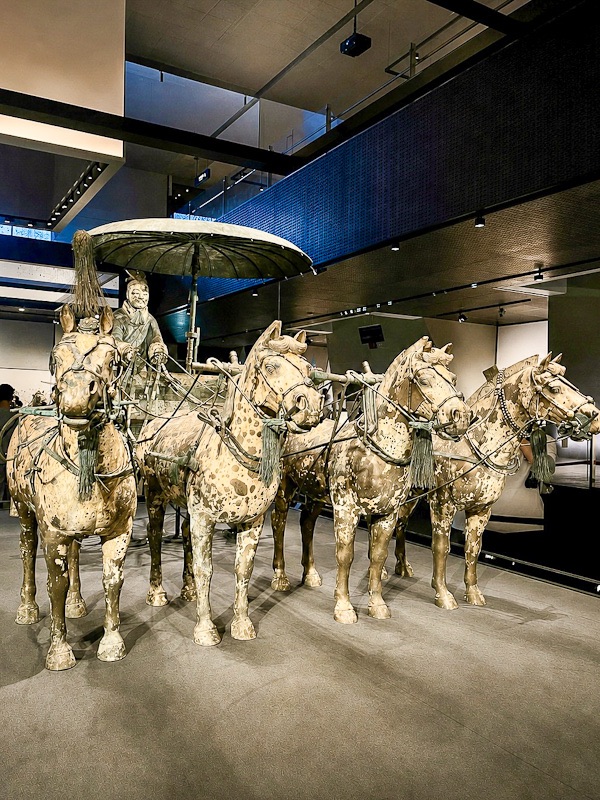
The two bronze chariots were discovered in 1980 and are approx 2,200 years old…half life size featuring over 3,000 individual parts decorated with gold and silver inlay. Many of the parts were mechanised showing remarkably advanced skills. Restored and relocated to the Bronze Chariot Exhibition Hall which in itself is built like a vast complex tomb and looks like something from a high budget Sci-Fi movie.
Turns out the mausoleum signposted everywhere is the actual site we’re walking. Acres of grounds planted with trees and flowers and a huge burial mound covered in greenery.
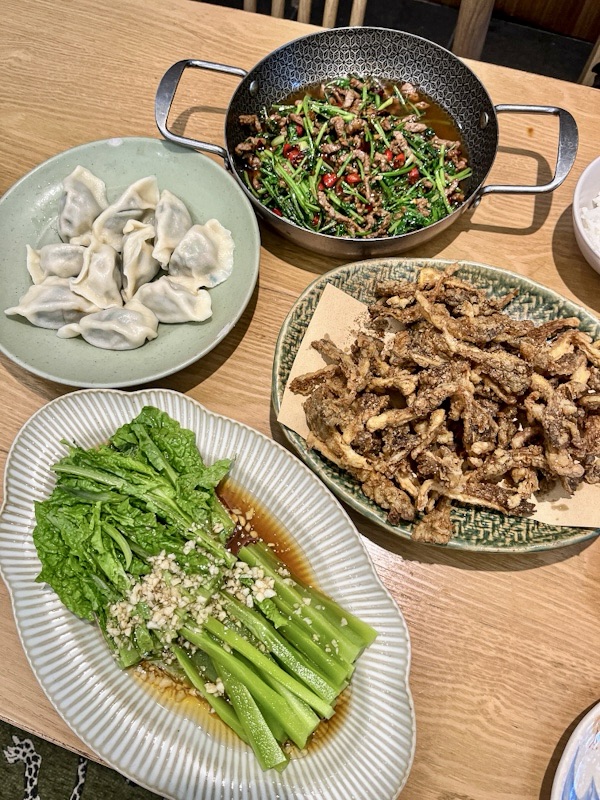
Back at the hotel worn out but elated, (we’ve walked 5 miles this morning), we rest for the afternoon. Later we go to ‘Three Sisters’ Dumplings’ at 192 East Mutoushi, Zhonglou near the city’s South Gate. Freshly made dumplings, lettuce in sweet vinegar, pork, chilli and coriander stir fry and deliciously crunchy salt and pepper fried mushrooms. We eat too much, at around $8 each including drinks it’s ridiculously good value for money.
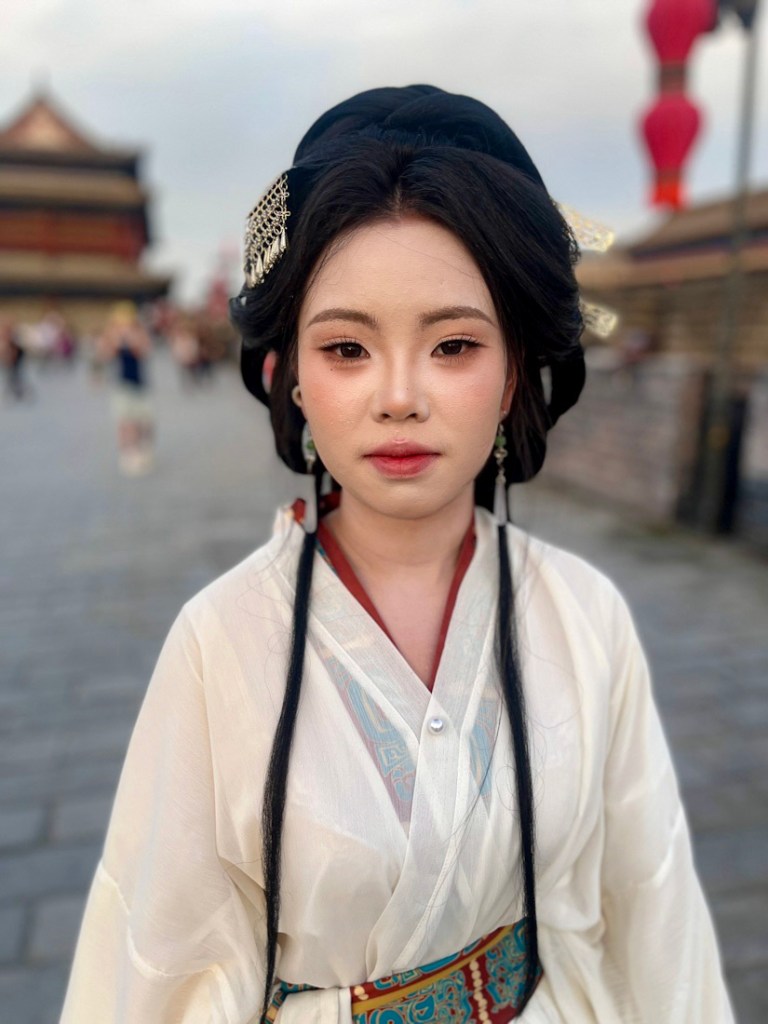
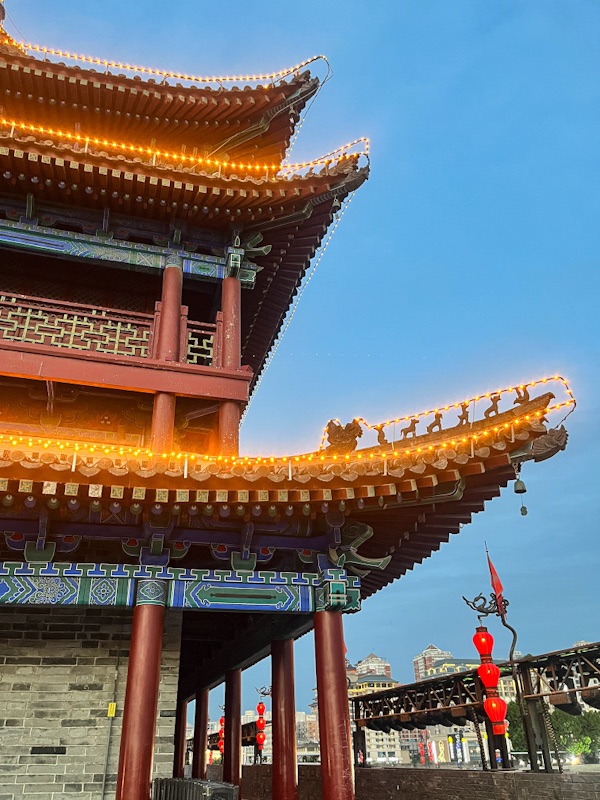
To walk it off we head up on to Xi’an’s city wall and watch the sun go down. Wandering among the pretty girls playing dress up, watching the lanterns and buildings light up, eating ice-creams in the shape of the city wall (something they sell of monuments all over China).
June 11. Breakfast in the attractive breakfast room of the hotel, we sit in our chrome lined booth and I eat omelette and dragon fruit avoiding the multitude of pastries and sugary snacks I’ve succumbed to too often in China. Dave’s planned our day, first to visit the Great Mosque of Xi’an.
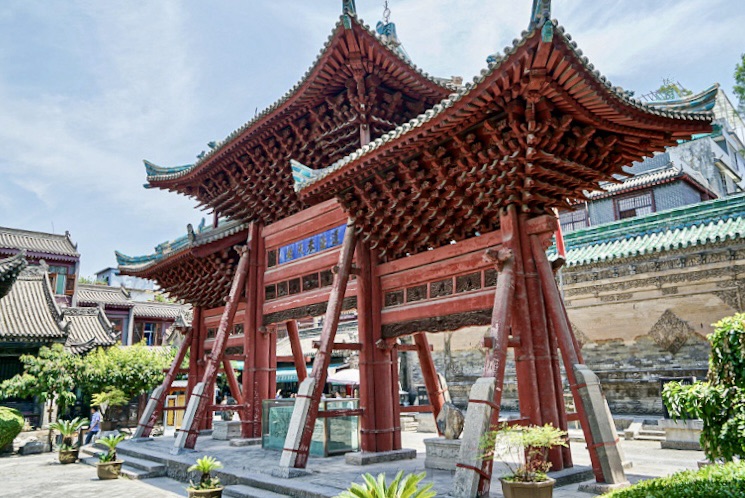
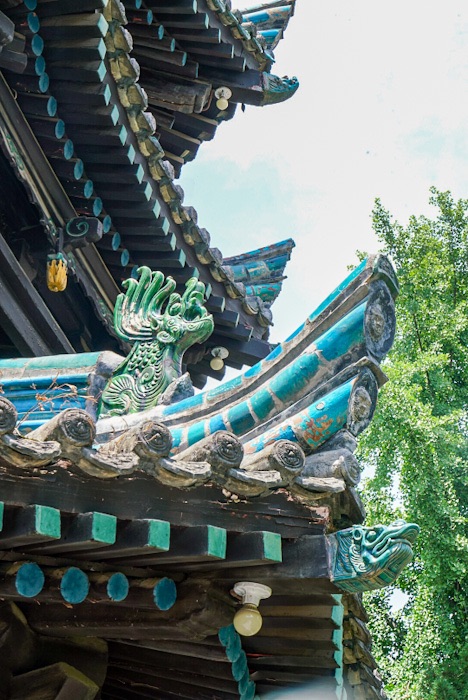
According to carved stone tablets preserved here, the mosque was established in 742 AD, Tang Dynasty. During the dynasties of the Song, Yuan, Ming and Qing the mosque was widened and restored. It covers an approx area of 13,000 sqm built in a rectangle east to west divided in to four courtyards. At the entrance is the visually dramatic red wooden Memorial Archway built early 17th century. We explore the Five Room Hall and the ‘One God Pavilion’ (or Phoenix Pavilion). Buildings have traditional glazed roof tiles, upturned eaves, layers of timber brackets.
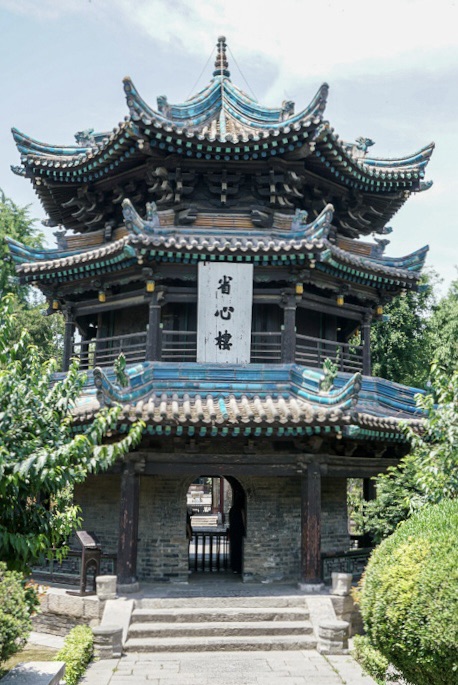
The Minaret is the tallest building, used for the Muslim call to prayer. The Imperial Hall holds the ‘Moon Tablet’, its Arabic inscription written by a late Imam showing the calculations of the Muslim Calendar. The Worship Hall in the last courtyard is closed to non-Muslims, it’s an active place of prayer. The carved stone Memorial Gateways are gorgeous. I could spend hours here if we had more time in Xi’an…it’s become one of my favourite places in China.
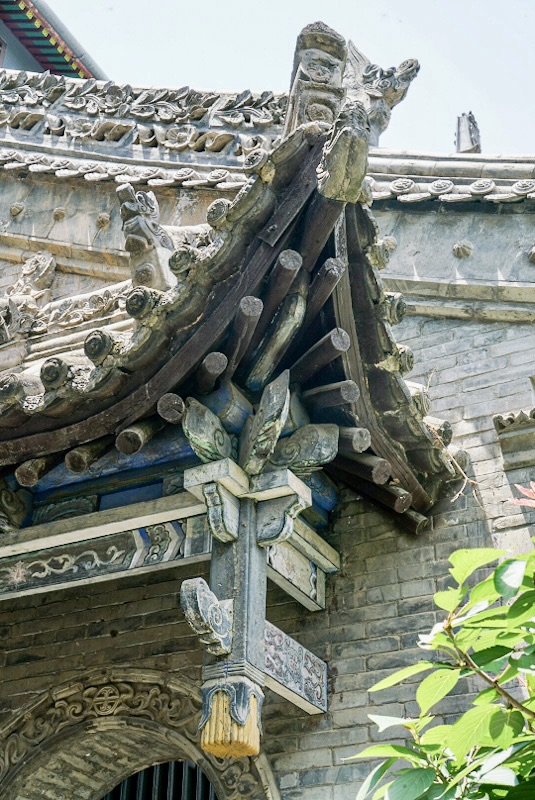
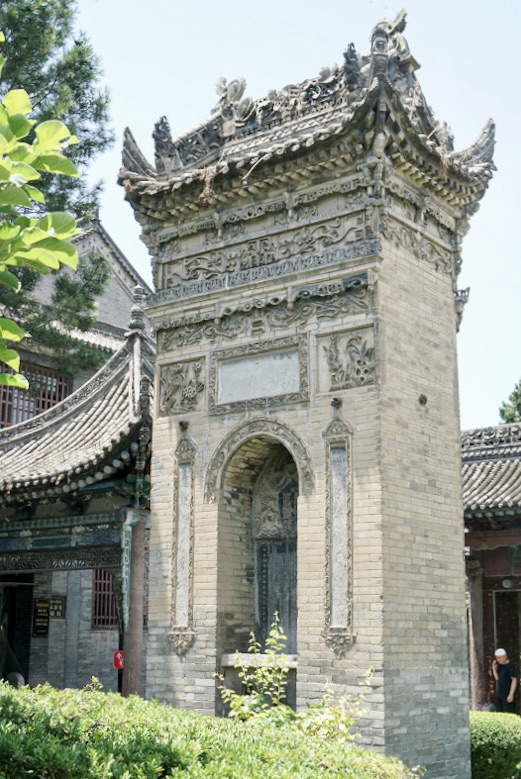
From the mosque we wander Defu Lane, a pretty street of cafes, bakeries and boutiques…dodging the scooters and tuktuks weaving through the middle who narrowly escape hitting anything. We buy sweet fig bread sticks and head to Shuyuanmen Cultural Street near the South Gate.
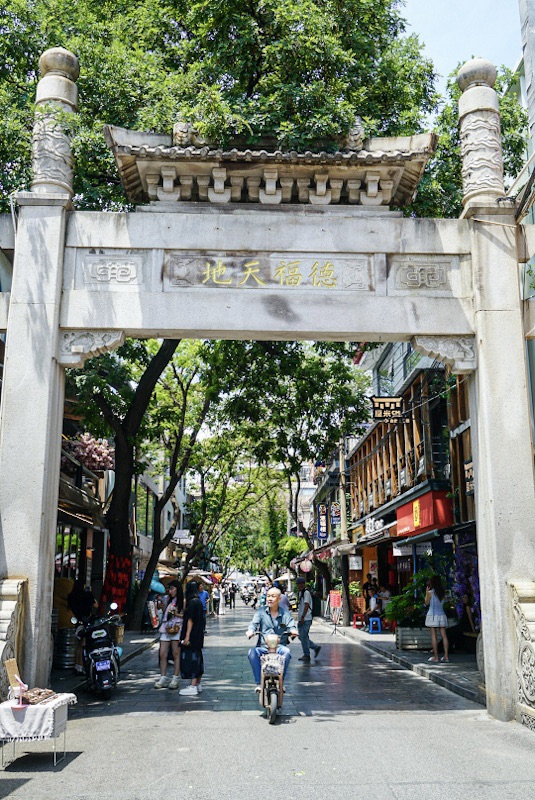
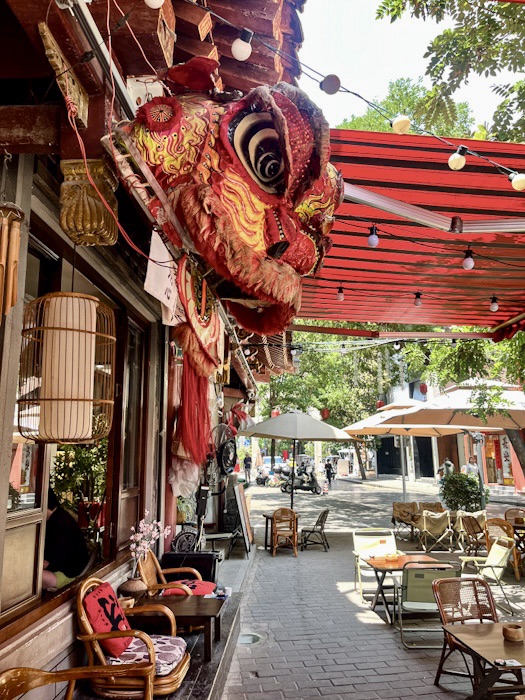
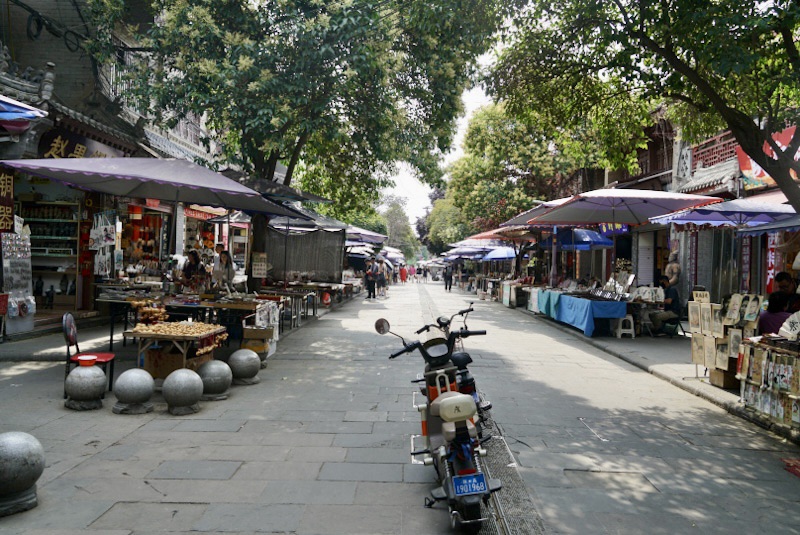
Unlike the touristy ancient alleyways, Shyuanmen is an active artist quarter. A pedestrian street known for its Ming and Qing dynasty architecture, traditional arts, and calligraphy supplies. Working artists are set up at pavement stalls, painting whilst selling their art. The calligraphy is beautiful, the hand-painted fans are attractive but the many cartoonish pictures of domestic cats are baffling.
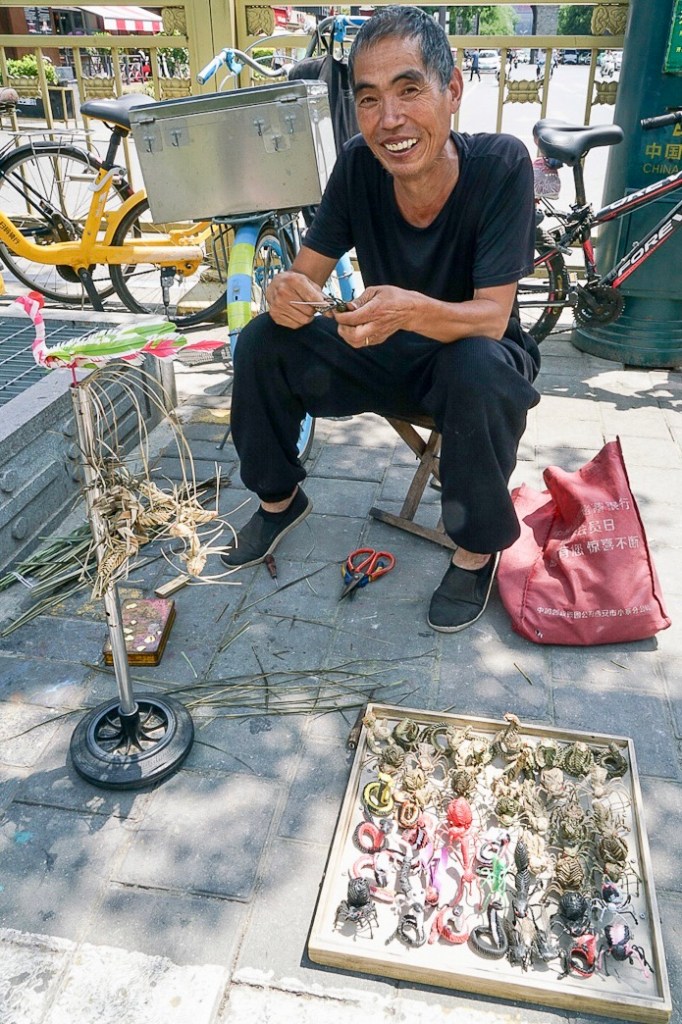
Leaving the street we sit on a wall to rest and eat, it’s 32c again. A street vendor on the pavement is making the most incredibly intricate bugs and fish from stripped bamboo and wire. Through google translate his friend tells us he’s been hand-crafting these small pieces for 10 years. They’re impressive, we buy a spider for 25 yuan. These are the randomly found souvenirs I love, an artist producing something so skilled from a pavement in a huge city.
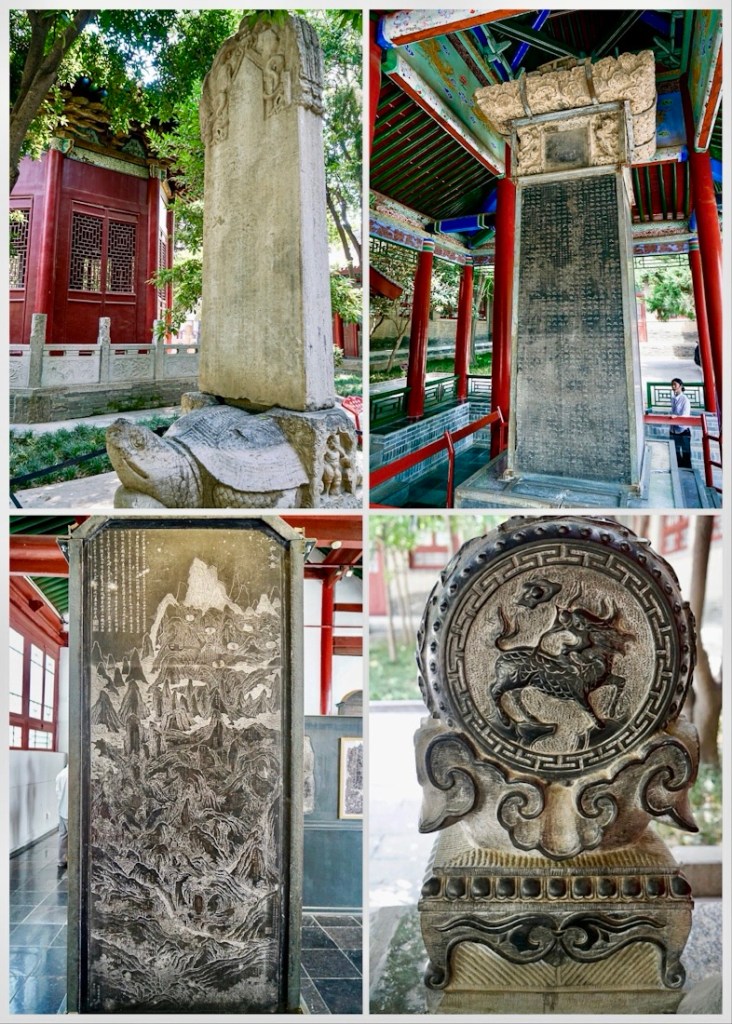
After convincing the artist’s rickshaw friend that we’re happy to walk (back and forth several minutes on Google translate) we visit the nearby Beilin Museum (also known as The Forest of Stone Steles) on Sanxue Street, near the Wenchang Gate. A revered museum of Classical Chinese ancient calligraphy containing over 3,000 carved stone tablets (steles) spanning over 2,000 years. There’s 114 stone tablets from the Tang Dynasty (837 AD) with preserved Confucian texts. Works by legendary calligraphers like Yan Zhenqing, Liu Gongquan, and Wang Xizhi. The Nestorian Stele (781 AD) is housed here, it provides historical proof of early Christianity in China.
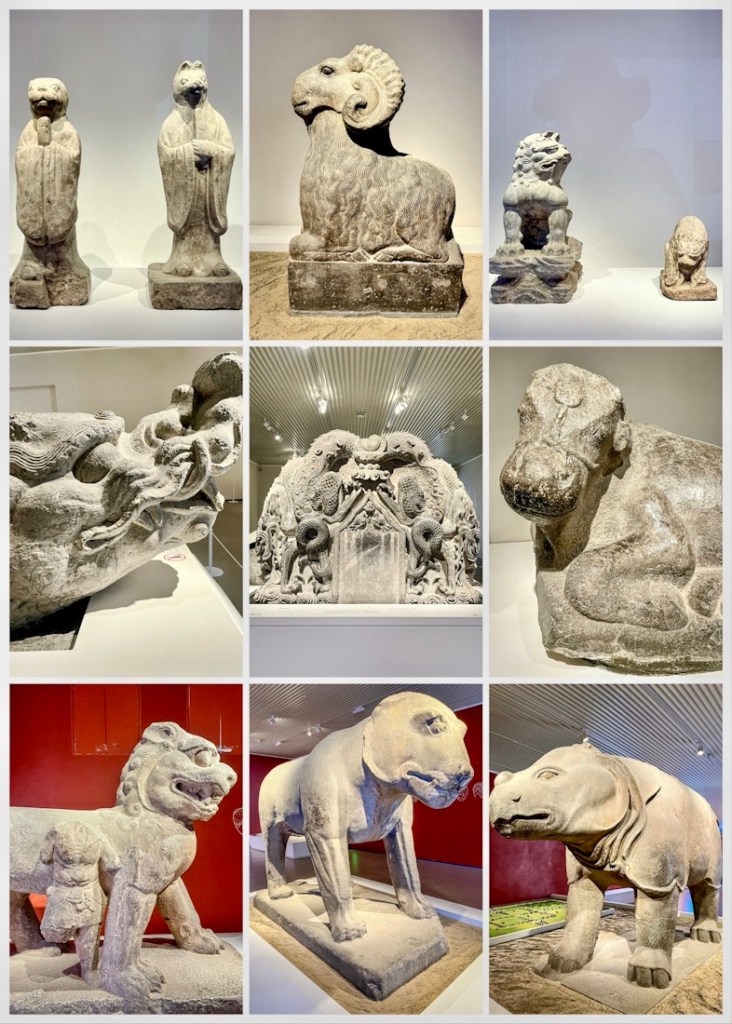
It’s a huge site and just when we think we’ve seen it all there’s a room of wonderful mausoleum sculptures and a 2 floor museum containing even more steles. It’s uncrowded, less visited, amazing to see. At the museum shop we’re tempted by two large calligraphy stone rubbed ‘paintings’. Gorgeous at $85 each but we currently don’t even know where we’ll be living.
Back at the hotel we rest a while…we’ve walked over 5 miles. Heading out in the evening to visit the Giant Wild Goose Pagoda. We arrive in Dayan Pagoda Northern Square just in time to see the 7pm display of the Yanta Music Fountain. At 20,000sqm with 1,000 water nozzles that shoot 60 metres high to synchronised operatic music, it’s the largest matrix musical fountain in Asia and it’s spectacular.
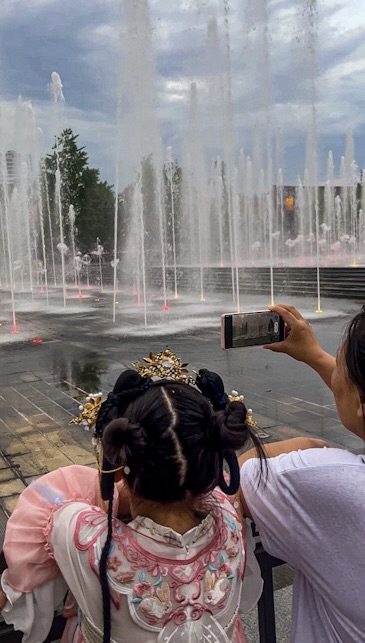
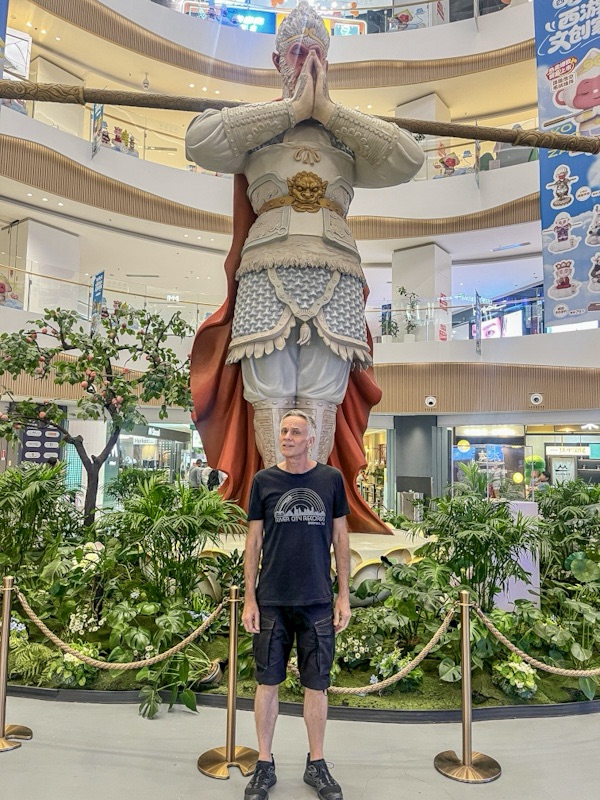
The display over, we walk with the crowds heading to Joy City Mall and the Pagoda, thousands of people. We eat in the mall food court sharing a table with a Chinese couple…we’re laughing at Dave waiting for our food order to come out, each order announced loudly in Chinese. The centre of the mall has a huge statue of Monkey King (Sun Wukong), 7.16 metres spanning two floors of the mall, hands held in meditation pose. We love it. Every mall should have one.
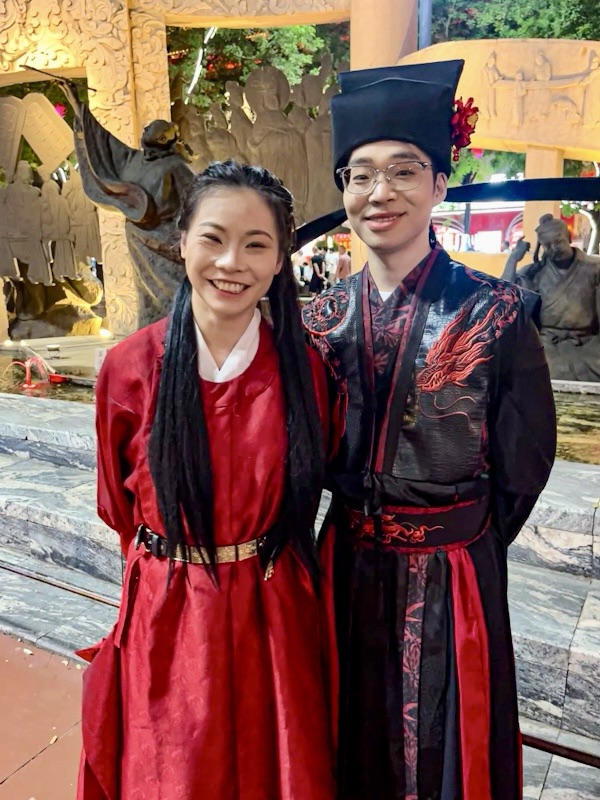
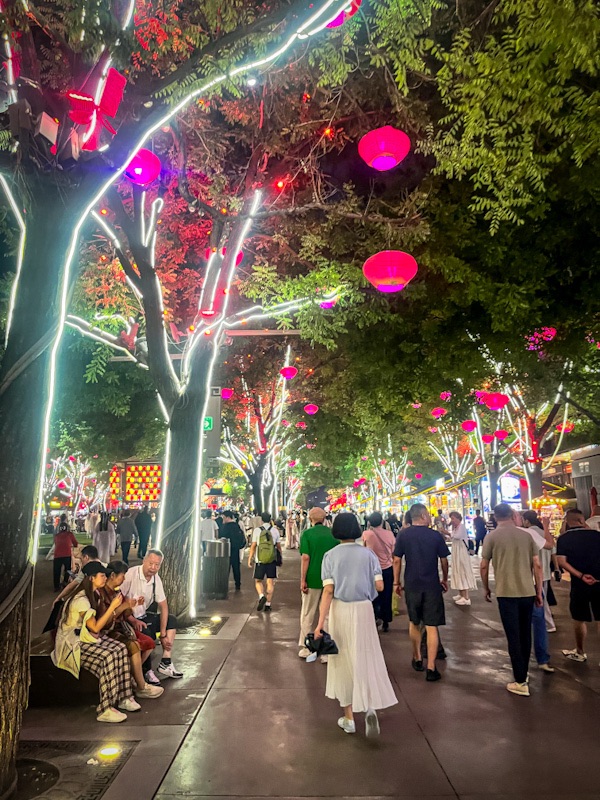
I’ve eaten too much again, Dave’s lost about 2 kilos, I’ve put over a kilo on. On the roof of the mall we look out at the pagoda. We choose not to go in, instead joining the crowds walking under the illuminated trees of Datang Everbright City. Like everything else it’s massive, an extra wide boulevard pedestrian street 1,500 metres long, lined with food and souvenirs stalls. Epic Chinese cultural performances are staged in the middle of the street. We have no idea what any of it’s about but it’s all totally bonkers and great fun. Out of thousands of people we only see a handful of other foreigners.
To Beijing
June 12. A 10.02am departure and we’re flying through the Chinese countryside and tunnels at phenomenal speed. The train steward arrives with a trolley and hands us a heavy padded brown book. We’re bemused but open it to see old Chinese currency…pages of Chinese souvenir related items in one book. We politely decline, I wonder how many they sell?
Coming out of Beijing West train station there’s more security here; two passport checks, more security officers. People are pushing. For the most part Chinese people are fabulous but in a crowd situation they push. It’s bedlam, I tell off a young man for attempting to climb over my suitcase to get on the escalator. He steps back. Despite the crowds it’s efficient and easy, we simply follow an orange line marked ‘car hailing’ to take us to the Didi pick up point.
Our hotel is in a traditional Hutong area of very narrow alleyways. The driver negotiates the tuktuks, scooters, pedestrians, a man collecting scrap metal and countless people with loaded bicycles. The grey brick and grey roofs look sombre, but a glimpse inside open doorways show inner alleys and courtyards hung with laundry, families going about their lives. We arrive at Base Hotel Apartments, the staff are friendly and fun. They upgrade our room so the bed isn’t pushed against a wall. The rooms have washing machines/dryers…great for long term travelling. We overlook the hutong.

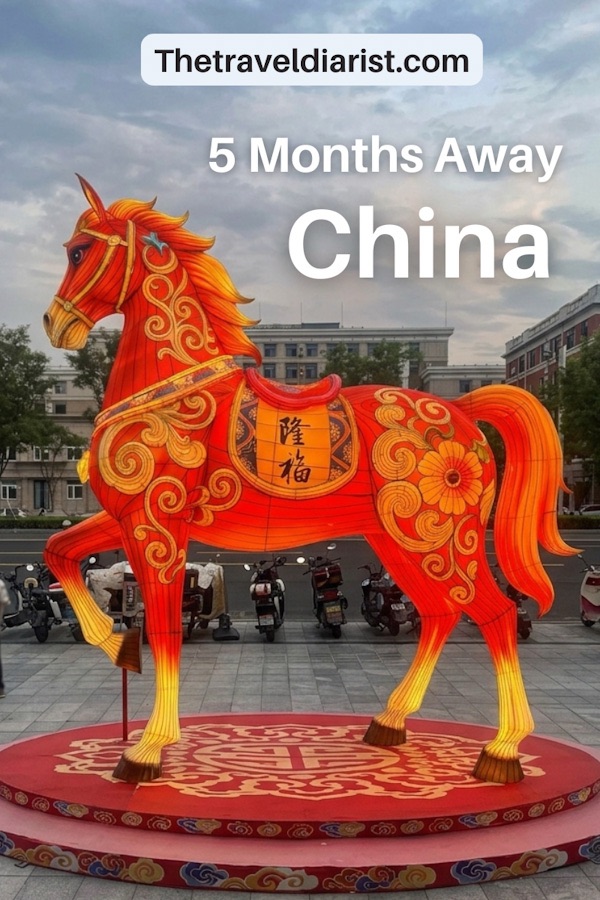
Vietnamese for dinner at a local restaurant, it’s ok, a bit disappointing and indifferent staff. The area is seeing a big refurbishment, there’s evidence of the usual shops and bakeries with more to come. Oversized anime sculptures, a beautiful horse in the style of a burning lantern. I hope the area doesn’t lose its character and turn in to an ‘ancient alleyway.’ There’s handicraft market stalls, a tattoo parlour, nail bars, barbers and a small dim bar which looks very hip. It feels more local than other areas we’ve stayed and we haven’t seen a single young woman dressed up Hanfu style or influencers with tripod IPhones.
Buddhist Temples and Park Views
June 13. A 30 minute walk from the hotel, cutting through the narrow alleys of the hutong out on to a busy main road. The shops along this stretch are mostly aimed at locals including the coffee shops…it’s a refreshing change. A lady calls to me: “Hello! welcome moustaches”…What? “Massages” Dave points out.

We reach the Lama Temple (Yonghegong) in the Dongcheng district. The largest and most important Tibetan Buddhist monastery outside of Tibet. The jawdropping giant Buddha stands 54 feet tall (18 metres) carved from a SINGLE piece of white sandalwood. There are 5 main halls all with statues, most with signs for no photography. Hundreds of people are burning incense sticks, the air choked with smoke…people are sneezing and coughing. I photograph where I’m allowed, I love the fabric pillar hangings (called ka’phan in Tibetan) rich in Buddhist colours, hand crafted from silk.
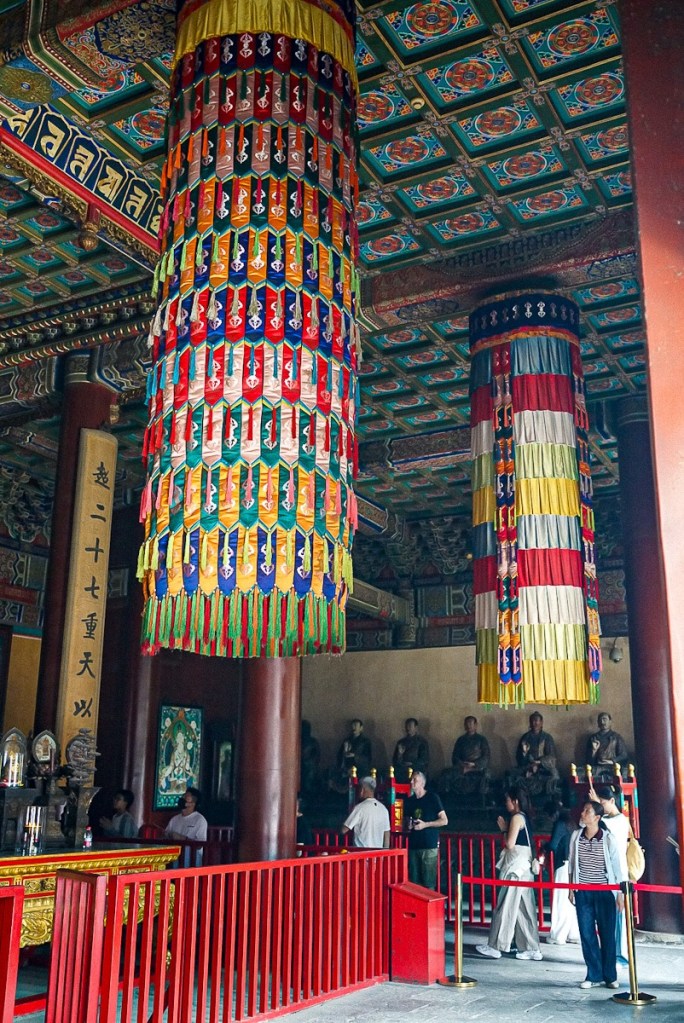
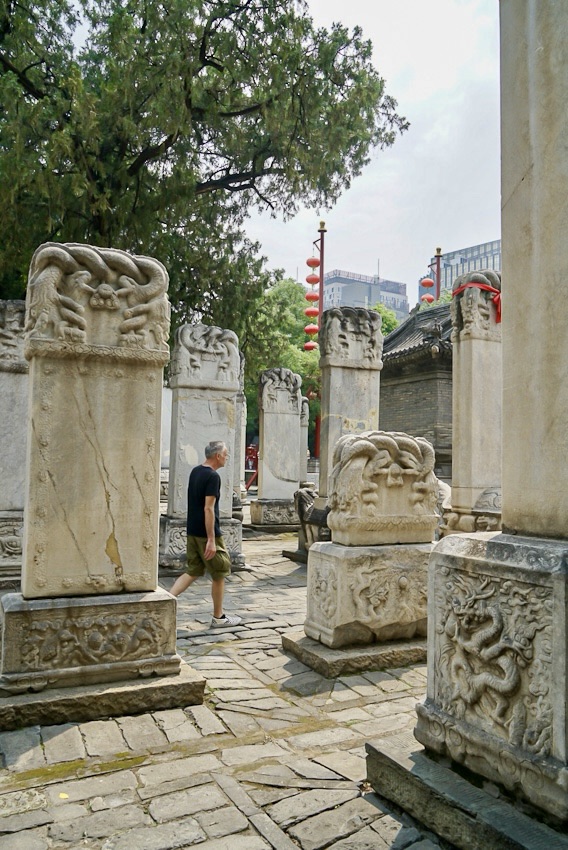
A Didi to the Taoist Dongyue Temple (Temple of the Eastern Peak) which the internet has advised me is a lesser known hidden gem and a visual spectacle. Sadly a lot of it is under massive refurbishment and most of the statues are covered in dust. I use Google translate to ask a lady “Where are The Department of Implementing Ghosts and The Department of Nightmares”, it sounds comical. Both won’t reopen until next year so we miss out on seeing demons punish the wicked in the Taoist underworld. No photography in most of the chambers, manned by monks sitting in dusty corners reading Taoist philosophy or playing on their phones. We walk among ancient Steles in the courtyard and see elaborately draped Chinese robes in the folk museum.
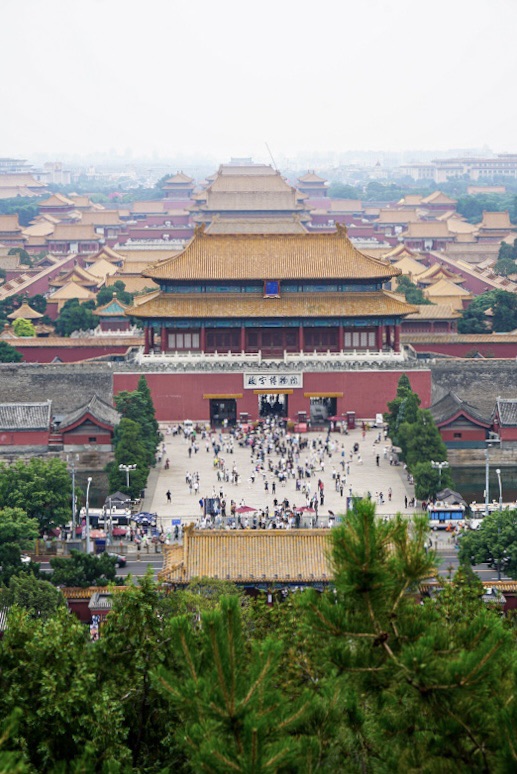
We move on to Jingshan Park where I buy a jasmine ice-cream before beginning our ascent of loads of steps for views of the Forbidden City. From the Wanchun Pavilion we wait for a space at the barrier to look out across the symmetrical courtyards of the Imperial Palace. Heavy smog hazes the view but even from this distance we can hear the excited clamour of hundreds of people.
Back near our hotel we eat western food at a nearby brewhouse showing American sports on big screens and a waitress wearing a ‘Hutong Clan’ T-shirt in the colours and symbol of Wu-Tang.
The Great Wall of China
June 14. Early to the breakfast room where a Chinese lady with curly red hair and sparkly trousers is barking orders at the staff. She looks like a demented drag queen. Perhaps someone hasn’t shown for work, she screams at a bewildered young man to go out for milk. They all look terrified.
We’ve spent a few hours figuring out visiting the Great Wall. The Badaling entrance is closest to us but a very steep climb much of it done on hands and knees. With my bad leg I veto it…without a bad leg I’d veto it. We opt for a Didi car to drive us 1.5 hours to the Mutianyu entrance. From there a walk to a shuttle bus, by the souvenir hawkers, 10 minutes on the bus and several flights of steps to the cable car…which climbs straight up in a couple of minutes.
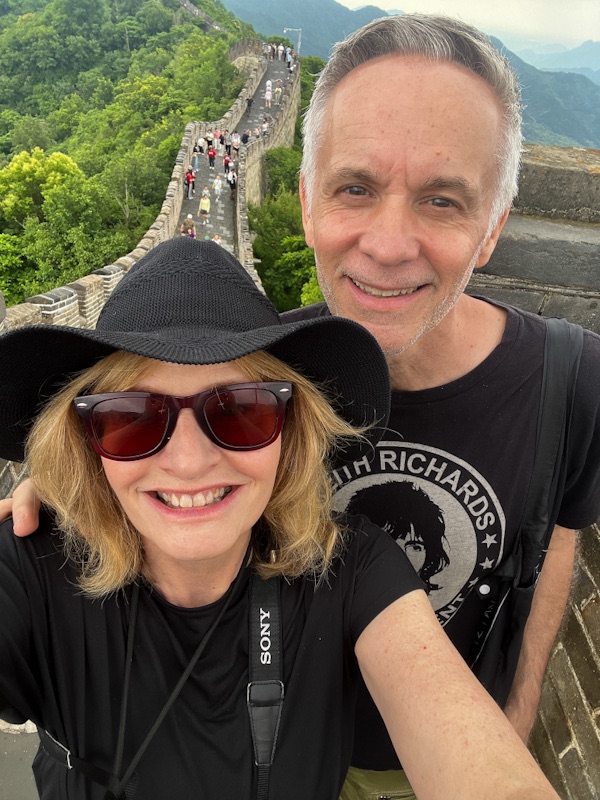
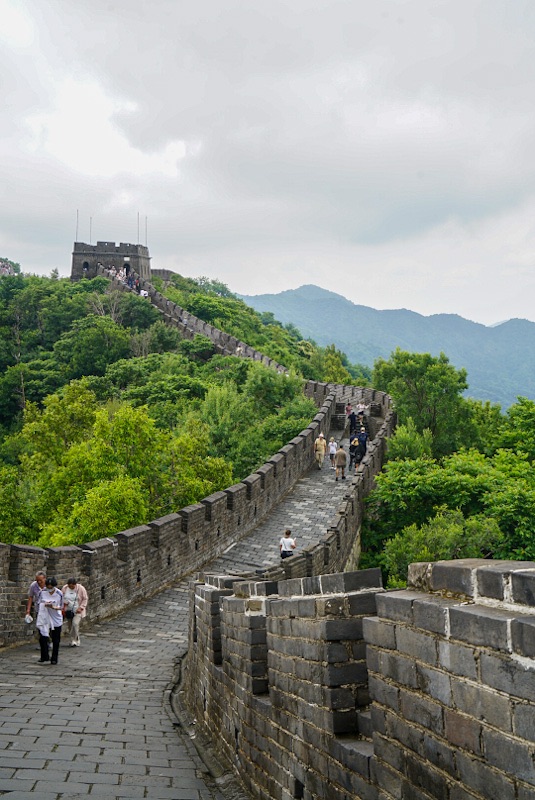
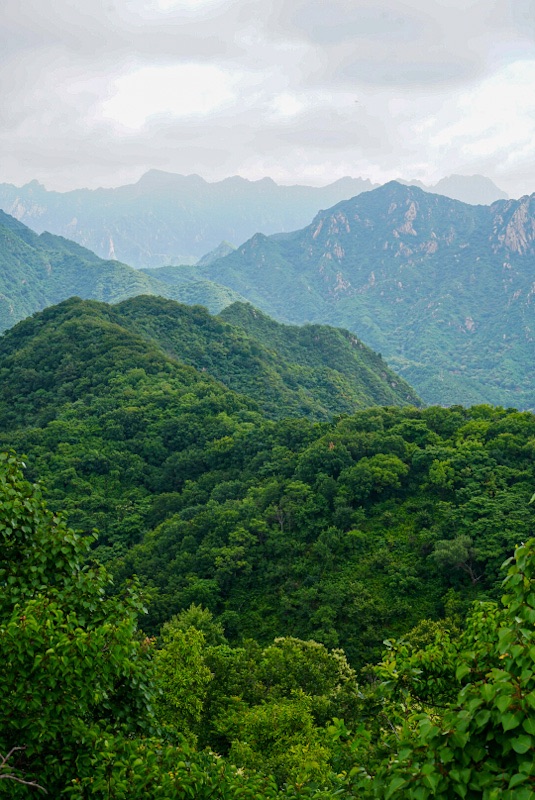
A short walk from that and we’re up ancient stone steps on to The Wall…and it’s a fantastic feeling, a pinch yourself moment realising you’re actually here. We start at Tower 14 (the most accessible) heading West…not following the entire ‘Hero Walk’ which sounds like torture. Instead we take the easiest route with my compromised leg, and there’s still areas where we’re clambering vertiginous sections of steps, pushing ourselves up steep slopes, scuffling over shallow steps,…up and down for around 4 towers. The views are incredible; mountains roll for miles topped with mist and the Wall winds on in to the distance. I’m surprised by the sound of Chinese classical music playing from strategically placed speaker poles. The atmosphere is buoyant, people chatter excitably…the majority Chinese tourists but plenty of Italians and Spanish.
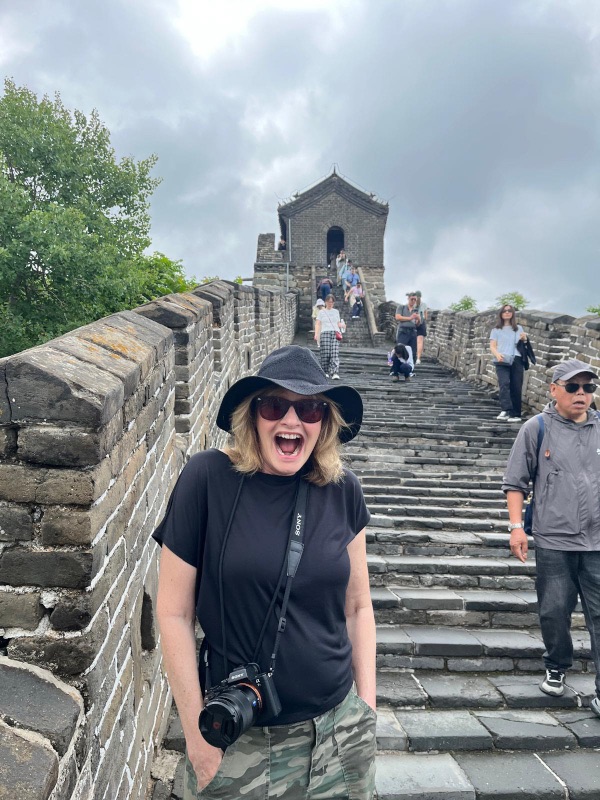
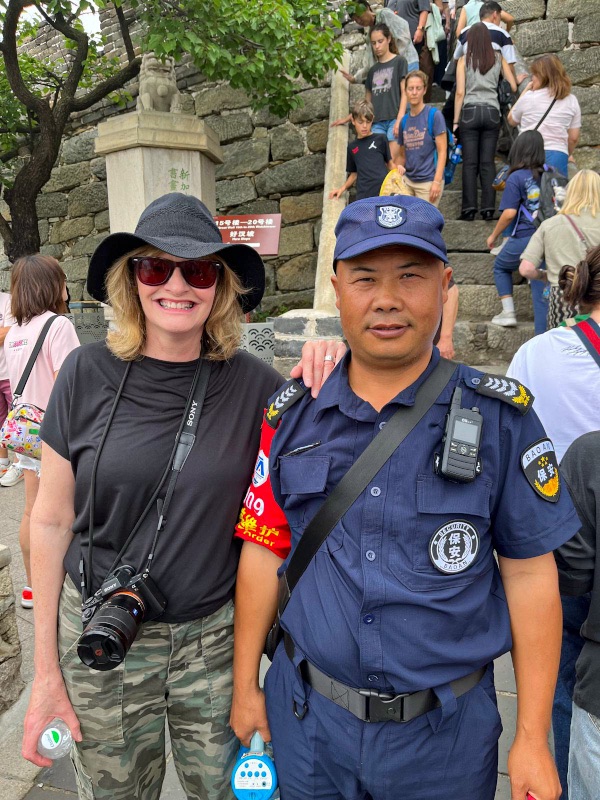
Coming back down very steep steps I laugh with a guard and exaggerate being exhausted by the climb…Dave takes our photo. The guard holds his loudspeaker for shouting at people who are messing around or going the wrong way. There’s a lot of shouting in China, I think they enjoy it. We’re glad we arrived early as it’s packed with people heading in as we’re coming back down.
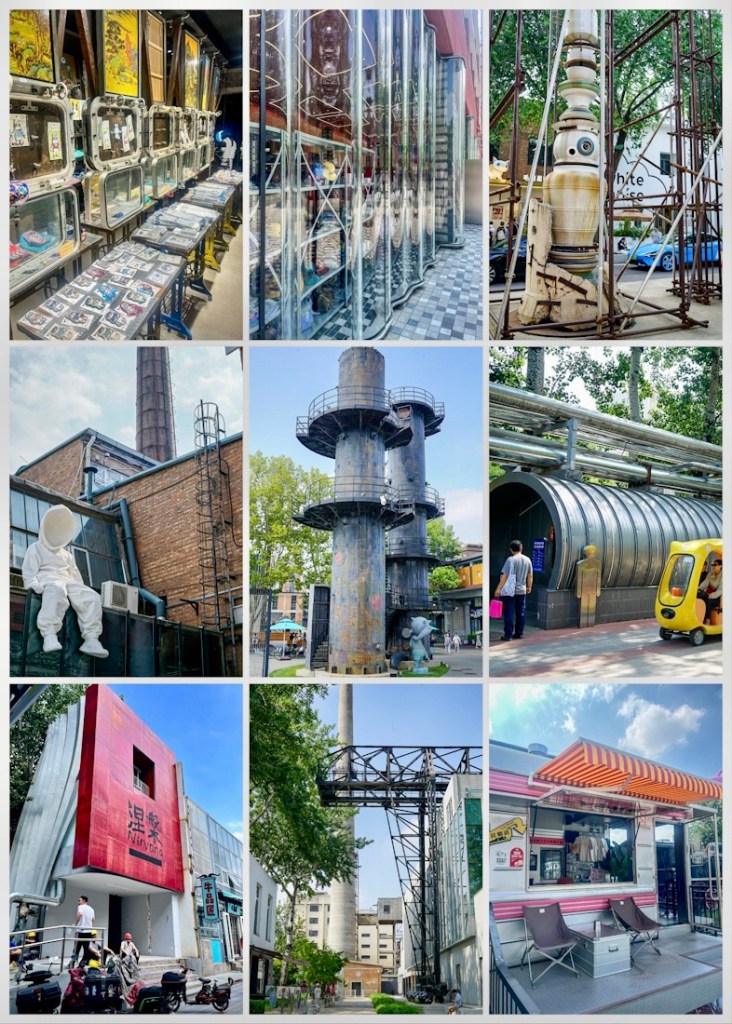
We’re elated from the experience and it’s only 11.30 so we get a Didi car to Beijing 798 Art Zone in the Chaoyang District. An area of 1950s decommissioned military factories, and like in Chengdu, now developed in to a cultural hub. We prefer this version, it’s distinctly more creative and quirky, lots of small galleries and some of the city’s largest…it’s less commercial with more artists evident. Old train carriages have been turned in to cafes and bars. A long metal tunnel houses public toilets. People hire funny yellow carts to drive about.
Back near the hotel we try out Mexican food…we’re surprised to find a Mexican restaurant in Beijing and it’s busy, most tables full. Dave’s Al Pastor tacos are great my food is just ok.
June 15. So many more historic places of significance we could visit but almost a month in China and we’ve done/seen so much we just want a wander. We accidentally wind up in a mall which online described The Box as an industrial youth culture hang out…it’s not what we expected but I run an errand at Watsons, we marvel at the fresh produce in the food court and see acres of pastel pink and mint green in the women’s fashion stores. We walk 45 minutes back to our hotel area, it’s in the historic Dongsi and Longfusi area (Qianliang Hutong)…Dongcheng District. We’ve walked around the plaza shops and restaurants a few times and down the hutong alley our hotel stands at the end of, this time we decide to cut through the middle of it.
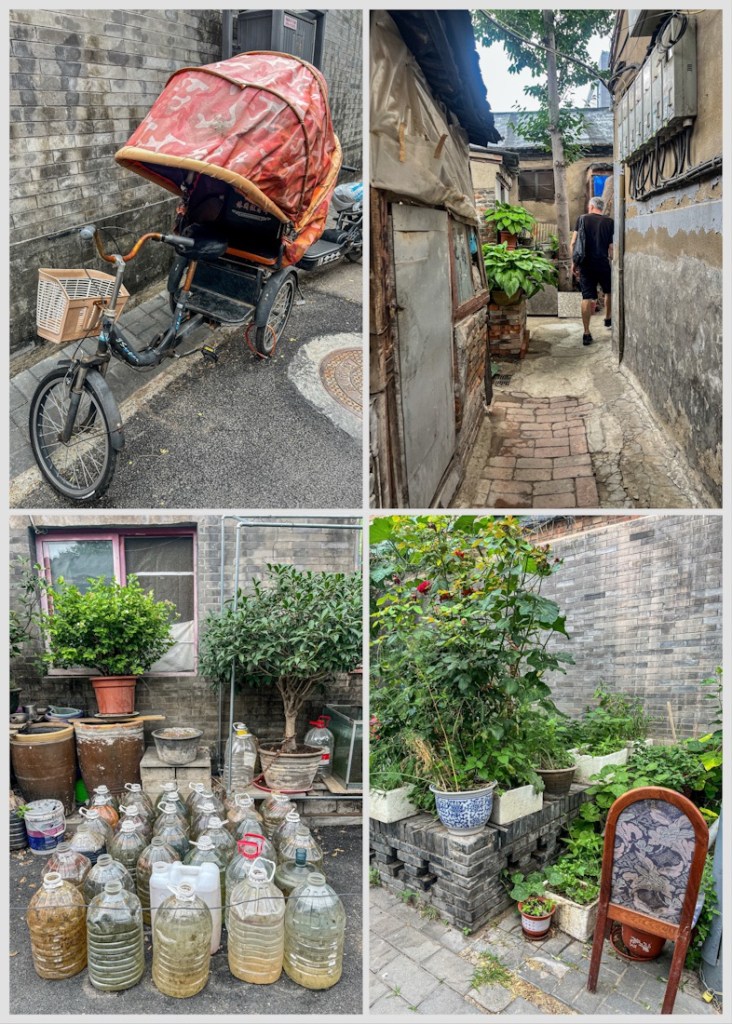
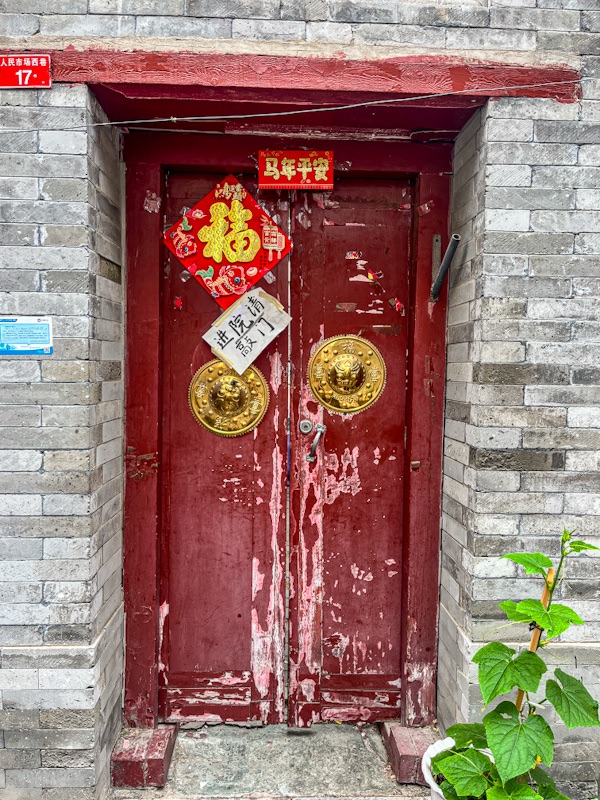
A Hutong is an old Chinese neighbourhood of narrow alleyways formed by rows of siheyuan (traditional courtyard residences) found in northern Chinese cities, most famously in Beijing. It’s a maze…we avoid walking in to washing hung to dry, gas bottles, piles of bricks, parked rickshaw bikes, plants in pots…trying to be respectful of the neighbours. Winding around we come to a dead end and work our way back out again. It’s a fascinating insight…we don’t see anyone whilst here as I imagine people are at work. I wonder what they think of the encroaching hotels, restaurants and bars. I hope it won’t be displaced by the rapid development around it.
Chinese food for dinner, on the main road not far from the hotel. The menu is in English as well as Chinese, we tick boxes with a pencil, it goes to the kitchen…and as the plates come out we realise we’ve over-ordered. 20 dumplings, a huge plate of stir fried pork another of egg fried rice, thankfully they forgot the broccoli …we’re overloaded. A screeching argument starts behind the scenes which builds in volume, everyone in the restaurant transfixed by the drama. After several minutes it stops, waiters are giggling…but around my 9th (and final dumpling) it starts up again…she’s really angry at someone. Quiet is restored when a diner heads in to the kitchen and tells her to shut up. Chinese Fawlty Towers.
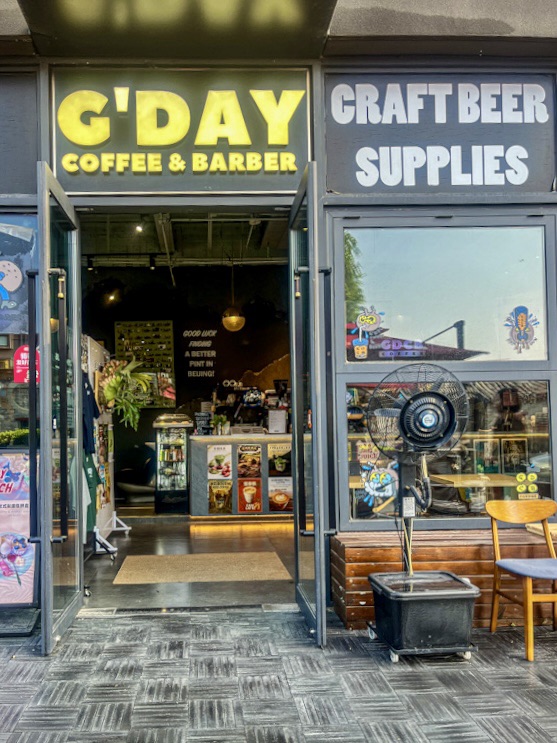
We walk back to G’Day coffee shop at the foot of our hotel where Dow gives Dave a haircut…after first watching a video Dave’s barber Tim filmed back in New York. Dow tells Dave he used to work in banking but hated it so started his own coffee shop/barber business, learning to cut hair from YouTube videos. Dave can’t tell if he’s joking or not. He comes back to the room more shorn than usual but it’s a good cut.
We finally make some decisions for our onward journey from Vietnam, we need to show departure flights on arrival at Hanoi immigration. Flights booked from Hanoi to Singapore to Manchester. We debated another visit to Japan (it’s expensive) and I really wanted to head to England via Uzbekistan but the heat there in July hovers around 37c. Istanbul almost makes it in, but it’s adding a lot more money to the flights and we can visit easily if we’re living back in Europe one day. We settle on this plan, no date booked yet for leaving the UK…a possible flight to Brazil from London in mind…their cooler season in August.
The Forbidden City
June 16. Our last full day in China, we have tickets for the Forbidden City. We booked weeks ago not realising they didn’t include a visit to Tiananmen Square. The Guards turn us away at the security entrance and point us to signs for Palace Museum, the new name given to the Forbidden City. There’s long distances to walk between things, these places are huge. We follow the crowds along Jingshan Qianjie, a lot more security and barriers in this area. And so many women dressed up..some men too. This is a monumental site for Chinese tourists to visit and they celebrate it.
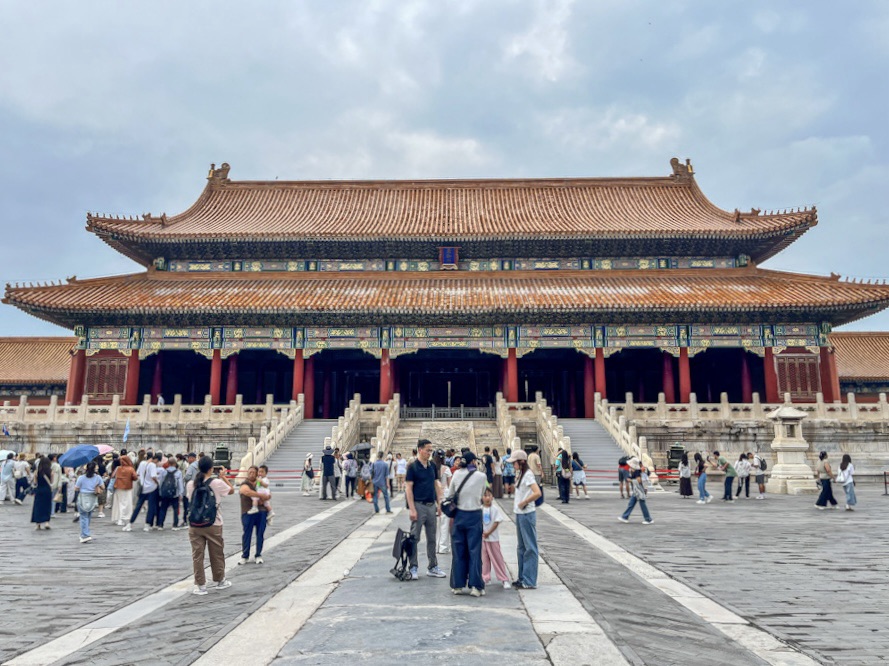
The Forbidden City is the world’s largest imperial palace complex. It served as the home of 24 Ming and Qing dynasty emperors..the centre of political power for over 500 years from 1420 to 1924.
The site is vast, over 8,000 separate ‘rooms’. It covers 178 acres and received over 19 million visitors in 2019. Hundreds of people are flooding through the gates, it’s a festive atmosphere. The area is so large and split in to so many sections it easily swallows us and doesn’t feel crowded. The architecture as expected is beautiful, meticulous to detail, encompassing the philosophical and religious as well as Imperial power. A lot of yellow, (yellow being the colour of the Emperor). The layout of courtyards, direction in which rooms face, the sloping roofs, the tranquility garden…it all follows precise order and symbolism.
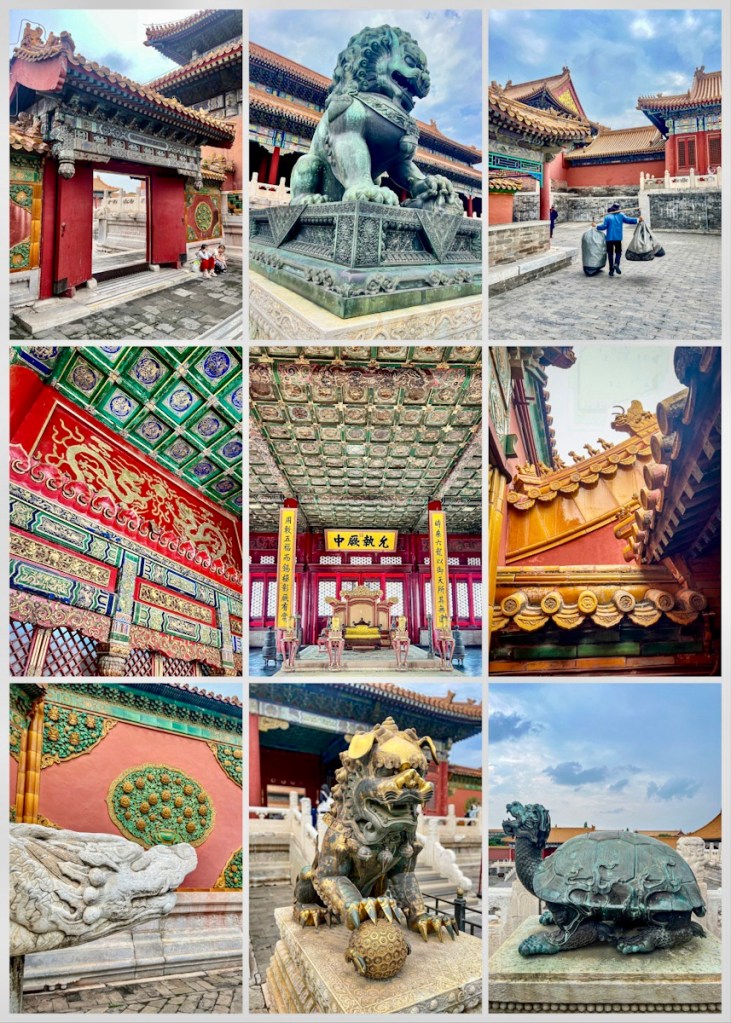
And the collections cover thousands of items. We visit the treasure gallery; beautifully carved jade, bowls, intricate bonsai shaped jewelled ornaments. In the clock and watch gallery, incredibly detailed time pieces, elaborate, featuring elephants, palms, flowers. Some very large pieces, many designed and made in London in the 1800s. Room after room reveals more treasures, gold, silver, jewellery, ancient stones carved with calligraphy.
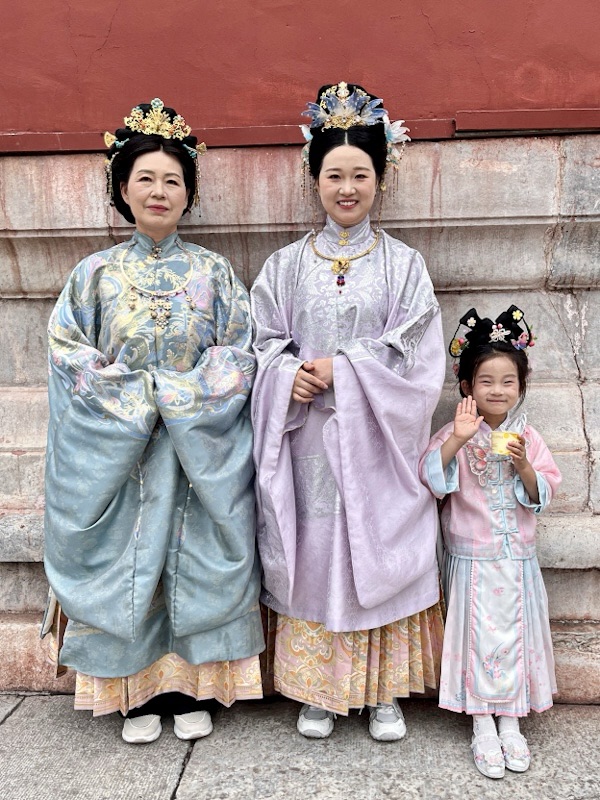
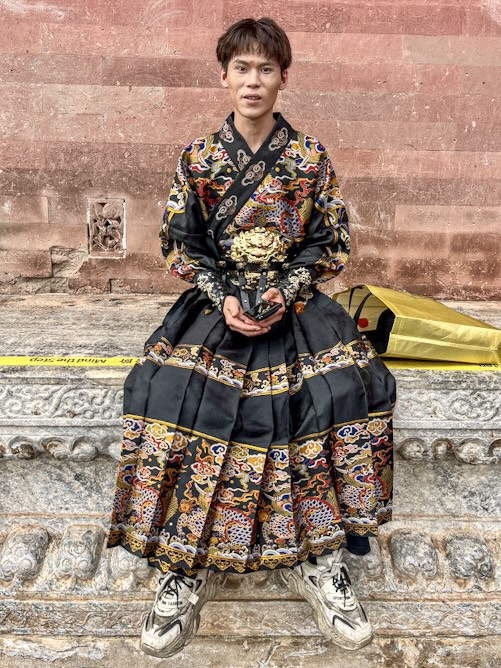
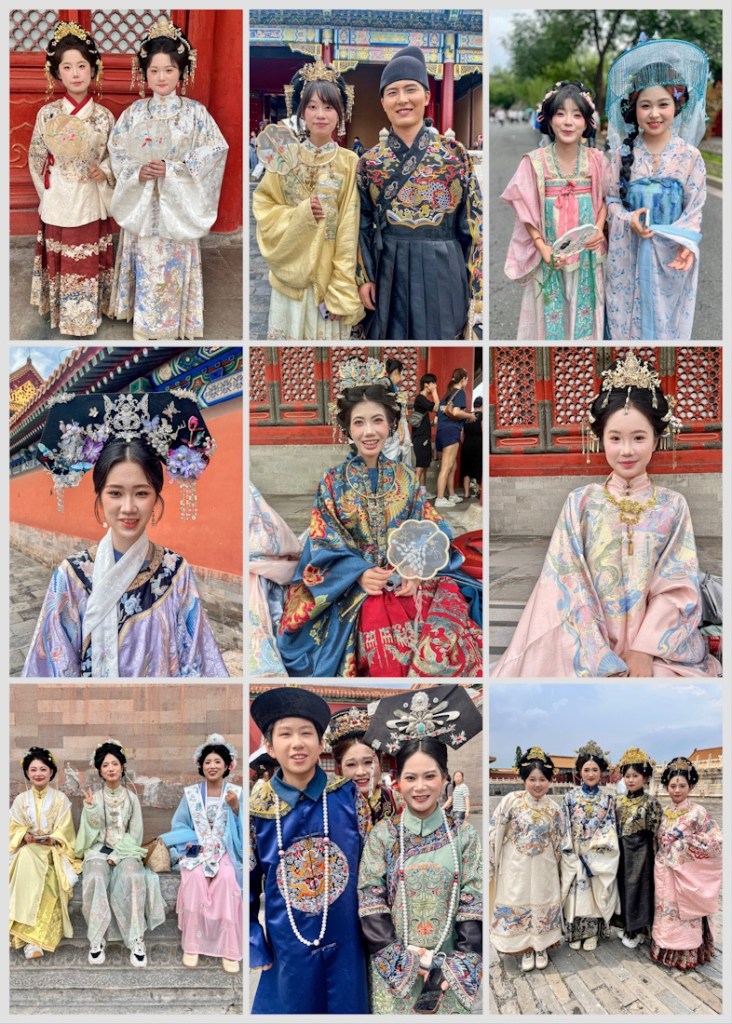
There’s only so much you can take in in one visit…in the courtyards I’m enjoying requesting photographs from the people dressed for the day in sumptuous costumes, many revealing jeans and trainers underneath.
3 hours later overwhelmed with the riches of Emperors we walk back to our hotel area, have an early dinner meeting Cai from Wales and another traveller Tessa from the Netherlands. Cai flies tomorrow to Seoul as do we. We swap numbers. Tessa will be in Vietnam the same time as us so we also swap numbers. Back in the hotel a storm rolls in and huge streaks of lightning strike horizontally across the sky lighting up the hutong. We pack ready for our flight tomorrow. China is incredible, it’s leaving the rest of the world in its dust. It’s been a privilege to spend a month here…not always easy and it makes you work for its rewards, but the warmth of the people is one of the best experiences we’ve had anywhere. I’d love to come back and see more.
 The Travel Diarist